Why You Sit in the Car After Arriving Home: Transition Anxiety and the Need to Reset Between Tasks
Author: Dr. Timothy Rubin, PhD in Psychology
Originally Published: May 2026
Last Updated: May 2026
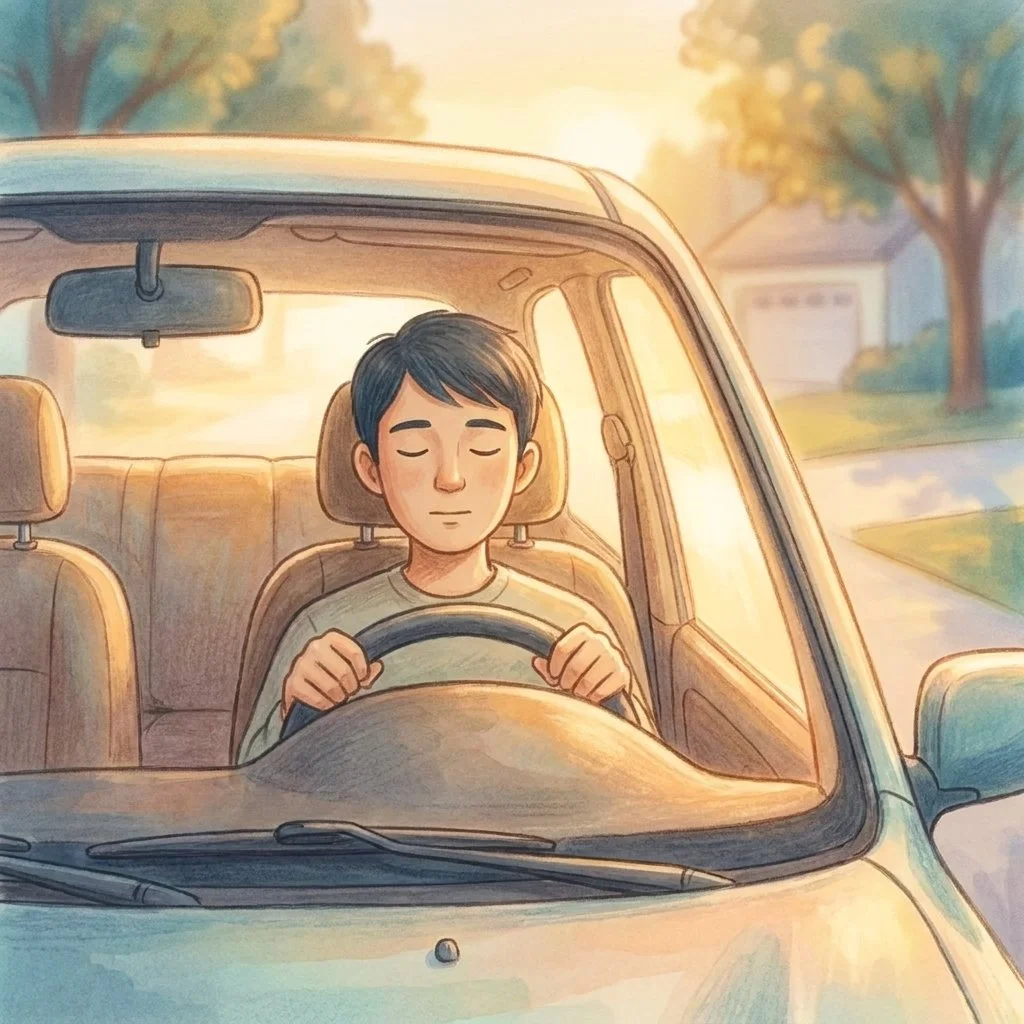
That few minutes in the parked car isn't laziness or avoidance — it's your brain doing exactly what it's designed to do between roles.
Contents
- The car pause is more common than you think
- What "transition anxiety" actually means
- The science of why your brain needs a buffer
- Why the car, specifically?
- Healthy reset vs. avoidance
- Who feels transitions most strongly
- How to do the transition on purpose
- When sitting in the car is a signal of something bigger
- A closing reframe
- FAQ: Transition Anxiety and the Car Pause
You pull into the driveway, turn off the engine, and just… sit there. Five minutes pass. Then ten. You finish the podcast, scroll your phone, promise yourself you'll go in after this one song. Sometimes it's the morning version — sitting in the parking lot at work, putting off the moment you walk in.
If this is you, you are not lazy, broken, or avoiding your life. You're doing something so common it has become a cultural moment — and there's real cognitive science behind why your brain wants that pause.
The car pause is more common than you think
In 2026, the Associated Press ran a feature on the phenomenon of sitting in the car before or after a long day — and it spread quickly because everybody recognized themselves in it. The psychologists quoted didn't pathologize the behavior. They named it. The car, they explained, is an "in-between space" — controllable, quiet, and not yet committed to whatever comes next. The question underneath all of it: why does my brain need this?
What "transition anxiety" actually means
It's not a clinical diagnosis — but it's a real experience
"Transition anxiety" isn't a category in the DSM-5. The closest formal label is Adjustment Disorder with anxiety, which applies only when symptoms cause significant distress and follow an identifiable life stressor.
But the phrase has caught on because it describes something most people feel: a small, low-grade unease at the threshold between one part of life and the next. The American Psychological Association notes that the related concept of anticipatory anxiety — worrying about something coming up — isn't a diagnostic condition on its own, even though it often shows up alongside other anxiety patterns. "Transition anxiety" is best thought of as a plain-language label for a real experience — not a disorder.
What's actually happening: a "micro role transition"
The technical term in organizational psychology is a micro role transition: the daily, ordinary act of moving between roles. Worker to parent. Caregiver to spouse. Employee to private self.
Researchers Blake Ashforth and colleagues introduced this framing in an influential paper on boundaries between roles. Their core insight: your brain doesn't switch identities instantly. It needs a buffer to dismount one role and remount another. The car becomes that buffer.
The science of why your brain needs a buffer
Task-switching has a real cognitive cost
For decades, psychologists treated "just switch tasks" as effortless. We now know it isn't. Foundational research on the cognitive cost of switching tasks showed that every shift requires the brain to reorient toward a new goal and reactivate a different set of rules.
Small switches feel cheap. Big ones — like going from a work meeting to a parenting moment — are anything but. Coming home is one of the biggest switches you make in a day. You're not just changing what you're doing; you're changing the rules entirely.
Attention residue: why work follows you to the door
Psychologist Sophie Leroy coined the term attention residue in a study on switching between work tasks. Her finding: when you stop working on one thing and start on another, part of your mind stays stuck on the previous task — and performance on the new task suffers. The effect is worse when the first task was unfinished, which describes basically every workday.
The driveway is where work residue meets the demands of home. Without a moment to let it dissipate, you snap, zone out, or arrive in body but not in mind.
The commute used to do this for free
Before remote work, most people had a built-in transition buffer: the commute. Research on commuting as a role transition found that the time between work and home — even when annoying — gives the brain a runway to land.
When millions lost their commutes during the pandemic, many felt strangely worse, even though their day was technically shorter. The Washington Post documented the rise of the "fake commute" — remote workers walking around the block at the end of the day, just to give themselves the buffer their body still expected. The car-sitter and the fake-commuter are doing the same thing: rebuilding a runway.
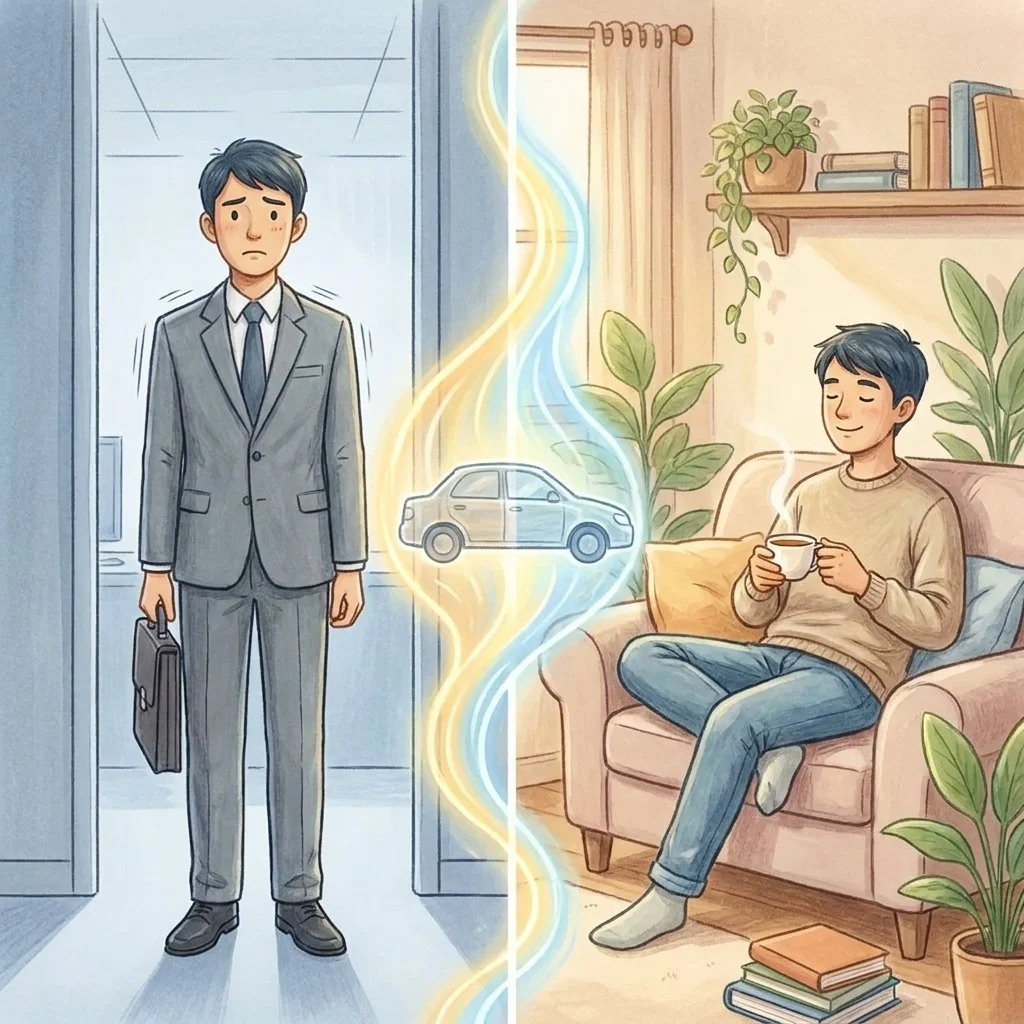
A role transition is the cognitive and emotional handoff from one version of you to another. Your brain needs a buffer to make the switch.
Why the car, specifically?
The car works as a transition space for reasons that aren't accidental:
- It's private. Nobody can see in. Nobody expects anything from you.
- It's contained. Temperature, music, silence — all under your control.
- It's neither here nor there. Not at work, not at home. Nowhere, and nowhere is exactly what you need.
- It can't be interrupted. You have a beat to brace before anyone reaches you.
- It's socially invisible. Sitting in a parked car looks like sitting in a parked car. You can disappear in plain sight.
People who don't drive often improvise the same thing — a long shower, a 10-minute walk, a few minutes alone before joining the family. The form changes; the function is the same.
Healthy reset vs. avoidance
This is the most important distinction in the whole article.
A reset is a pause that ends. You sit, you breathe, you let work fall off you, you walk inside calmer than when you stopped.
Avoidance is a pause that doesn't want to end. You're not decompressing — you're delaying, scrolling, ruminating, or dreading what's behind the door. You arrive inside worse than when you parked.
A simple test: "Is this a pause that ends with me ready to go in? Or am I delaying because I don't want to be inside?" If it's the second one, the car-sitting isn't the problem. The destination is.
Who feels transitions most strongly
Transitions are hard for everyone, but they're harder for some people — and that's a known pattern, not a personal failing.
ADHD brains and task switching
People with ADHD often describe transitions as one of the most exhausting parts of the day. Studies of attentional set-shifting in adults with ADHD have found a specific difficulty with the preparation phase of switching — the part where the brain gets ready to leave one mode and enter another.
If you have ADHD and the car pause has always felt non-negotiable, that's not surprising — it's informative. You may benefit from longer, more deliberate transition rituals. See our guide on mindfulness techniques for adult ADHD focus for practices that work with how an ADHD brain handles attention.
Anxiety and the dread behind the door
For people prone to anxiety, transitions carry an extra weight: the brain is rehearsing what comes next before you've even arrived. A landmark review on anticipatory anxiety in the brain describes how anxious brains over-weight the possibility of negative future events — even when nothing bad is actually coming.
Sitting in the car is partly your brain pre-running tomorrow's meeting or the email you haven't opened. For more on this pattern around upcoming events, see our piece on the Sunday scaries.
How to do the transition on purpose
The goal isn't to skip the pause. It's to make it intentional, so it resets you instead of leaving you stuck.
1. Pre-commit to a transition ritual
Decide ahead of time how long your buffer will be and what will happen in it. Three minutes. One song. Five slow breaths. The point is that you chose it — and that it has an end, which an accidental pause tends to lack.
Doing the same small thing every day turns the buffer into a habit: a consistent cue (engine off), a simple routine (one song + slow breaths), and a felt reward (a calmer body). For more on building these habits, see our guide to a morning mental wellness routine — the same principles work in reverse at the end of the day.
2. Use a sensory anchor
A sensory anchor is something distinct from both the leaving context and the arriving context. The most evidence-backed option is breath. Research on slow breathing has found that even a single session measurably reduces anxiety in the moment. Aim for roughly six breaths a minute — a long inhale, a longer exhale.
If breath feels too internal, try a body-based anchor: pressing your feet into the floor of the car, noticing five things you can see, naming sounds outside the window. Our guide to breathwork for anxiety covers techniques most likely to downshift your nervous system in a few minutes.
3. Name what you're carrying — and set a clear ending
Take 30 seconds to ask: "What from today am I bringing inside? What can I leave in the car?" You don't need to solve anything — just acknowledge what's still loud and decide what comes through the door. You'll be surprised how much can stay parked.
Then give yourself a specific signal that the buffer is over: the last note of a chosen song, a hand on the steering wheel, a phrase you say out loud — "Okay, going in." This stop signal tells your brain: that part is done; this next part starts now.
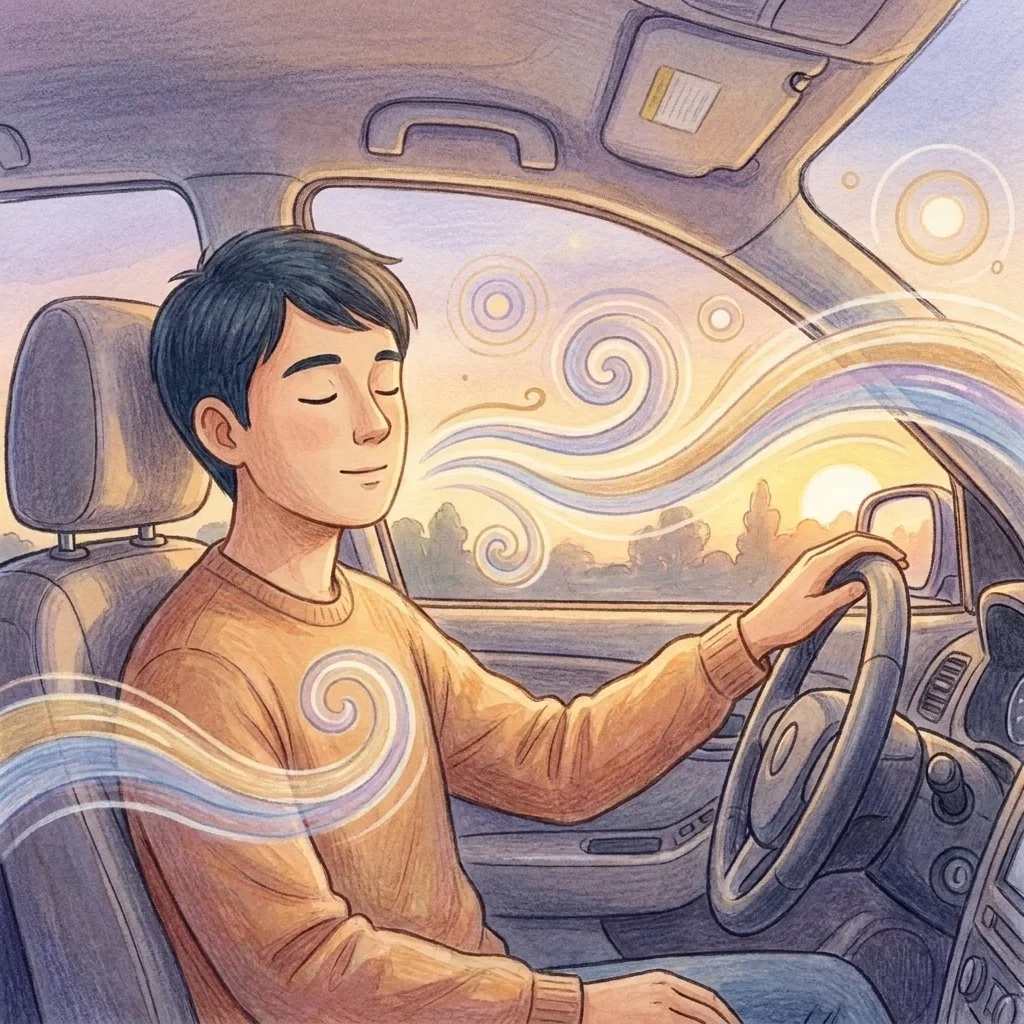
A 3-to-10-minute intentional pause — breath, music, or a sensory anchor — is enough to reset most people between roles.
When sitting in the car is a signal of something bigger
The car pause is healthy for most people, most of the time. But it can also be a quiet signal that something else is going on — if the pause keeps getting longer, if you're dreading entry rather than decompressing, if it's tied to a person or environment that feels chronically draining, or if the car is the only place in your day where you feel like yourself.
In these cases, the issue isn't the transition — it's what's waiting on the other side. The car-sitting is information. Waiting mode anxiety is a close cousin, and functional freeze describes the state of being physically stuck even when nothing external is stopping you.
If any of this feels familiar in a way that's affecting your life, a conversation with a therapist is worth more than any blog post.
A closing reframe
The car pause isn't laziness or a failure of executive function. It's your brain doing exactly what it's supposed to do: making space between two parts of your life that don't actually want to touch.
The work isn't in eliminating the pause. It's in doing it on purpose — with intention, with an ending, and with enough self-respect to call it what it is: a reset, a buffer, an ordinary act of taking care of yourself between roles.
Sit in the car. Take the breath. Then go inside.
-Tim, Founder of Wellness AI
About the Author
Dr. Timothy Rubin holds a PhD in Psychology with expertise in cognitive science and AI applications in mental health. His research has been published in peer-reviewed psychology and artificial intelligence journals. Dr. Rubin founded Wellness AI to make evidence-based mental health support more accessible through technology.
Make Your Reset More Intentional
Try Wellness AI for personalized meditations and supportive conversations that help you decompress between work, home, and everything in between.


FAQ: Transition Anxiety and the Car Pause
Why do I sit in my car before going inside?
Your brain needs a buffer to switch from one role (worker, commuter) to another (partner, parent, private self). It's a normal, adaptive response to the cognitive cost of switching contexts — not a sign that anything is wrong with you.
Is transition anxiety a real diagnosis?
No. Transition anxiety is a popular term, not a clinical diagnosis. It isn't in the DSM-5. But it describes a real experience grounded in research on task-switching, anticipatory anxiety, and role transitions. If transitions cause significant distress, an underlying condition like an anxiety or adjustment disorder may be involved.
How long should my car decompression be?
For most people, 3 to 10 minutes is enough to downshift the nervous system and clear attention residue from the day. The exact length matters less than whether the pause has a clear end and leaves you feeling more reset than when you parked.
Why is task switching so exhausting?
Every time your brain switches tasks, it has to reorient its goals and reactivate a different set of rules. That work adds up across a day, and big switches like moving from work to home are especially costly because the roles are so different.
Does transition anxiety affect people with ADHD more?
Yes. Research on adults with ADHD has found a specific difficulty with the preparation phase of task switching. If you have ADHD and have always needed a long car pause, that's consistent with the research — not a character flaw.
What's the difference between decompressing and avoiding?
A decompression pause has an end and leaves you calmer. An avoidance pause keeps extending, fills with scrolling or rumination, and ends with you feeling worse. The simplest test: do you arrive inside more regulated than when you parked?
How can I make my decompression more intentional?
Pick a length (3 to 10 minutes), a simple ritual (slow breathing, one chosen song, a body scan), and a clear endpoint (last note of the song, a phrase like "okay, going in"). Doing the same small thing every day turns the car pause into a real reset rather than an accidental stall.