Author: Dr. Timothy Rubin, PhD in Psychology
Originally Published: April 2026
Last Updated: April 2026

Waiting mode can make even a minor upcoming event feel like it's consumed your entire day.
Contents
- What Is Waiting Mode?
- The Science Behind the Freeze
- Why Waiting Mode Hits Harder with ADHD
- How to Break Out of Waiting Mode
- When Waiting Mode Signals Something Deeper
- Putting It Together: A Quick-Start Guide
- About the Author
- FAQ: Waiting Mode Anxiety
You have a doctor's appointment at 3 PM. It's 9 AM. And somehow, you can't do anything. You know you have six free hours. You know you could be productive. But your brain has already decided: the day is spoken for. Welcome to "waiting mode."
If this sounds familiar, you're far from alone. Waiting mode — the inability to start or complete tasks when you have something coming up later — is one of the most widely reported experiences in anxiety and ADHD communities. And while it might feel like a personal failing, the science behind it tells a very different story.
What Is Waiting Mode?
Waiting mode isn't a clinical diagnosis — it's a community-coined term that emerged from neurodivergent spaces online. But it describes something psychologists have studied for decades under different names.
At its core, waiting mode is a form of anticipatory anxiety — the mental and emotional response to an upcoming event, even when that event is minor or positive. Your brain locks onto the future appointment and struggles to release attention back to the present.
Psychologists call this anticipatory processing — the pattern of mentally rehearsing an upcoming event, imagining what could go wrong, and generating worst-case scenarios. The problem is that this rehearsal doesn't prepare you — it just keeps your stress response activated for hours.
The Science Behind the Freeze
Researchers have identified several overlapping mechanisms that explain why waiting mode happens. Understanding them can help you see that this isn't laziness — it's your brain's threat-detection system working overtime.
Worry Uses Up Your Mental Bandwidth
A major meta-analysis examining over 22,000 participants found that anxiety reliably reduces working memory capacity. Think of working memory as your brain's scratchpad — the limited space where you hold information, plan tasks, and make decisions. When worry about an upcoming event occupies that space, there's less room for anything else.
Research confirms this directly: people prone to worry showed significantly reduced working memory during active worrying compared to positive thinking. The worry itself was consuming cognitive resources, creating a self-reinforcing cycle — less capacity means less ability to redirect your attention away from the worry.
Your Attention Shifts to Threat-Scanning
Attentional Control Theory explains that anxiety tips the balance between two attentional systems: the goal-directed system (which helps you focus on tasks) and the stimulus-driven system (which scans for potential threats). When you're anxious about an upcoming event, the threat-scanning system dominates — making it harder to start and sustain productive work.
Time Feels Distorted
Anxious people tend to experience time as moving more slowly when focused on something worrying. And the more you attend to the passage of time, the longer it feels. When you're stuck in waiting mode, you're essentially watching the clock all day.
Your Brain Treats Uncertainty Like a Threat
An influential review in Nature Reviews Neuroscience showed that the brain's response to uncertainty involves increased vigilance and inhibited action — essentially freezing behavior until the uncertain situation resolves. Even a routine appointment carries some uncertainty, and your nervous system responds by putting you on standby.
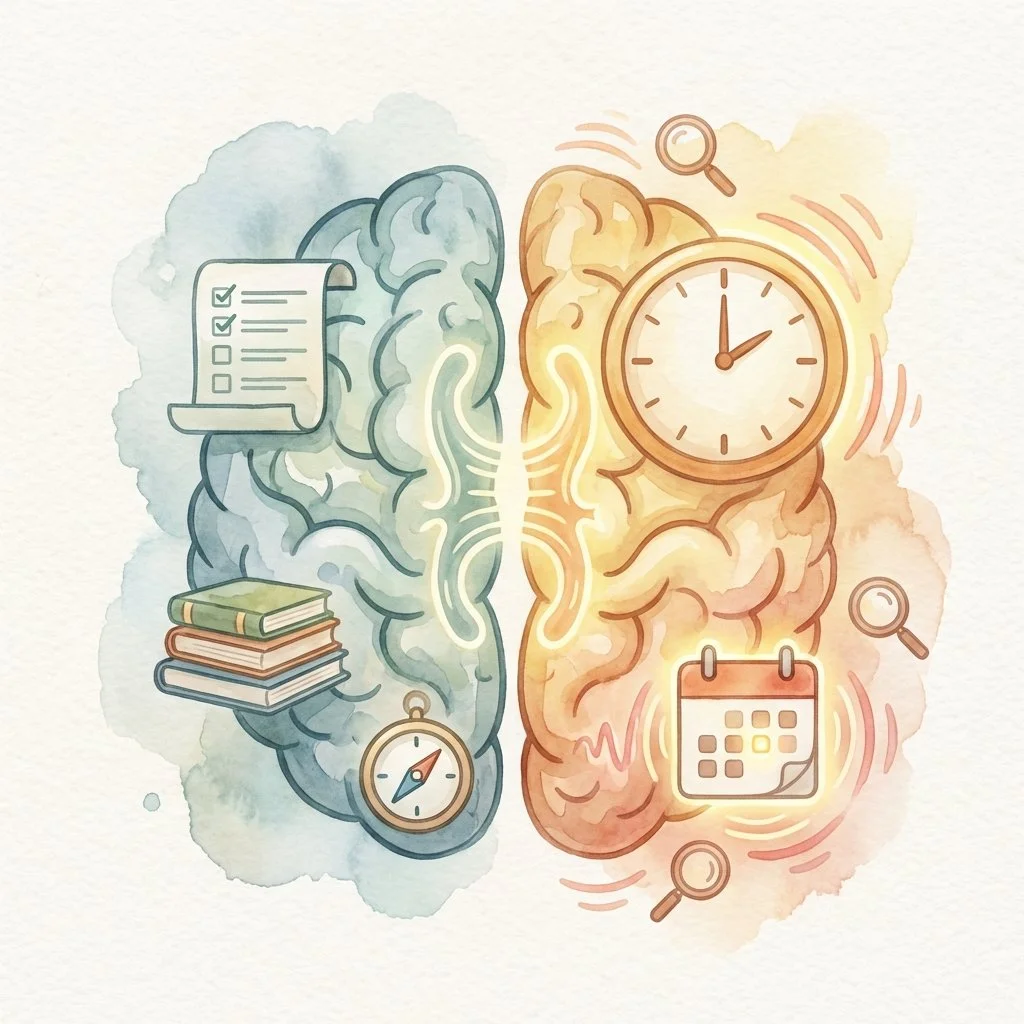
Anxiety shifts your brain's attentional balance away from productive focus and toward threat-scanning.
Why Waiting Mode Hits Harder with ADHD
While anyone can experience waiting mode, it's especially common — and especially debilitating — for people with ADHD. Several well-documented factors explain why.
Time Blindness Creates "Now vs. Not Now"
Russell Barkley, a leading ADHD researcher, has described ADHD as fundamentally a disorder of self-regulation across time. People with ADHD often experience "time blindness" — difficulty sensing how much time has passed or how long something will take.
Research on timing deficits in ADHD consistently shows impairments in estimating durations and planning ahead. In practical terms, this creates a "now vs. not now" experience: the appointment feels equally close whether it's 20 minutes or five hours away. That vague sense of "something is coming" makes it nearly impossible to gauge how much productive time you actually have.
Starting Tasks Is Already Hard
ADHD involves well-documented difficulties with task initiation and cognitive switching. Starting something while waiting requires initiating activity (already challenging), maintaining it while tracking time (impaired), and switching to appointment prep when needed (also impaired). When the difficulty of all those transitions stacks up, the brain's default answer is: don't start at all.
Motivation Needs Urgency
Brain imaging studies show that ADHD is associated with differences in dopamine reward pathways — the circuits that generate motivation and drive. Tasks that are routine, non-urgent, or lack immediate reward are exactly the kind the ADHD brain struggles to engage with. During a waiting period, available tasks almost always fall into this category.
Anxiety and ADHD Overlap More Than You'd Think
Research suggests that roughly half of adults with ADHD also have a co-occurring anxiety disorder. When you combine impaired time perception, difficulty with task initiation, and a tendency toward anxious rumination, waiting mode goes from an occasional inconvenience to a recurring pattern that can derail entire days.
How to Break Out of Waiting Mode
The good news: the same mechanisms that create waiting mode also point toward specific, evidence-based strategies for overcoming it. The key insight across all of these is the same: you don't need to eliminate the anxiety first — you need to act alongside it.
Use "If-Then" Plans to Bypass the Freeze
One of the most powerful tools for overcoming initiation paralysis is the implementation intention — a specific "if-then" plan that links a situation to an action. Instead of relying on motivation, you create an automatic trigger: "If it is 10 AM, then I will open the report and write for 25 minutes."
Research across thousands of participants found this technique has a medium-to-large effect on goal attainment. It works because it automates the decision to start — you don't need to debate with yourself about whether to begin.
Split Your Day into Two Tracks
Instead of viewing your day as one block dominated by the appointment, split it into two separate tracks: the time before and the time after. Assign specific, achievable tasks to each block.
Pair this with worry postponement — a well-studied CBT technique where you acknowledge anxious thoughts but defer them to a designated "worry time." Research shows that worries frequently lose their urgency when revisited later.
Start Absurdly Small
Behavioral activation — the principle that action precedes motivation, not the other way around — is one of the best-supported interventions in psychology. A recent clinical trial found that behavioral activation produced large improvements in generalized anxiety symptoms.
In practice, this means starting with a task so small it feels almost silly: open one email, write one sentence, fold five items of laundry. The "5-minute rule" works because it lowers the barrier below the threshold where your anxiety can block you.
Practice ACT-Style Acceptance
Acceptance and Commitment Therapy (ACT) offers a fundamentally different approach. Rather than trying to eliminate the anxious feeling before acting, ACT teaches you to notice the anxiety, acknowledge it, and act anyway in line with your values.
Multiple meta-analyses have found ACT as effective as CBT for anxiety. The core technique here is cognitive defusion — learning to observe "I can't do anything until the appointment" as a mental event rather than a literal truth. Try saying to yourself: "I notice I'm having the thought that I can't start anything right now."
Ground Yourself in the Present Moment
Mindfulness practices directly counter the future-oriented worry that drives waiting mode. Research consistently shows that mindfulness-based approaches are effective for anxiety reduction. One study found that anticipatory threat responses specifically mediated the relationship between mindfulness and reduced anxiety.
A simple grounding technique you can try right now: the 5-4-3-2-1 exercise. Name five things you can see, four you can touch, three you can hear, two you can smell, and one you can taste. This redirects your attention from internal worry to external reality.

Grounding techniques redirect attention from anxious anticipation back to the present moment.
When Waiting Mode Signals Something Deeper
Everyone experiences anticipatory anxiety from time to time. But when the pattern becomes persistent and starts significantly affecting your daily functioning, it may be worth exploring with a professional.
The National Institute of Mental Health describes Generalized Anxiety Disorder (GAD) as excessive worry occurring more days than not for at least six months, feeling difficult to control, and causing noticeable distress or impairment. About 3% of U.S. adults experience GAD in any given year.
Consider reaching out for support if you notice anticipatory worry happening most days, difficulty controlling it even when you try, avoidance of appointments or commitments, physical symptoms like chronic muscle tension or insomnia, or your work and relationships being affected.
For social anxiety specifically — where waiting mode tends to center on evaluative situations like meetings or presentations — NIMH recommends CBT as a first-line treatment. If you have ADHD and suspect anxiety may be compounding your waiting mode, a clinician who understands both conditions can help.
Putting It Together: A Quick-Start Guide
Next time you feel waiting mode setting in, try this sequence:
1. Name it. Recognize what's happening: "I'm in waiting mode." Just labeling the experience creates psychological distance.
2. Split the day. Divide your time into pre-event and post-event blocks. Give each block its own small goal.
3. Set an if-then. Pick one task and create a specific plan: "At [time], I will [action] for [duration]."
4. Start tiny. Choose something so small it feels ridiculous. Five minutes of anything counts.
5. Let the anxiety ride along. You don't have to feel ready. Start while feeling unready — that's not a bug, it's the strategy.
Waiting mode feels like a wall, but it's more like fog. It looks impenetrable from a distance, but once you take a single step forward, you often find there's more room to move than you expected.
-Tim, Founder of Wellness AI
About the Author
Dr. Timothy Rubin holds a PhD in Psychology with expertise in cognitive science and AI applications in mental health. His research has been published in peer-reviewed psychology and artificial intelligence journals. Dr. Rubin founded Wellness AI to make evidence-based mental health support more accessible through technology.
Break Through Waiting Mode with Guided Support
Try Wellness AI for personalized mindfulness exercises and therapy tools designed to help with anticipatory anxiety.


FAQ: Waiting Mode Anxiety
What is waiting mode anxiety?
Waiting mode is the inability to focus or start tasks when you have an upcoming event. It's driven by anticipatory anxiety — your brain locks onto the future event and struggles to redirect attention to the present.
Is waiting mode an ADHD thing?
It's especially common in ADHD due to difficulties with time perception and task initiation, but anyone with anxiety can experience it. About half of adults with ADHD also have a co-occurring anxiety disorder, which intensifies the pattern.
Why can't I do anything before an appointment even if it's hours away?
Worry about the upcoming event occupies your working memory — the mental workspace you use for planning and tasks. Time perception distortions can also make the event feel imminent regardless of how far away it actually is.
How do I break out of waiting mode?
Try using "if-then" plans to automate task initiation, start with very small tasks to build momentum, practice ACT-based acceptance, and use mindfulness grounding exercises to redirect attention to the present.
Can waiting mode be a sign of an anxiety disorder?
Occasional waiting mode is normal. If anticipatory anxiety happens most days, feels uncontrollable, and impairs your daily functioning, it may indicate Generalized Anxiety Disorder. Consider speaking with a mental health professional.
What's the difference between waiting mode and procrastination?
Procrastination involves avoiding a specific unpleasant task. Waiting mode is broader — you can't do anything, even enjoyable things. The paralysis comes from the upcoming event consuming your mental resources, not from the tasks themselves.
Does medication help with waiting mode?
The underlying ADHD or anxiety can be treated. ADHD medication can help with time perception and task initiation, while SSRIs are first-line treatments for anxiety disorders. A clinician can help determine the right approach.
Are there apps that can help with waiting mode anxiety?
Mindfulness and meditation apps can provide structured grounding exercises. Tools that combine CBT techniques with personalized meditation — like Wellness AI — can help build skills that counteract anticipatory anxiety over time.