Author: Dr. Timothy Rubin, PhD in Psychology
Originally Published: May 2026
Last Updated: May 2026

The argument is over, but your body hasn't gotten the memo yet — that's the conflict hangover.
The argument ended an hour ago. The conversation is over. But your chest is still tight, your stomach is in knots, and your mind won't stop replaying every word. You can't tell if you're still angry, scared, or just exhausted.
Sound familiar? This experience happens to almost everyone, after fights with partners, parents, siblings, friends, or coworkers. There's a name for it that's catching on in the relationship-psychology world: a "conflict hangover." And while it isn't a clinical diagnosis, it describes something very real, physiologically measurable, and surprisingly predictable.
The good news: once you understand what's happening in your body and brain, the recovery window gets shorter — and the things you do next stop making it worse.
Contents
- What Is a Conflict Hangover?
- Why Your Body Stays in Fight-or-Flight
- Why Your Mind Won't Stop Replaying It
- Why Some People Feel It Harder
- The 20-Minute Rule: Regulate Before You Repair
- 5 Evidence-Based Ways to Recover
- When It Signals Something Bigger
- Key Takeaways
- Frequently Asked Questions
What Is a Conflict Hangover?
A conflict hangover is the cluster of bodily and emotional symptoms that linger after a heated argument: a racing heart, tight chest, queasy stomach, jittery hands, fatigue, replaying the conversation, and a general sense of fragility that can last anywhere from an hour to a couple of days.
It happens because an argument triggers a full stress response — and that response takes much longer to wind down than the argument itself takes to finish. The fight may have lasted ten minutes; the chemistry can run for hours.
It isn't a character flaw, a sign you're "too sensitive," or evidence that something is wrong with your relationship. It's biology doing exactly what it was designed to do — just on a timeline that doesn't match modern life.
Why Your Body Stays in Fight-or-Flight After the Argument Ends
During an argument, your body activates the classic stress response: your adrenal glands flood your bloodstream with adrenaline and cortisol, your heart rate climbs, your breathing speeds up, and blood flow shifts away from your gut and toward your muscles. This is a normal acute stress response, and it's the same system that prepares you to fight a predator or run from danger.
The catch: the system has a slow exit. The chemistry takes time to clear.
Stress hormones take time to clear
Adrenaline calms down quickly — within minutes of the argument ending, the initial shakiness usually fades. Cortisol is the slow one. Even after a short fight, cortisol can stay elevated for an hour or more, which is why you can feel "off" long after the conversation has technically ended.
Research has shown that the stressors that produce the biggest and longest cortisol responses are precisely the ones arguments produce: situations that feel out of your control and that involve being judged or evaluated by someone you care about.
Your "calm down" system is slow to come back
Your parasympathetic nervous system — the "rest and digest" branch — is what should bring you back to baseline. The vagus nerve is its main highway. Under normal conditions, it slows your heart, settles your breathing, and tells your gut to relax.
After acute conflict, vagal tone takes noticeably longer to recover than the conflict itself lasted. This is part of why "just calm down" doesn't work as advice — the physical machinery for calming down is, briefly, offline. For more on the vagus nerve's role in anxiety recovery, see our guide to vagus nerve exercises for anxiety.
Why your stomach hurts after a fight
The nausea, cramping, loss of appetite, or sudden urgent trip to the bathroom isn't in your head. It's the gut-brain axis in action.
Your gut has its own dense network of nerves — sometimes called the "second brain" — and it's in constant two-way conversation with your central nervous system. When stress hormones flood your system, they directly change how your intestines move, how sensitive your gut feels pain, and how the lining of your gut behaves. The "punched in the stomach" feeling after a hard conversation is a real physical event, not an exaggeration.
Why Your Mind Won't Stop Replaying It
The body is only half the story. The mental aftermath has its own predictable shape.
The rumination spiral
You replay the conversation. You draft comebacks you'll never use. You analyze the tone of one specific sentence for twenty minutes. This is rumination, and decades of research from psychologist Susan Nolen-Hoeksema have shown that this kind of repetitive, passive replaying doesn't help you solve anything — it just keeps the stress signal alive.
Every replay re-triggers the threat appraisal that started the cortisol response in the first place. The fight is over, but your nervous system keeps getting fresh signals that danger is ongoing.
Catastrophic threat thoughts
Post-argument anxiety also tends to pull thinking toward worst-case scenarios. "They're going to leave me." "I ruined this." "Everything is broken." These thoughts feel certain in the moment, but they're a feature of the stress response, not an accurate read on reality.
This is one reason defusion techniques from Acceptance and Commitment Therapy — which create distance from catastrophic thoughts rather than arguing with them — tend to work better than logic in this state.
The shame undertow
For many people, especially those raised in volatile or invalidating environments, conflict triggers shame, not just fear. "I'm a bad partner." "I'm too much." "Why am I like this?"
Researcher June Tangney's work distinguishes between guilt ("I did something bad") and shame ("I am bad"), and shame is the more corrosive of the two — it pulls people into withdrawal, defensiveness, and global self-condemnation rather than constructive repair.
Why Some People Feel It Harder Than Others
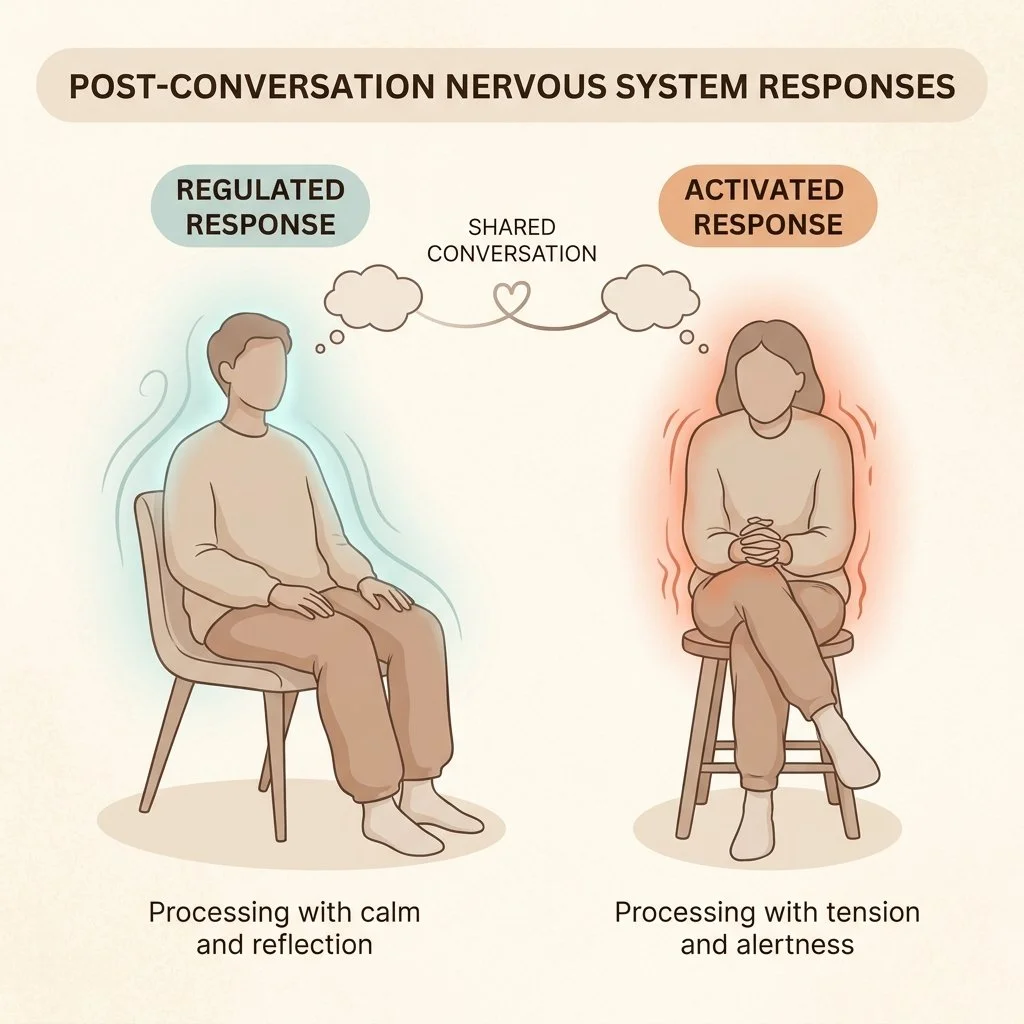
Two people in the same argument can have very different nervous system responses — neither is more valid than the other.
If your partner shrugs off an argument while you spiral for two days, you're not broken. Several well-studied individual differences amplify post-conflict distress.
Anxious attachment
People with anxious attachment tend to amplify distress signals during and after conflict — partly because their early experiences taught them that emotional intensity is what brings a caregiver back.
The result is that disagreements feel more threatening, take longer to recover from, and often drive reassurance-seeking patterns like sending "are we okay?" texts on a loop.
Rejection sensitivity
Some people are wired — through temperament, history, or both — to anxiously expect and intensely react to signs of rejection. For them, ambiguous moments during an argument get read as the relationship ending. This pulls the post-conflict anxiety into much higher gear.
A history of high-conflict environments
If you grew up in a home where arguments meant real danger, or where conflict was followed by long silences and emotional withdrawal, your nervous system learned that disagreement is genuinely threatening. That learning is still there in adulthood.
It can show up as hypervigilance — scanning your partner's face, tone, and texting patterns for signs of impending disaster.
The 20-Minute Rule: Regulate Before You Repair
Psychologist John Gottman's marital research lab has spent decades studying what actually happens to couples' bodies during conflict. One of the most useful concepts from that work is "flooding" — the point during an argument where your heart rate climbs high enough that your thinking brain effectively goes offline.
Gottman's research found that once you're flooded, you can't hear your partner accurately, can't access your usual problem-solving abilities, and tend to fall back on defensive or hostile responses. Trying to "talk it out" while flooded isn't mature — it's neurobiologically counterproductive.
Gottman's prescription is simple: stop and take a break of at least 20 minutes. That's roughly how long it takes for the cardiovascular system to settle after an argument-induced spike.
A few things matter about how you take the break:
- Name it explicitly. "I'm flooded. I need 20 minutes." Walking off without warning reads as stonewalling.
- Commit to coming back. "I'll come back at 8:30." This is the difference between a break and abandonment.
- Actually self-soothe during the break. Don't use the time to rehearse your counterargument or scroll through social media. Walk, breathe, take a shower — anything that helps your body genuinely settle.
The principle that comes out of this research is one of the most important things you can take from this article: regulate your body before you try to repair the relationship. A flooded conversation almost always makes things worse.
5 Evidence-Based Ways to Recover

Slow exhales, movement, and self-soothing all come before the repair conversation.
Here are five tools with the strongest research support for shortening a conflict hangover. Use them in roughly this order.
1. Slow, extended-exhale breathing
The single fastest way to bring your stress response down is to breathe in a way that activates the parasympathetic side of your nervous system — and the secret is to make your exhales longer than your inhales.
A long exhale stimulates the vagus nerve and signals to your body that the danger is over. Research on slow breathing consistently shows that practicing this for even a few minutes can meaningfully lower heart rate and shift the nervous system toward recovery.
A few techniques worth trying:
- 4-7-8 breathing. Inhale for 4 seconds, hold for 7, exhale for 8. Repeat 4–8 cycles.
- Box breathing. Inhale 4, hold 4, exhale 4, hold 4.
- Physiological sigh. A double inhale through the nose followed by a long exhale through the mouth. Effective in under a minute.
For a deeper look at which technique fits which moment, see our guide to breathwork for anxiety.
2. Move your body
Acute stress mobilizes your body for action. When that action never happens — because the "threat" was a verbal argument, not a charging animal — the stress chemistry has nowhere to go. Movement gives it somewhere to go.
A brisk 10–20 minute walk, a few minutes of stretching, a short run, or even gentle body shaking can help your body process and clear the stress response. Research has shown that even short bouts of physical activity dampen the cortisol response to subsequent stress.
You don't need a workout. You need just enough movement to remind your body the danger has passed. For more on body-based regulation, see our guide to somatic exercises for anxiety.
3. Defuse from catastrophic thoughts
When your mind is generating thoughts like "they're going to leave me" or "I always ruin everything," the worst thing to do is argue with them. Logic against catastrophic thinking, while you're flooded, usually fuels more rumination.
A more effective move is cognitive defusion, a technique from Acceptance and Commitment Therapy. Instead of trying to talk yourself out of the thought, you label it: "I'm having the thought that they're going to leave me."
That tiny linguistic shift — "I'm having the thought that…" — creates just enough distance between you and the thought that it loses some of its emotional weight. You stop being inside the thought. You start being someone who is noticing a thought.
4. Self-soothe before reaching back out
The most common mistake people make during a conflict hangover is reaching back out too early — sending a long apology text, calling to "talk things out," or asking "are you still mad?" while still emotionally flooded.
This almost always backfires. You re-trigger your own stress response, you often misread their reply, and you can pull them back into a conversation neither of you is ready for. Worse, compulsive reassurance-seeking — even when it temporarily calms you — tends to erode the very security you're trying to build.
The order matters: soothe yourself first, then reach out. If you're not sure whether you're regulated, you're probably not.
Doing this from memory is harder than it sounds when you're still flooded. If it helps to have something guide you through it, we've written up a comparison of some of the apps that target anxiety, including the panic and breathing tools built for exactly this moment.
5. Make a real repair attempt
Once your body is back online, repair becomes possible — and according to Gottman's research, the act of attempting repair matters more than how perfectly you do it. A good repair has three ingredients:
- Acknowledge impact. "I can see that landed hard."
- Take ownership of your part. "I was harsh, and that wasn't fair." (No "but.")
- Suggest a concrete next step. "Can we try this again tomorrow morning?"
This works in romantic relationships, friendships, family arguments, and workplace conflicts. The form changes — you wouldn't say the same words to your manager that you'd say to your partner — but the structure is the same. For more on managing emotional intensity before and during conflicts, see our guide to anger management techniques.
When a Conflict Hangover Signals Something Bigger
Most conflict hangovers are a normal stress response that resolves within a day. But a few patterns are worth taking seriously.
Symptoms that last days, not hours
If post-conflict anxiety regularly lingers for two or three days, disrupts your sleep, or affects your appetite, that may reflect a more sensitized stress response — sometimes a sign of generalized anxiety, chronic stress, or unresolved trauma.
Compulsive reassurance-seeking
If you can't stop checking in even after being reassured, the pattern itself becomes the problem. This is a well-studied dynamic with effective treatments.
Freezing, dissociation, or panic during conflict
If a raised voice causes you to shut down, go numb, or panic, your nervous system may be running on a trauma-shaped script. A trauma-informed therapist can help — approaches like EMDR, somatic experiencing, and Internal Family Systems all have evidence behind them.
The relationship itself doesn't feel safe
Recurring conflict hangovers from someone who name-calls, intimidates, threatens, or escalates physically isn't a regulation problem — it's an information problem. Your nervous system is correctly registering danger. In the US, the National Domestic Violence Hotline (1-800-799-7233) is a free, confidential starting point.
If post-conflict anxiety is a recurring feature of your life — not just an occasional bad night — talking to a therapist is worth it. The right modality depends on what's driving the pattern, and a good clinician can help you figure that out.
Key Takeaways
Before we get to frequently asked questions, here are the essential points to remember:
✓ The conflict hangover is real and measurable — What you feel after a fight is the natural tail of a stress response, not a sign you're "too sensitive"
✓ Cortisol and vagal tone recover on their own timeline — Most people need at least 20 minutes after a heated argument before their body is truly ready for productive conversation
✓ Some people feel it harder for known reasons — Anxious attachment, rejection sensitivity, shame proneness, and a history of high-conflict environments all amplify post-conflict anxiety
✓ The right order is regulate, then repair — Slow exhales, movement, defusion, and self-soothing all come before reaching back out
✓ A good repair has three parts — Acknowledge impact, take ownership of your part, suggest a concrete next step
✓ Persistent post-conflict anxiety is worth paying attention to — If it lasts days, drives reassurance-seeking, or comes with freezing or panic, a therapist can help
-Tim, Founder of Wellness AI
About the Author
Dr. Timothy Rubin holds a PhD in Psychology with expertise in cognitive science and AI applications in mental health. His research has been published in peer-reviewed psychology and artificial intelligence journals. Dr. Rubin founded Wellness AI to make evidence-based mental health support more accessible through technology.
Calm Your Body After a Fight
Wellness AI offers personalized AI therapy chat and on-demand guided meditations built around how you're actually feeling — including the moments right after a hard conversation.


Frequently Asked Questions
How long does a conflict hangover usually last?
For most people, the acute physical symptoms (racing heart, queasiness, shakiness) settle within 20–60 minutes if you stop replaying the argument. The mental tail of light anxiety often lingers a few hours, occasionally up to a day or two. If it reliably lasts longer than 2–3 days, that's worth talking to a therapist about.
Why do I feel so much worse than my partner after the same fight?
Individual differences are huge here. Anxious attachment, rejection sensitivity, shame proneness, and a history of high-conflict relationships all amplify post-conflict anxiety. Two people in the same argument can have very different nervous system responses — neither is more valid than the other.
Is it okay to take a break in the middle of an argument?
Yes — done right, it's actually the evidence-based move. The keys are to name it ("I'm flooded, I need 20 minutes"), commit to a specific return time, and actually self-soothe during the break instead of rehearsing your case.
Does this apply to fights with family, friends, or coworkers too?
Yes. The physiology of the stress response is the same regardless of the relationship. A heated argument with your sister, your best friend, or your manager produces the same cortisol spike and the same recovery curve as a fight with your partner.
Why do I feel sick to my stomach after a fight?
Because of the gut-brain axis. Stress hormones directly affect your digestive system — they change gut motility, increase pain sensitivity, and can cause nausea, cramping, or sudden urgency. It's a real physical event, not an overreaction.
Should I text my partner during the cool-down period?
Generally not to discuss the fight. A short message like "I need some space to settle, I'll come back to this at 8" is fine. Long apology texts or "are we okay?" check-ins sent while still flooded usually escalate things rather than calm them.
What if I can't stop replaying the argument in my head?
That's rumination, and it keeps the stress response active. The most effective response is to shift modalities — change what your body is doing rather than trying to think your way out. A walk, slow breathing, or cold water on your face interrupts the loop more effectively than analysis.
When should I see a therapist about post-conflict anxiety?
Good signals: it's affecting your sleep, work, or appetite for more than a couple of weeks; you're stuck in reassurance-seeking loops; conflicts trigger panic, freezing, or dissociation; or you're afraid of someone in your life. Any one of those is a reasonable reason to reach out.