Sunday Scaries: Why You Get Anxious Before the Work Week (And How to Stop)
Author: Dr. Timothy Rubin, PhD in Psychology
Originally Published: April 2026
Last Updated: April 2026

That familiar knot in your stomach on Sunday evening? You're far from alone.
Contents
- What Are the Sunday Scaries?
- Why Sunday Nights Trigger Anxiety
- Evidence-Based Ways to Beat the Sunday Scaries
- When Sunday Anxiety Is a Bigger Problem
- FAQ: Sunday Scaries
It's Sunday evening. The weekend felt too short, tomorrow's to-do list is already forming in your head, and a heavy sense of dread is settling in. Sound familiar? If so, you're experiencing what millions of people call the "Sunday scaries" — and research suggests you're in very good company.
What Are the Sunday Scaries?
The Sunday scaries describe that wave of anxiety, unease, or dread that shows up on Sunday evenings as the work week approaches. It's not a clinical diagnosis, but it reflects a very real pattern of anticipatory anxiety — the kind that comes from imagining stressful situations before they actually happen.
And it's remarkably widespread. A YouGov survey of over 30,000 U.S. adults found that nearly 40% of millennials and Gen Z workers experience Sunday scaries on a weekly or near-weekly basis. Other surveys have put the number even higher — some finding that more than 80% of professionals worry about the upcoming week on Sundays.
The symptoms vary from person to person. For some, it's a vague sense of unease. For others, it's a racing heart, trouble sleeping, irritability, or an inability to enjoy the rest of Sunday. Whatever form it takes, the Sunday scaries are your brain's way of bracing for the week ahead — and understanding why it happens is the first step toward making it stop.
Why Sunday Nights Trigger Anxiety
Your Brain Is Already Stressed About Monday
At the core of the Sunday scaries is anticipatory anxiety — your brain's habit of mentally rehearsing stressful situations before they arrive. Research published in Psychoneuroendocrinology found that simply anticipating a stressful event can trigger a significant cortisol response — even before anything stressful actually occurs.
Your body doesn't wait for Monday morning to start stressing. It begins the stress response on Sunday night. A daily-diary study of 112 employees found that work-related worry during the evening predicted exhaustion the next morning — meaning the worry itself was draining, even before the workday started.
The Weekend-to-Weekday Whiplash
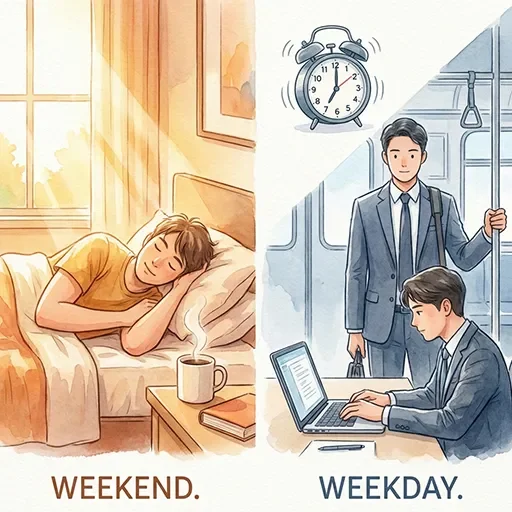
The shift from weekend freedom to weekday structure is one of the biggest psychological transitions we make each week.
There's a psychological concept called "boundary crossing" that helps explain why Sundays feel so heavy. Organizational researchers Ashforth, Kreiner, and Fugate describe how we constantly transition between our "home self" and "work self," and that the bigger the gap between those two roles, the harder the transition feels.
Weekends are the most segmented time we have — two days of relative freedom, personal choice, and rest. When Sunday evening arrives, you're facing the largest role transition of the week. Your brain has to shift from autonomy and relaxation back to deadlines and demands, and that shift creates friction.
Your Sleep Schedule Is Working Against You
If you sleep in on weekends (and most of us do), you may be experiencing what researchers call social jet lag — the mismatch between your body's natural sleep-wake rhythm and the schedule your job demands.
A 2025 study of over 2,700 workers published in Sleep Medicine found that workers with two or more hours of social jet lag had roughly double the rate of anxiety symptoms compared to those with consistent sleep timing. And meta-analytic evidence confirms the link between social jet lag and poorer mental health across multiple studies.
That extra sleep on Saturday and Sunday mornings might feel restorative, but it can actually prime you for more anxiety when Sunday night rolls around.
Unstructured Time Lets Worry In
During the workweek, your mind is occupied with tasks, meetings, and deadlines. But on Sunday evening, as activities wind down, there's suddenly space for anxious thoughts to surface. Research on psychological detachment from work shows that while mentally disconnecting during the weekend is good for recovery, the transition back to thinking about work can flood you with concerns you'd been keeping at bay.
It Might Be Telling You Something Deeper
Sometimes Sunday scaries aren't just about the transition — they're a signal. If your dread is specifically about your boss, your workload, or your work environment, it may point to a deeper issue like burnout or a genuinely unhealthy workplace. We'll come back to this in the section on when Sunday anxiety is a bigger problem.
Evidence-Based Ways to Beat the Sunday Scaries
The good news is that the Sunday scaries respond well to targeted strategies. Here are six approaches grounded in research.
1. Challenge Your Catastrophic Monday Thoughts
When Sunday anxiety hits, your brain tends to jump to worst-case scenarios: "This week is going to be terrible," "I'll never get through that project," "Everyone will notice I'm behind." These are classic cognitive distortions — thought patterns that feel true but aren't based in evidence.
Cognitive restructuring, a core technique in cognitive behavioral therapy, involves identifying these thoughts and questioning them. Ask yourself: Is this thought based on facts or feelings? What's the most realistic outcome? Have I handled similar weeks before?
This isn't positive thinking — it's accurate thinking. Meta-analytic research has consistently found that CBT techniques like cognitive restructuring produce meaningful reductions across multiple anxiety disorders.
2. Create a Sunday Evening Wind-Down Ritual

A predictable Sunday evening ritual signals to your brain that the transition is manageable.
Research on the psychology of rituals suggests that predictable sequences of behavior help regulate emotions — even when the person performing the ritual doesn't consciously believe it will work. Experiments by Norton and Gino found that rituals reduced distress primarily by restoring a sense of control.
Your Sunday ritual doesn't need to be elaborate. It might be making a specific cup of tea, doing a 10-minute meditation, reviewing your week ahead, or taking an evening walk. The key is consistency — doing roughly the same thing at the same time each Sunday evening helps your brain treat the transition as manageable rather than threatening.
3. Try Scheduled Worry Time
This sounds counterintuitive, but it works. Instead of letting anxious thoughts about Monday swirl all evening, designate a specific 15–30 minute window earlier in the day to sit down and worry deliberately. Write down your concerns, problem-solve what you can, and then close the notebook.
A 2024 meta-analysis of seven randomized trials found that worry postponement significantly reduced both the duration and frequency of worry, with effects showing up within the first week or two of practice. When worries pop up outside your designated time, gently remind yourself: "I'll deal with that during worry time."
For more on managing anxious thought spirals, see our guide to grounding techniques for emotional overwhelm.
4. Plan Monday Morning (Just a Little)
Part of what makes Monday feel daunting is the uncertainty. What should I tackle first? What meetings do I have? Am I forgetting something? A short Sunday evening planning session — even just five minutes — can dramatically reduce that ambiguity.
Recovery research suggests that the difference between helpful planning and harmful rumination is intent and containment. Brief, action-oriented planning (making a short to-do list, checking your calendar, laying out clothes) reduces uncertainty without spiraling into worry. The goal is to give your brain a clear "first step" for Monday so it can stop generating worst-case scenarios.
5. Use Mindfulness to Stay in Sunday, Not Monday
When the Sunday scaries hit, you're mentally living in Monday. Mindfulness practice pulls you back to the present moment — which, on a Sunday evening, is usually perfectly fine.
A large-scale study published in Nature Human Behaviour found that even a single brief body scan meditation significantly reduced anxiety compared to an active control. And a meta-analysis of 65 trials confirmed that brief mindfulness exercises — even sessions as short as 10 minutes — are effective at reducing anxiety and stress.
You don't need a full meditation session. A few minutes of deep breathing or a simple body scan can activate your parasympathetic nervous system and bring your stress response down. Research shows that diaphragmatic breathing lowers both cortisol and heart rate within minutes.
6. Address the Root Cause
If you experience intense Sunday scaries every single week, it's worth asking whether the problem is the transition or the destination. Persistent dread about a specific job, boss, or work environment isn't something a breathing exercise can fix — it's information.
A healthy amount of Sunday unease is normal. But when the dread feels disproportionate, chronic, and tied to a specific workplace situation, it may be a signal to evaluate your work environment, set better boundaries, or consider a change. Our guide to CBT techniques for managing anxiety and stress covers strategies for building resilience — but sometimes the healthiest response is addressing the external stressor itself.
When Sunday Anxiety Is a Bigger Problem
For most people, the Sunday scaries are a mild, manageable nuisance. But for some, they cross into territory that deserves professional attention.
Physical symptoms are escalating. If you're experiencing nausea, chest tightness, headaches, or panic-like symptoms every Sunday, your body is telling you something important.
Sleep is consistently disrupted. Occasional restless Sunday nights are common, but if you regularly can't fall asleep or wake in the middle of the night due to work anxiety, it may be affecting your health. Our guide to better sleep covers evidence-based approaches.
It's spreading beyond Sundays. When the dread starts creeping into Saturday or even Friday evening, it may reflect generalized anxiety rather than simple anticipatory stress.
You dread specific aspects of work. If the anxiety centers on a toxic relationship, an unsustainable workload, or an unsafe environment, those are workplace problems — not personal anxiety problems. The APA's 2023 Work in America survey found that more than two-thirds of employees experience workplace stress, and many worry about disclosing mental health struggles at work.
If any of these resonate, consider talking with a mental health professional. The Sunday scaries on their own aren't a disorder — but they can be a symptom of something that benefits from support, whether that's generalized anxiety, burnout, or a work situation that needs to change.
A morning mental health routine can also help you start Mondays from a more grounded place, even while you work on the bigger picture.
-Tim, Founder of Wellness AI
About the Author
Dr. Timothy Rubin holds a PhD in Psychology with expertise in cognitive science and AI applications in mental health. His research has been published in peer-reviewed psychology and artificial intelligence journals. Dr. Rubin founded Wellness AI to make evidence-based mental health support more accessible through technology.
Beat the Sunday Scaries with Personalized Support
Try Wellness AI for guided meditations and therapy sessions designed to help with anxiety, stress, and anticipatory worry.


FAQ: Sunday Scaries
Are the Sunday scaries normal?
Yes. Surveys suggest that 40–80% of working adults experience some form of Sunday night anxiety. It's a normal anticipatory stress response, especially common among millennials and Gen Z.
Why do I only get anxious on Sundays?
Sunday evening is when the largest psychological shift of the week occurs — from weekend autonomy to workplace obligations. Unstructured time allows anticipatory worries to surface in a way busy weekdays don't.
Can the Sunday scaries be a sign of burnout?
Yes. If your Sunday dread is intense, persistent, and accompanied by emotional exhaustion or cynicism about work, it may reflect burnout rather than normal anticipatory anxiety.
How do I stop Sunday night anxiety?
A combination of strategies works best: challenge catastrophic thoughts with cognitive restructuring, build a calming Sunday evening routine, try brief mindfulness, and do minimal Monday planning to reduce uncertainty.
Does sleeping in on weekends make the Sunday scaries worse?
It can. Research on social jet lag shows that shifting your sleep schedule by two or more hours on weekends is linked to higher anxiety. Try keeping wake times within about an hour of your weekday schedule.
Do the Sunday scaries mean I should quit my job?
Not necessarily. If your dread is tied to a toxic environment or misaligned role, it may signal a need for change. If the anxiety is more general, evidence-based coping strategies can help significantly.
What's a quick exercise for Sunday night anxiety?
Try slow breathing: inhale for 4 counts, hold for 4, exhale for 6. Repeat 4–5 times. Research shows diaphragmatic breathing activates the body's calming response within minutes.
Can meditation help with the Sunday scaries?
Yes. Studies show that even a single brief mindfulness session can reduce acute anxiety. Try a body scan, guided meditation, or a few minutes of focused breathing to shift your attention back to the present. See our guide to meditation for work stress for more.