Emotional Flashbacks: Why You Overreact to Small Things (and How to Ground Yourself)
Author: Dr. Timothy Rubin, PhD in Psychology
Originally Published: May 2026
Last Updated: May 2026

An emotional flashback is a recognizable pattern - and once you understand the mechanism, it stops feeling like proof that something is wrong with you.
Contents
- What an Emotional Flashback Actually Is
- Where the Term Comes From
- Why Your Brain Does This
- What Emotional Flashbacks Get Confused With
- Signs You May Be Having an Emotional Flashback
- How to Ground From an Emotional Flashback
- When Emotional Flashbacks Point to Something Bigger
- You're Not Too Much
- Frequently Asked Questions
You're standing in the kitchen. Your partner says, with no particular edge, "Did you forget to do the dishes again?" And something drops through the floor of you. Your chest goes tight, your face is hot, your eyes sting. A second ago you were fine. Now you feel about nine years old, and somewhere underneath the heat there's a voice saying I always get this wrong, I'm always the problem.
Ten minutes later you're shaky and a little ashamed, asking the question that probably brought you here: Why did I react like that? It was just the dishes.
If you've had that experience - a tiny trigger, a huge reaction, gone almost as fast as it arrived - you are not broken, too sensitive, or "crazy." You may have just had an emotional flashback. It's a recognizable pattern, it has a name, and understanding the mechanism changes how it feels.
What an Emotional Flashback Actually Is
An emotional flashback is a sudden, intense emotional reaction - usually shame, fear, rage, or grief - that is disproportionate to whatever is happening right now, and that carries the emotional charge of a much older experience.
The key word is emotional. A "classic" trauma flashback is vivid and sensory: images, sounds, the felt sense of being back in an earlier event. An emotional flashback usually has none of that. There's no movie playing, and often no clear memory at all. What floods in is the feeling - the helplessness, the dread, the certainty that you're bad - without the story that would explain it. You don't see the past; you just suddenly feel like you're in it.
That missing narrative is what makes emotional flashbacks so disorienting. With a normal upsetting event, you can point to the cause. With an emotional flashback, the surface cause ("the dishes") is nowhere near big enough to account for the size of what you feel - so your mind reaches for the only available explanation, which is something is wrong with me.
Where the Term Comes From
The phrase "emotional flashback" was popularized by psychotherapist Pete Walker, whose work on complex trauma - especially his book Complex PTSD: From Surviving to Thriving - gave a generation of trauma-informed therapists a vocabulary for this experience.
It's worth being precise here. "Emotional flashback" is a clinical concept drawn from practitioner experience - not a formal diagnosis, and not a term you'll find in the DSM-5-TR. Walker's framework is a practitioner model, widely adopted because it describes something clinicians and clients recognize, rather than a finding from controlled research.
What is well established is the broader territory the concept sits in. The World Health Organization's ICD-11 introduced complex post-traumatic stress disorder (CPTSD) as a formal diagnosis, defined by the symptoms of PTSD plus persistent difficulties in three areas: emotion regulation, a damaged sense of self, and trouble sustaining relationships. An emotional flashback is one recognizable way affect-regulation difficulty shows up in daily life - so the umbrella is evidence-based, even if this particular term is a clinical shorthand.
Why Your Brain Does This
If the reaction makes no logical sense, that's because it isn't being generated by the logical part of your brain. Three things are happening underneath.
The body remembers what the mind can't narrate
Neuroscience research has shown that emotional memory and conscious, factual memory are handled by different brain systems that operate in parallel. The amygdala encodes the emotional charge of an experience; the hippocampus and cortex encode the explicit, "I remember when..." story.
Joseph LeDoux's research on fear learning established that the amygdala can form emotional memories that operate without conscious awareness - especially for things that happened when you were very young, before the explicit-memory system was fully online. The feeling got stored; the story didn't. So when the feeling is triggered, it arrives without a return address.
Your nervous system pattern-matches - fast, not accurate
Underneath conscious thought, your brain continuously scans for cues that resemble earlier threats. A tone of voice, a phrase, a facial expression, a feeling of being criticized - any of these can match a stored template and trigger the original emotional response. Conditioned fear responses can be expressed even without conscious recognition of the trigger, which is why the reaction can be underway before you've had a single conscious thought about it.
The size of the reaction matches the original wound
This is the heart of it. The intensity you feel isn't calibrated to the dishes. It's calibrated to whatever first laid down that emotional template - the original moment of feeling unsafe, unloved, or not good enough.
The present-day event is just the key that fits an old lock. That's why "I overreacted" is the wrong frame. You didn't overreact to this. You reacted, accurately and proportionately, to that - it's just that that isn't actually in the room.
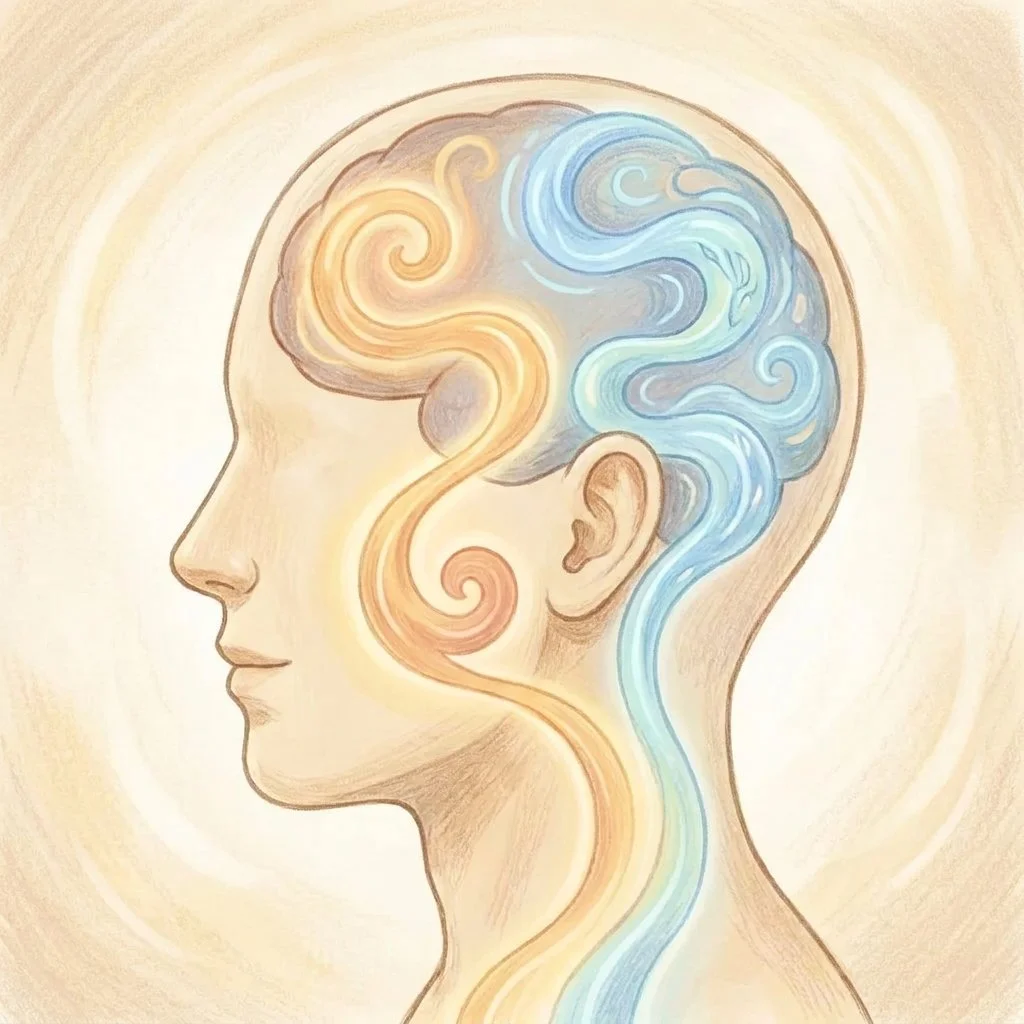
Emotional memory and factual memory are stored by different brain systems - which is why a feeling can return without the story attached to it.
What Emotional Flashbacks Get Confused With
Because the experience is hard to name, people often file it under something else. A few useful distinctions:
Versus a classic PTSD flashback
A classic flashback is sensory and intrusive - you re-experience an event through images, sounds, or bodily sensations. An emotional flashback is mostly feeling-state, with little or no narrative or sensory content.
Versus a panic attack
A panic attack is built around acute physical symptoms and a fear of those symptoms - racing heart, can't breathe, "am I dying." An emotional flashback centers on a sudden shift in your emotional sense of yourself: feeling small, young, ashamed, or unsafe. Our guide to grounding techniques for panic attacks covers the panic side in more depth.
Versus rejection sensitivity dysphoria (RSD)
RSD is a specific, intense pain response to perceived rejection or criticism. An emotional flashback can be triggered by many kinds of cue - a tone, a power dynamic, a feeling of being trapped. If rejection is your most common trigger, our guide to rejection sensitivity in adults is worth reading alongside this.
Versus "just being too sensitive"
Throw this one out. "Too sensitive" frames the reaction as a character flaw. An emotional flashback is a learned nervous-system response - it means your system once correctly registered that certain cues predicted harm. That's not a defect of personality; it's a record of history.
Signs You May Be Having an Emotional Flashback
It's easier to use grounding tools when you can recognize what's happening. Common signs:
- The reaction feels wildly disproportionate to the trigger.
- You suddenly feel younger, smaller, or less capable than you actually are.
- Your body activates fast - chest, stomach, throat, tears - without a clear narrative reason.
- Familiar, harsh self-talk shows up: I'm bad. I ruined this. I'm too much. They're going to leave.
- It eases when you get distance from the trigger - and is often followed by a second wave of shame, this time about having reacted at all.
That last point matters. The shame about the flashback is part of the pattern, not a separate failing - and naming it as part of the same wave is itself a step toward loosening it.
How to Ground From an Emotional Flashback
You can't logic your way out of a limbic response in real time, but you can give your nervous system the signals it needs to settle. Here's a five-step plan, adapted from the work of trauma-informed therapists and anchored to what the research supports.
1. Name what's happening
Say it, silently or out loud: "I'm having an emotional flashback. This feeling is real, but the danger isn't current." Naming an internal experience engages the prefrontal cortex and creates a small but crucial gap between you and the feeling - you become the person observing the wave rather than the wave itself. This is the same skill at the center of cognitive defusion: you don't have to argue with the feeling, just notice it as a feeling.
2. Locate yourself in time and place
Flashbacks collapse time. Your job is to re-establish it. Look around and state the facts: "I am 34 years old. I am in my own kitchen. It is 2026. What I'm feeling belongs to then, not now." Anchor it with your senses - name three things you can see, two you can hear, one you can feel under your hands. Our guide to grounding through emotional overwhelm goes deeper on sensory orientation.
3. Breathe out slowly
Reach for your breath, and make the exhale the long part. There's a clear physiological reason: during inhalation the vagus nerve's influence on the heart is briefly suppressed, and during exhalation vagal activity is restored, shifting you toward the parasympathetic "rest" state. Reviews of slow-paced breathing find that a longer exhale than inhale measurably increases parasympathetic activity and reduces anxiety. Try inhaling for a count of four and exhaling for six or eight. Our breathwork for anxiety guide has more patterns.
4. Turn toward the younger part of you with compassion
The part of you that's flooded is, in a real sense, young. Instead of scolding it - which only deepens the original wound - speak to it the way you'd speak to a frightened child: "This part of me is small and scared. It's not making it up. I'm an adult now, and I can keep us safe." Self-directed compassion is a practical regulation tool, and we cover it in depth in self-compassion for anxiety.
5. Postpone any high-stakes decision
Whatever the flashback is urging you to do right now - send the furious text, end the relationship, quit the job - put it on hold. A decision made mid-flashback is a decision made in response to an event that isn't actually happening. Tell yourself you can revisit it in a few hours, once you're oriented. Almost always the urgency drains away with the flashback, leaving a normal-sized situation you can handle in a normal-sized way.
When Emotional Flashbacks Point to Something Bigger
Occasional emotional flashbacks are part of being human, especially during stressful seasons. But when they're frequent, intense, or interfering with your relationships and work, they can be a sign of complex trauma, attachment wounds, or unresolved childhood adversity.
That's worth taking seriously - not as a verdict on you, but as useful information about what kind of support would actually help. Several trauma-focused therapies are well suited to this work, including EMDR, Internal Family Systems, Somatic Experiencing, and trauma-focused CBT. A trauma-informed clinician can help you find the right fit.
Persistent flashbacks often overlap with hypervigilance, and if intrusive thoughts are also part of the picture, our guide to managing intrusive thoughts covers when self-help reaches its limits. If you're in the US and want a place to start, the SAMHSA National Helpline (1-800-662-4357) offers free, confidential referrals; if you're in crisis, you can call or text 988.

Each time you name a flashback instead of being swept under by it, you teach your nervous system something new.
You're Not Too Much
It's worth ending where the title started. The instinct after an emotional flashback is to conclude that you're too sensitive, too reactive, too much. The more accurate story is gentler: you have a nervous system that once learned, correctly, that certain cues meant danger. It did its job.
The work now isn't to feel less. It's to recognize the pattern when it shows up, to know that the size of the feeling measures an old wound rather than a present threat, and to have a few tools for the moments it does. Each time you name a flashback instead of being swept under, you teach that old system something new - that this time, you've got it.
-Tim, Founder of Wellness AI
About the Author
Dr. Timothy Rubin holds a PhD in Psychology with expertise in cognitive science and AI applications in mental health. His research has been published in peer-reviewed psychology and artificial intelligence journals. Dr. Rubin founded Wellness AI to make evidence-based mental health support more accessible through technology.
Tools for the Moment a Flashback Hits
Wellness AI offers supportive therapy conversations and personalized guided meditations to help you ground yourself and feel steadier - whenever you need it.


Frequently Asked Questions
What is an emotional flashback?
An emotional flashback is a sudden, intense emotional reaction - often shame, fear, rage, or grief - that's disproportionate to the present situation and carries the emotional charge of an older experience. Unlike a classic flashback, it usually has no images or narrative; it's mostly feeling.
Why do I overreact to small things?
Often the reaction isn't really to the small thing. A minor trigger can pattern-match to an earlier experience your nervous system stored as threatening, so the intensity matches the old wound rather than the current event.
Are emotional flashbacks the same as panic attacks?
No, though they can overlap. A panic attack centers on acute physical symptoms and fear of those symptoms. An emotional flashback centers on a sudden shift in your emotional sense of yourself - feeling small, young, ashamed, or unsafe.
Is "emotional flashback" an official diagnosis?
No. It's a clinical concept popularized by therapist Pete Walker and widely used in trauma-informed therapy, but it isn't a DSM-5-TR diagnosis. The related condition complex PTSD is a formal diagnosis in the WHO's ICD-11.
How do I stop an emotional flashback once it starts?
You can't switch it off instantly, but you can shorten it: name what's happening, orient yourself to the present time and place, breathe with long slow exhales, offer yourself compassion, and postpone any high-stakes decisions until you feel grounded.
Do emotional flashbacks mean I have CPTSD?
Not necessarily. Occasional emotional flashbacks are common and don't indicate a disorder. Frequent, intense, or life-interfering flashbacks can be associated with complex trauma, and a trauma-informed therapist can help you understand what's going on.
Why do I feel ashamed after an emotional flashback?
The shame is part of the pattern, not a separate failing. Once the flashback fades, the mind often turns on itself for having reacted. Recognizing that second wave as part of the same event helps loosen its grip.
Can therapy help with emotional flashbacks?
Yes. Trauma-focused approaches such as EMDR, Internal Family Systems, Somatic Experiencing, and trauma-focused CBT are designed to work with the implicit emotional memories that drive flashbacks. A trauma-informed clinician can help you find the right fit.