Anger Management: Mindfulness and CBT Techniques That Work
Author: Dr. Timothy Rubin, PhD in Psychology
Originally Published: Dec 2025
Last Updated: Dec 2025

Mindfulness creates a pause between anger and reaction, allowing for more skillful responses.
Table of Contents
Anger is a normal human emotion—but when it spikes fast, it can hijack your words, your choices, and your relationships. If you've searched for ways to control anger, wondered about calming techniques for frustration, or looked up anger management strategies, this guide is for you.
The goal isn't "never get angry." It's to build a pause between the surge and the reaction, so you can respond with clarity and self-respect instead of regret.
Why Anger Feels So Intense: Understanding Your Body's Response
Anger is tightly linked to your stress response, which triggers hormone release and physical changes like increased heart rate and blood pressure as part of your "fight-or-flight" response. The National Institute of Child Health and Human Development notes how stress hormones like epinephrine and cortisol affect your blood pressure and blood sugar.
From a brain perspective, threat-related emotion circuits activate quickly—sometimes before slower, deliberate thinking catches up. Neuroscience research suggests that emotion circuits can trigger rapid reactions before "thinking" systems fully evaluate what's happening. That's why anger can feel "instant," and why reasoning with yourself mid-spike can be hard.
There's also a health angle: a systematic review found a higher rate of acute cardiovascular events in the two hours following anger outbursts. This doesn't mean anger is always dangerous—but it supports the value of learning to downshift.
Mindfulness Techniques for Anger Management: Create a Pause You Can Use
Mindfulness isn't "being calm." It's noticing what's happening—body sensations, thoughts, urges—without automatically acting on it. A meta-analysis found that mindfulness-based interventions reduced anger and aggression versus controls. You don't need long sessions; short practices done consistently can build the skill of pausing.
If you want foundational skills that transfer well to anger, see our guide on Meditation for Anxiety.
1. The "Pause and Breathe" Method (30–90 seconds)
When anger rises, start with your physiology. Slow breathing is a fast way to lower arousal. Research suggests that diaphragmatic breathing patterns can increase high-frequency heart rate variability, linked to parasympathetic "rest-and-digest" activity. A meta-analysis of randomized trials found that breathwork interventions improve stress and mental health outcomes overall.
Try this breathing technique:
- Inhale for 4 seconds
- Hold for 7 seconds
- Exhale for 8 seconds (focus on the exhale)
- Repeat 5–8 times
Even a small drop from 9/10 intensity to 6/10 makes better choices possible. The exhale is the "downshift" that creates the pause.
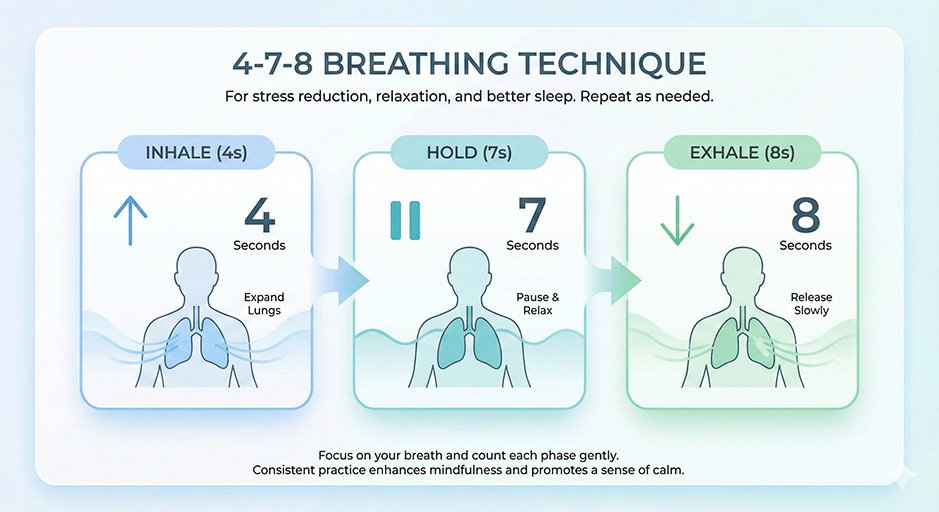
Mindfulness creates a pause between anger and reaction, allowing for more skillful responses.
2. Label What's Happening (Emotion + Urge)
Name it quietly: "Anger." "Tension." "Urge to interrupt." This creates distance—enough to remember you have options. Research on emotion labeling suggests that naming feelings can reduce their intensity.
3. Quick Body Scan (30 Seconds)
Anger often concentrates in the jaw, hands, and chest. Scan those areas and soften what you can. For a deeper practice, see our guide on Body Scan Meditation.
CBT Anger Management: Change Your Thoughts, Change Your Response
Mindfulness helps you pause. CBT helps you decide what to do next. A large meta-analysis reported that psychological treatments are generally effective in treating problematic anger. Another review concluded that cognitive-behavioral approaches are the most widely disseminated anger treatments and show consistent effectiveness.
For broader CBT skills that pair well with anger work, see our guide on 8 Evidence-Based CBT Techniques.
4. Catch the "Hot Thought" and Reframe It
Anger often rides on a thought that feels completely true: "They did that on purpose." "This is unacceptable." "If I don't fight back, I'll lose." Reframing isn't positivity—it's accuracy.
Example:
Hot thought: "They're disrespecting me on purpose."
Reframe: "I don't know their intent. I do know the impact, and I can address it calmly."
For a step-by-step walkthrough, see our guide on Cognitive Restructuring.
5. Problem-Solve Instead of Mind-Read
Anger energizes action. CBT channels that energy into effective moves:
- What's the problem (specific behavior, not character)?
- What outcome do I want?
- What's one next step that gets me closer?
Sometimes the best "next step" is a short timeout, then a clearer conversation.
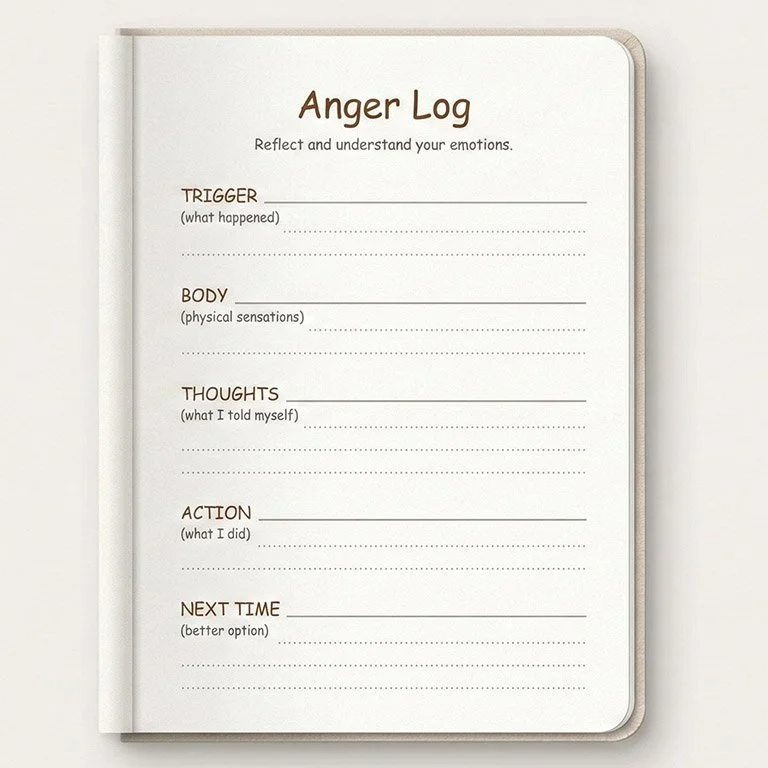
An anger log makes it easier to spot patterns and practice more skillful responses.
6. Use an Anger Log to Find Patterns
Tracking turns "random explosions" into predictable cycles. SAMHSA's evidence-informed workbook includes tools like an anger meter, anger log, and anger control plan.
Simple template:
Trigger → Body → Thought → Action → Better option next time
What Actually Helps (and What Doesn't)
Progressive Muscle Relaxation (PMR) Works
PMR reduces anger-related tension by tensing and releasing muscle groups. It's included in many structured anger programs. Clinical research suggests that relaxation training can improve anger control in some settings.
Quick version:
- Clench fists 5s → release 10s
- Shrug shoulders 5s → release 10s
- Unclench jaw 5s → release 10s
Venting Isn't Reliable Anger Management
"Let it out" is popular advice, but not well-supported. Experimental research found that venting anger can keep people angrier and more aggressive. A large meta-analytic review found that arousal-decreasing strategies (breathing, meditation, yoga) reduce anger and aggression, while venting and other arousal-increasing activities generally do not.
If you're "too activated to think," try a grounding reset. See our guide on Grounding Techniques for Emotional Overwhelm.

Effective anger management leads to clearer communication and stronger relationships.
Anger Isn't the Enemy—Rumination and Suppression Are
Many people either explode or stuff it down. Research suggests that anger is linked with more rumination and suppression, and with less acceptance and cognitive reappraisal. Translation: acknowledge anger, regulate intensity, then communicate.
A useful sentence starter:
"I'm getting worked up. I want to talk, but I need two minutes first."
When to Seek Professional Support
If anger is frequent, harming relationships, leading to threats or violence, or feeling out of your control, it's worth seeking professional support. Evidence-based options include CBT, mindfulness-based programs, and skills-based therapies like DBT emotion regulation.
Between therapy sessions or while exploring treatment options, digital tools can help reinforce skills. Wellness AI provides personalized mindfulness exercises, breathing techniques, and CBT-based support tailored to your specific triggers and patterns.
Warning signs that professional help may be needed:
- Anger outbursts more than 2-3 times per week
- Damage to property or physical aggression
- Threats or intimidation toward others
- Legal consequences (arrests, restraining orders)
- Job loss or workplace conflicts due to anger
- Relationship breakdown or family estrangement
About the Author
Timothy Rubin, PhD is a psychologist and the founder of Wellness AI, a mental health app that combines AI-powered therapy with personalized guided meditations. Dr. Rubin's work focuses on making evidence-based mental health support more accessible through innovative technology. His expertise spans clinical psychology, cognitive behavioral therapy, and the application of AI to mental health care.
Get Personalized Support for Anger and Other Mental Health Issues Today
Wellness AI provides personalized mindfulness exercises, breathing techniques, and CBT-based support tailored to your anger triggers and patterns.


Frequently Asked Questions
Is anger always bad for you?
No. Anger signals boundaries, values, or unfairness. The goal is regulating intensity and responding effectively rather than eliminating anger entirely.
What if I can't calm down in the moment?
Start with your body: slow breathing, brief pause, or progressive muscle relaxation. Research shows arousal-decreasing strategies are most consistently effective for anger management.
Does mindfulness actually work for anger management?
Yes. Meta-analysis research found that mindfulness-based interventions significantly reduce anger and aggression compared with control groups.
Should I vent my anger to get it out?
Usually not. Research shows venting can maintain or increase anger and aggression rather than reducing it. Arousal-decreasing strategies work better.
How do I talk about my feelings instead of exploding?
Regulate first using breathing or grounding, then use a clear structure: "When X happens, I feel Y, and I need Z." Keep it specific and behavior-focused.
When is anger a sign I should talk to a professional?
If anger leads to threats, violence, repeated relationship harm, legal or work consequences, or feels uncontrollable, a licensed professional can help you build safer coping skills.
Can anger and anxiety occur together?
Yes. Anxiety often manifests as irritability or anger, and anger can trigger anxiety about consequences. Both involve threat response activation. See our Anxiety Guide for complementary strategies.
How long does it take to see improvement with these techniques?
Many people notice some improvement within 2-4 weeks of consistent practice. Building strong anger management skills typically takes 2-3 months of regular use.