Somatic Exercises for Anxiety: Releasing Stress Stored in Your Body
Author: Dr. Timothy Rubin, PhD in Psychology
Originally Published: April 2026
Last Updated: April 2026
Somatic exercises work through the body to release stored tension, calm the nervous system, and ease anxiety from the ground up.
Contents
- What Is Somatic Therapy?
- How Your Body Stores Stress and Trauma
- The Window of Tolerance: Why Somatic Work Matters
- Somatic Exercises You Can Try at Home
- Bottom-Up vs. Top-Down: How Somatic Work Complements CBT
- When to Work with a Somatic Therapist
- Safety Considerations
- FAQ: Somatic Exercises for Anxiety
What Is Somatic Therapy?
If you've ever noticed your shoulders creeping up toward your ears during a stressful day — or felt a pit in your stomach before a difficult conversation — you already know that anxiety doesn't just live in your thoughts. It shows up in your body, too.
Somatic therapy is built on this insight. The word "somatic" comes from the Greek soma, meaning "body," and somatic approaches work by tuning into physical sensations as a pathway to emotional healing. Rather than starting with your thoughts (the way traditional talk therapy often does), somatic exercises start with what you feel in your body.
The most well-known somatic framework is Somatic Experiencing (SE), developed by Dr. Peter Levine. Levine observed that animals in the wild routinely shake off stress after a threatening encounter — literally trembling to discharge the survival energy — and then return to normal. Humans, he proposed, often don't complete this discharge cycle. Instead, we suppress the body's natural stress response, and that trapped activation contributes to chronic anxiety, tension, and trauma symptoms.
How Your Body Stores Stress and Trauma
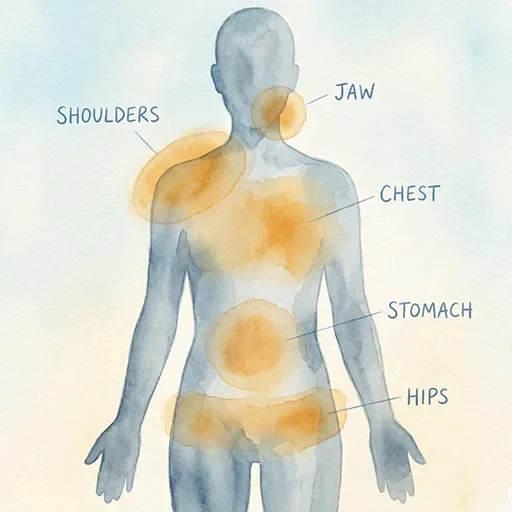
Stress commonly gets stored in the shoulders, jaw, chest, stomach, and hips — often without your conscious awareness.
When you experience stress or threat, your autonomic nervous system launches the fight-or-flight response: muscles tighten, heart rate increases, and stress hormones flood your system. This is healthy and protective in the short term.
The problem arises when stress becomes chronic or when traumatic experiences aren't fully processed. Research shows that prolonged nervous system activation can lead to lasting changes in muscle tension patterns, breathing habits, and posture. You might carry tightness in your jaw without realizing it, or hold shallow breath as a default — your body essentially gets "stuck" in a protective mode.
This is what somatic practitioners mean when they say the body "stores" stress. It's not metaphorical — it's physiological. Chronic muscle guarding, altered vagal tone, and dysregulated stress hormones are measurable consequences of unresolved tension. And they keep feeding the anxiety loop: your tight body signals to your brain that something is still wrong, which keeps you on high alert.
The Window of Tolerance: Why Somatic Work Matters
One of the most useful concepts in somatic work is the window of tolerance, a term coined by psychiatrist Dr. Dan Siegel. Your window of tolerance is the zone in which you can experience stress or difficult emotions without becoming overwhelmed or shutting down.
When you're inside your window, you can think clearly, feel your feelings, and respond (rather than react). When anxiety pushes you outside that window, you tip into either hyperarousal (panic, racing heart, hypervigilance) or hypoarousal (numbness, dissociation, shutdown).
Somatic exercises help expand your window of tolerance over time. By gently practicing awareness of physical sensations — and learning that your body can move between activation and calm safely — you train your nervous system to handle more without flipping into survival mode. A growing body of evidence suggests that body-based interventions can meaningfully reduce anxiety symptoms and improve emotional regulation.
Somatic Exercises You Can Try at Home

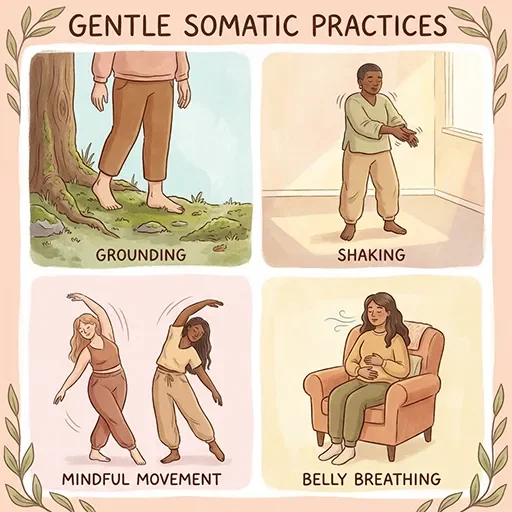
Simple somatic exercises like grounding, shaking, mindful movement, and breath work can be practiced anywhere in just 5–10 minutes.
The following exercises are gentle, beginner-friendly practices you can do on your own. They don't require any equipment, and most take just 5–10 minutes.
Body Scan with Tension Awareness
A body scan is one of the simplest somatic practices. Sit or lie down comfortably and slowly move your attention through your body from head to toe. The somatic twist: instead of trying to relax each area, just notice what's there. Is your jaw clenched? Are your shoulders lifted? Is there a heaviness in your chest?
The goal isn't to fix anything — it's to build awareness of your body's stress patterns. Over time, this awareness alone can begin to shift tension. Research on body scan meditation has found that it helps reduce both physical tension and psychological distress.
Grounding Through Feet and Hands
When anxiety pulls you into your head, grounding exercises bring you back into your body. Stand with bare feet on the floor and press down gently, noticing the texture, temperature, and pressure. Slowly shift your weight from one foot to the other.
You can do the same with your hands: press your palms firmly together for 10 seconds, then release and notice the tingling. Or press your hands flat against a wall and push gently. These simple grounding techniques activate sensory pathways that signal safety to your nervous system, helping interrupt the anxiety spiral.
Gentle Shaking and Tremoring
Inspired by Levine's observations about how animals discharge stress, Trauma Release Exercises (TRE) use gentle movements to activate the body's natural tremor response. You don't need formal TRE training to try a simplified version.
Stand with feet hip-width apart and gently bounce or shake your body — start with your hands, let it move to your arms, and allow your whole body to shake loosely for 1–2 minutes. Some people feel an emotional release during this; others simply feel more relaxed afterward. Preliminary research suggests that tremor-based exercises may help reduce muscle tension and stress markers.
Pendulation
Pendulation is a core technique in Somatic Experiencing. It involves gently shifting your attention back and forth between a place of comfort in your body and a place of tension or discomfort.
Start by noticing somewhere that feels neutral or pleasant — maybe your hands feel warm, or your feet feel grounded. Stay with that sensation for a few breaths. Then gently shift your awareness to a spot that holds tension — perhaps your tight shoulders. Stay briefly, then return to the comfortable spot. This rhythmic back-and-forth teaches your nervous system that it can approach discomfort without getting stuck there.
Slow Mindful Movement
Slow, intentional movement is one of the most accessible somatic practices. This might look like gentle stretching, slow walking, or simple yoga-inspired movements — the key is moving slowly enough to stay connected to the sensations in your body.
Try raising your arms overhead as slowly as possible, noticing every micro-sensation along the way. Or roll your neck in a slow circle, pausing wherever you find tension. Studies on mindful movement practices show significant reductions in anxiety and improvements in body awareness.
Breath-Body Connection
While breathing exercises are common in anxiety management, the somatic version focuses on feeling the breath in your body rather than controlling it. Place one hand on your chest and one on your belly. Without changing anything, notice which hand moves more. Notice the temperature of the air entering your nostrils.
Then, experiment: breathe deeply into your belly and notice what shifts. Exhale slowly and feel your muscles release. Extending the exhale activates the vagus nerve, which sends a direct calming signal to your nervous system.
Bottom-Up vs. Top-Down: How Somatic Work Complements CBT
If you've tried cognitive-behavioral approaches to anxiety, you know the power of working with your thoughts — identifying cognitive distortions, challenging unhelpful beliefs, and building new thinking patterns. This is top-down processing: using the thinking brain to influence how you feel.
Somatic exercises work from the bottom up. Instead of starting with thoughts, they start with the body and nervous system. The idea is that when your body feels safe, your mind naturally follows. You don't have to think your way out of a panic response if you can feel your way to regulation first.
Research increasingly suggests that combining top-down and bottom-up approaches may be more effective than either alone. When cognitive strategies meet body-based regulation, you're addressing anxiety from both directions. If CBT has helped you understand your anxiety but you still feel stuck in physical tension and reactivity, somatic exercises may be the missing piece.
When to Work with a Somatic Therapist
The exercises above are safe starting points for most people, but they're not a substitute for professional support — especially if you're dealing with significant trauma.
A trained somatic therapist can help you navigate intense physical and emotional responses that might surface during body-based work. They're skilled at reading subtle cues and pacing the process so you don't become overwhelmed. Consider working with a professional if you experience frequent dissociation, have a history of complex trauma, or find that body awareness exercises consistently trigger intense distress.
You can find certified Somatic Experiencing practitioners through the SE International directory and licensed somatic therapists through Psychology Today's therapist finder.
Safety Considerations
Go slowly. Body-based work can surface unexpected emotions. If you feel overwhelmed, stop the exercise and use a grounding technique — press your feet into the floor, hold something cold, or name five things you can see.
Respect your limits. If an exercise consistently brings up intense fear, anger, or dissociation, that's a signal to pause and consider professional guidance rather than pushing through.
Tremoring caution. If you try shaking or TRE-inspired exercises and feel dizzy, lightheaded, or emotionally flooded, stop and rest. These practices are meant to feel relieving, not distressing.
Not a replacement for treatment. Somatic exercises can be a powerful complement to therapy and medication, but they're not a standalone treatment for trauma disorders, severe anxiety, or PTSD. If your symptoms significantly interfere with daily life, seek professional care.
-Tim, Founder of Wellness AI
About the Author
Dr. Timothy Rubin holds a PhD in Psychology with expertise in cognitive science and AI applications in mental health. His research has been published in peer-reviewed psychology and artificial intelligence journals. Dr. Rubin founded Wellness AI to make evidence-based mental health support more accessible through technology.
Release Anxiety from Your Body
Try Wellness AI for personalized somatic-inspired meditations and therapy support designed to calm your nervous system.


FAQ: Somatic Exercises for Anxiety
What are somatic exercises for anxiety?
Somatic exercises for anxiety are body-based practices that help release stored tension and calm the nervous system. They include techniques like body scanning, grounding, gentle shaking, slow mindful movement, and breath awareness — all focused on physical sensations rather than thoughts.
Can I do somatic therapy exercises at home?
Yes. Many somatic exercises are safe and effective for home practice, including body scans, grounding through your feet, slow mindful movement, and breath-body awareness. However, if you have a history of significant trauma, working with a trained somatic therapist is recommended for deeper processing.
How do you release trauma stored in the body?
Somatic approaches use body awareness, gentle movement, and nervous system regulation techniques to help complete the body's natural stress response cycle. Practices like progressive muscle relaxation, tremoring, and pendulation can help discharge physical tension that's been held in the body.
How long does it take for somatic exercises to work?
Many people notice some immediate calming effects — even from a single 5–10 minute session. Deeper shifts in anxiety patterns and nervous system regulation typically develop over weeks of regular practice. Consistency matters more than session length.
What's the difference between somatic therapy and CBT?
CBT is a "top-down" approach that works by changing thought patterns to influence emotions and behavior. Somatic therapy is "bottom-up" — it works through the body and nervous system to influence emotional states. Many therapists now combine both approaches for more comprehensive anxiety treatment.
Is somatic experiencing the same as somatic exercises?
Not exactly. Somatic Experiencing (SE) is a specific clinical framework developed by Peter Levine for processing trauma, typically practiced with a trained therapist. Somatic exercises are a broader category of body-based practices that anyone can do. SE principles inspire many of the exercises described in this article.
Can somatic exercises help with panic attacks?
Somatic exercises — especially grounding and extended-exhale breathing — can help during the early stages of a panic attack by activating the parasympathetic nervous system. Practiced regularly, they can also help expand your window of tolerance, making panic episodes less frequent over time.
Are somatic exercises safe for everyone?
Somatic exercises are generally safe for most people. However, individuals with severe trauma, dissociative disorders, or certain neurological conditions should consult a healthcare provider or trained somatic therapist before starting body-based practices, as they can occasionally surface intense emotional responses.