Relationship Anxiety & Reassurance Loops: Understanding and Breaking the Cycle
Author: Dr. Timothy Rubin, PhD in Psychology
Originally Published: December 2025
Last Updated: December 2025

When your nervous system is searching for certainty, even a normal delay in texting can feel like a threat.
Contents
- Reassurance seeking in relationships: what it is (and what it isn’t)
- The reassurance loop (anticipation → reassurance → relief → bigger doubt)
- How to break the cycle (CBT + ACT)
- A 5-minute relationship anxiety meditation (metta)
- When to seek extra support
- Digital tools that can help
- FAQ: Relationship anxiety & reassurance loops
Do you ever feel calm the moment your partner replies… and then anxious again 20 minutes later? That emotional whiplash can be a sign of reassurance seeking in relationships—a pattern where anxiety pushes you to seek certainty (a text back, a “we’re fine,” a quick check), and your brain learns to rely on that hit of relief.
This guide explains the loop and offers a practical plan to break it using CBT, ACT, and a short relationship anxiety meditation to support felt security.
Reassurance seeking in relationships: what it is (and what it isn’t)
Reassurance exists on a spectrum. Occasional reassurance is healthy. It becomes a problem when it feels urgent, happens repeatedly, and becomes your main way to regulate anxiety.
In clinical research, reassurance seeking often shows up alongside “safety behaviors”—things we do to feel safe in the short term that can keep fear alive in the long run (Rector et al., 2019; Beesdo-Baum et al., 2012).
In romantic relationships, reassurance seeking can look like:
- Repeatedly asking “Are you mad at me?” or “Do you still love me?”
- Re-reading texts for “hidden meaning” or checking “last seen” / read receipts
- Sending follow-up messages quickly when you don’t get a response
Reassurance seeking is also closely linked to attachment anxiety—a tendency to worry about rejection or abandonment (Shaver et al., 2005).
If you want a deeper overview of anxious attachment patterns (and what helps), see relationship anxiety and anxious attachment.
The reassurance loop (anticipation → reassurance → relief → bigger doubt)
Here’s the loop many people recognize instantly:
- Anticipation: “They haven’t texted back. Something is wrong.”
- Reassurance behavior: You check, ask, re-read, or send another message.
- Short relief: Anxiety drops for a moment. Your body unclenches.
- Bigger doubt: The mind finds a new angle: “But what if they’re just being polite?”
If checking reduces anxiety, your brain learns to repeat it. Over time, uncertainty itself starts to feel intolerable—which is why “just stop overthinking” rarely works.
Psychologists call this intolerance of uncertainty—a pattern that shows up across many emotional difficulties (Boswell et al., 2013).
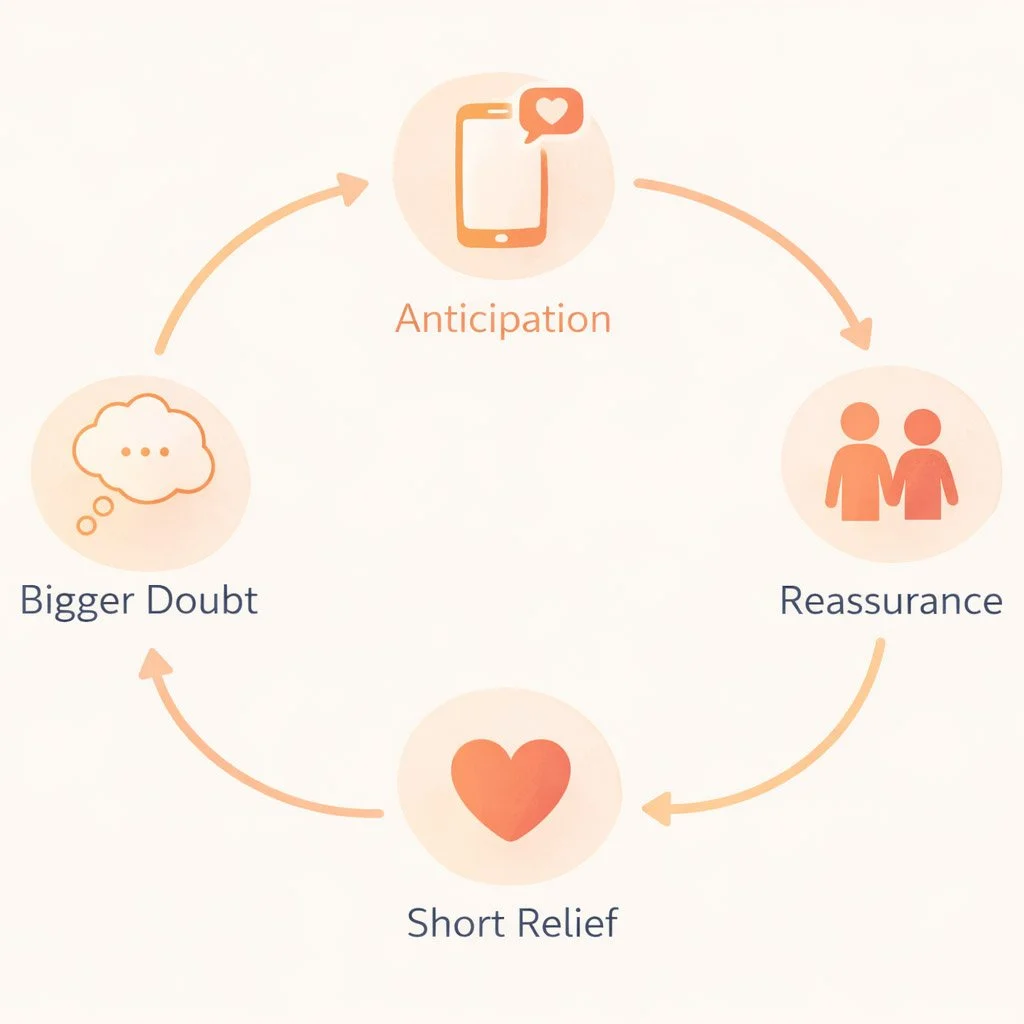
The loop is self-reinforcing: the more you use reassurance to feel okay, the more you “need” it to feel okay.
How to break the cycle (CBT + ACT)
The goal isn’t to never ask for reassurance. It’s to build felt security—the ability to stay steady even when you don’t have complete certainty right now.
CBT and ACT are evidence-based approaches for anxiety, and guidelines often recommend CBT for many anxiety conditions (NICE CG113; Kaczkurkin & Foa, 2015). The same principles can help with relationship anxiety patterns.
Step 1: Practice uncertainty tolerance (a CBT mindset shift)
If relationship anxiety had a “core fear,” it’s often: “I can’t handle not knowing.” So the practice target becomes: learning that you actually can.
Try this 60-second reset when anxiety spikes:
- Name the uncertainty: “I don’t know what they’re thinking right now.”
- Name one fact: “They said they’d be busy.”
- Choose one steady action: “I’ll wait 15 minutes and do one valued task.”
Small “wait practice” is a gentle exposure. It teaches your nervous system that discomfort rises and falls—and you don’t need to fix it immediately.
Step 2: Defuse from anxious thoughts (an ACT skill)
CBT often asks, “Is this thought accurate?” ACT adds: “Is getting tangled up in this thought helping me act like the partner I want to be?”
A simple defusion phrase is: “I’m having the thought that…” It’s a quick way to create distance from a scary story.
Research on ACT shows it can reduce anxiety and depression, and meta-analyses suggest it performs similarly to established treatments in many contexts (A-Tjak et al., 2015; Twohig & Levin, 2017).
If you want a deeper comparison between ACT-style defusion and CBT-style restructuring, see thought defusion vs. cognitive restructuring.
Mini skill: Repeat one anxious phrase out loud for 30 seconds until it starts to feel like “just words.” Studies on cognitive defusion techniques suggest this can reduce believability and distress (Masuda et al., 2009).
Step 3: Stop checking phone anxiety with a “checking plan”
If your relationship anxiety centers on texting, you’re not alone. Phones turn uncertainty into something you can measure (“last seen,” “delivered,” “read”), which makes checking feel logical—even when it’s backfiring.
A “checking plan” turns a reflex into a choice:
- Pick check-in windows: e.g., at the top of the hour, not every 2 minutes.
- Delay in tiny steps: when you feel the urge, wait 5 minutes, then 10, then 15.
- Remove accelerants: consider disabling read receipts/last-seen features if they spike anxiety.
During the delay, do three slow breaths or a quick body scan. You’re training your nervous system to ride the wave without acting on it.
Short example: Instead of “?? are you mad” after 12 minutes, try: “Hey—my brain is doing the worry thing. No rush. I’m going to take a walk and I’ll check my phone at 6.” That’s reassurance to your body, not a demand for your partner to fix the feeling.
For a deeper dive into texting-specific triggers, see why delayed texts hurt.

“Delay the check” is a skill you can train—like strengthening a muscle.
Step 4: Swap reassurance for connection bids (without flooding your partner)
This is the key pivot: instead of using reassurance to escape anxiety, use planned connection to build security.
Relationship research highlights perceived partner responsiveness—feeling understood, cared for, and valued—as a core ingredient of closeness (Canevello & Crocker, 2010; Laurenceau et al., 2005).
A connection bid is a small, specific request that aims for closeness rather than certainty. Examples:
- “Can we do a 10-minute check-in tonight after dinner?”
- “I’d love a quick goodnight text when you’re free.”
- “I miss you. Want to plan something for Saturday?”

Connection bids are small, specific invitations to connect—without turning your partner into an anxiety “thermostat.”
Reassurance seeking often asks your partner to prove you’re safe right now. Connection bids invite a shared moment, which usually feels better for both people.
A 5-minute relationship anxiety meditation (metta) for felt security
When you’re in a reassurance spiral, your body is often in a threat state. Meditation doesn’t replace communication, but it can help you shift from “alarm” to “safe enough.”
Loving-kindness (metta) practices cultivate warmth and compassion, and reviews suggest they may support emotional wellbeing and reduce distress in some contexts (Hofmann et al., 2011; Hofmann et al., 2015).
Try this 5-minute relationship anxiety meditation:
- Settle (30 seconds): One hand on your chest, one on your belly. Slow breath out.
- Offer kindness to yourself (1–2 minutes): “May I feel safe. May I be at ease. May I feel loved.”
- Offer kindness to your partner (1–2 minutes): “May you be safe. May you be at ease. May you feel loved.”
- Offer kindness to the relationship (30 seconds): “May we grow in trust. May we communicate with care.”

A little warmth toward yourself can make it easier to tolerate uncertainty without reaching for reassurance.
If metta resonates, you might like loving-kindness meditation for anxiety relief or our meditation for anxiety guide.
When to seek extra support
Relationship anxiety is common. But if it’s constant, escalating, or driving behaviors you can’t control, support can help.
Consider talking to a professional if you notice:
- Compulsive checking that’s disrupting sleep, work, or daily life
- Frequent reassurance fights, accusations, or emotional “testing”
Evidence-based therapy approaches like CBT and ACT can help with anxiety patterns (NIMH; NICE).
If you are experiencing emotional or physical abuse, prioritize safety and seek support right away (trusted people, local services, or emergency resources in your area).
Digital tools that can help
Tools like guided meditations, journaling prompts, and reminders for “checking plans” can make it easier to practice skills in the moment. If you use an app, keep the goal simple: support your practice, not replace real-world communication.
If you're specifically looking for AI therapy apps that can hold the thread of an ongoing relationship situation across sessions — rather than resetting each time you open them — see our comparison: AI therapy for relationship anxiety: which apps work best for anxious attachment, reassurance loops, and breakup recovery.
-Tim, Founder of Wellness AI
About the Author
Dr. Timothy Rubin holds a PhD in Psychology with expertise in cognitive science and AI applications in mental health. His research has been published in peer-reviewed psychology and artificial intelligence journals. Dr. Rubin founded Wellness AI to make evidence-based mental health support more accessible through technology.
Try Personalized Support for Relationship Anxiety
Explore evidence-based CBT/ACT tools and calming guided meditations you can use during reassurance spirals and texting triggers.


FAQ: Relationship anxiety & reassurance loops
What is reassurance seeking in relationships?
It’s the urge to repeatedly ask for certainty (“Are we okay?”) or check for proof (texts, read receipts) to relieve anxiety. Occasional reassurance is normal; the issue is when it becomes compulsive.
Is reassurance seeking always unhealthy?
No—reassurance can be part of healthy attachment. It becomes unhelpful when you need it urgently and often, and it’s the only way you can calm down.
How do I stop checking phone anxiety?
Use a “checking plan”: set specific check-in windows and practice delaying urges in small steps. Pair the delay with slow breathing or a brief body scan.
How do I ask for reassurance without starting a reassurance loop?
Try a connection bid: ask for a small, specific moment of closeness instead of repeated certainty questions. Over time, aim to reduce the frequency as your tolerance for uncertainty grows.
Does meditation help with relationship anxiety?
It can help you regulate your nervous system so you respond more thoughtfully instead of reacting on impulse. Loving-kindness (metta) practices are especially oriented toward warmth, safety, and connection.
When should I seek therapy for relationship anxiety?
If anxiety is persistent, disrupting daily life, or fueling compulsive checking and repeated conflict, therapy can help. If there is abuse or you feel unsafe, prioritize safety and seek support immediately.