Author: Dr. Timothy Rubin, PhD in Psychology
Originally Published: May 2026
Last Updated: May 2026
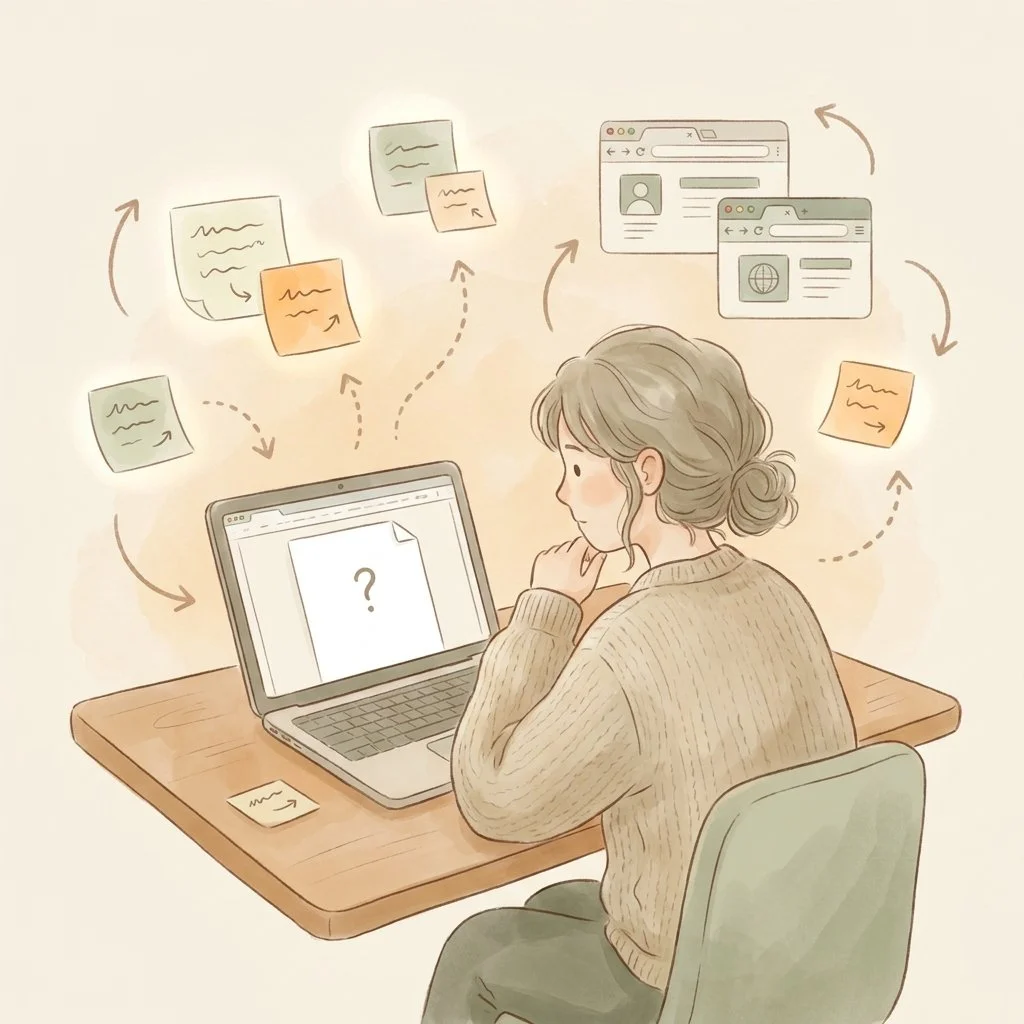
Analysis paralysis happens when more thinking leads to less deciding — and it has clear psychological mechanisms behind it.
Contents
- What Is Analysis Paralysis?
- Why Your Brain Gets Stuck
- The Hidden Cost of Not Deciding
- Five Ways to Get Unstuck
- When Analysis Paralysis Is Part of Something Bigger
- Key Takeaways
- About the Author
- Frequently Asked Questions
You're standing in the cereal aisle. There are 47 boxes. You've been there for ten minutes, and you feel a little ridiculous about being stuck on a decision that doesn't matter at all.
Or maybe it's the email you've been drafting for an hour, the project you keep "researching" instead of starting, or the job offer you've reread so many times the words have lost meaning. Whatever the scene, the feeling is the same: your brain is doing more thinking, and you are getting less decided.
This is analysis paralysis. It's common, it has clear psychological mechanisms, and there are evidence-based ways out.
What Is Analysis Paralysis?
Analysis paralysis is a type of overthinking in which you get so absorbed in weighing your options that you can't actually make a decision — even when the stakes are small. It's not a formal psychiatric diagnosis. It's a recognizable pattern that shows up across anxiety, depression, perfectionism, and ADHD, and most people experience some version of it from time to time.
It usually comes in two flavors. High-stakes paralysis is the job offer, the breakup, the cross-country move. Low-stakes paralysis is the lunch order, the email phrasing, the Netflix queue. The stakes look different, but the underlying mechanics are surprisingly similar.
Why Your Brain Gets Stuck
Analysis paralysis isn't one thing. It's usually a tangle of four overlapping drivers, and most people get stuck because more than one is active at once.
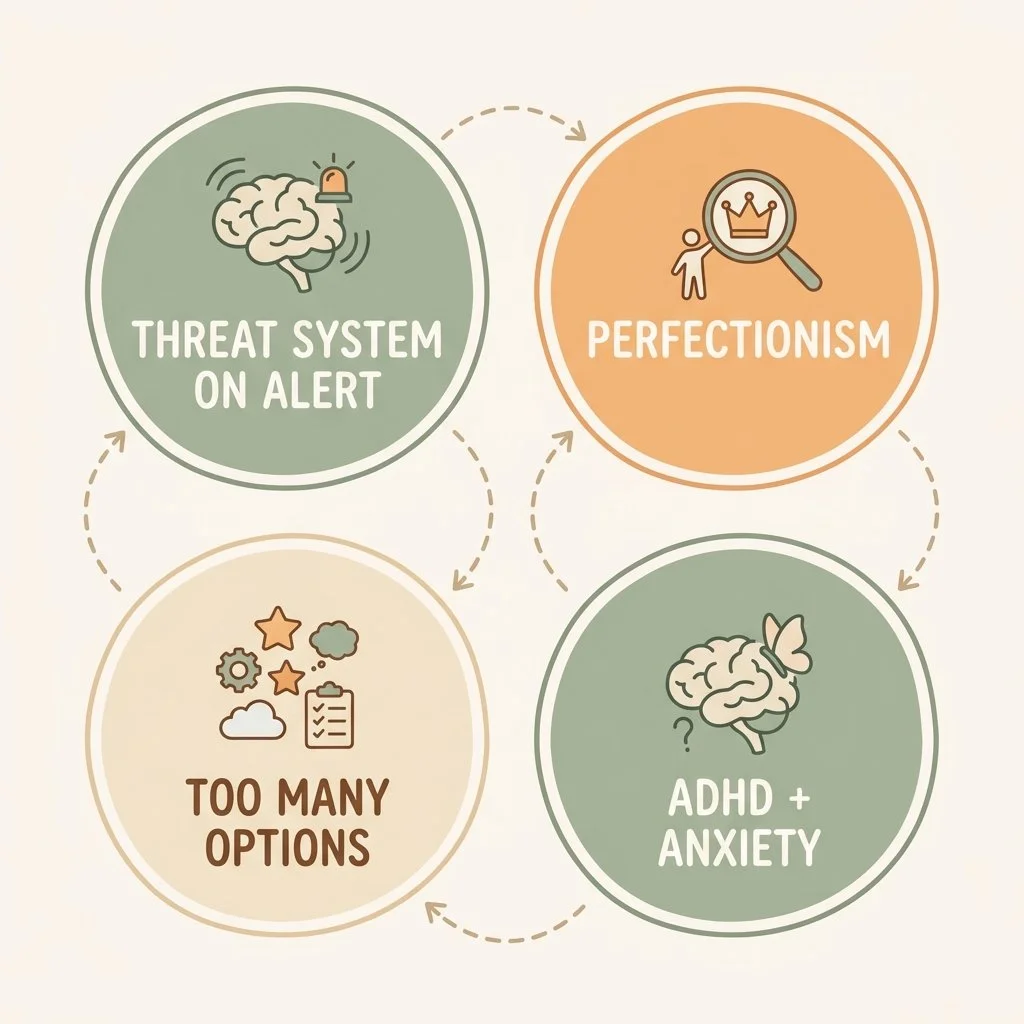
Four overlapping drivers of analysis paralysis. Most people get stuck because more than one is active at the same time.
Your threat system is on alert
When you're anxious, your brain inflates the perceived cost of being wrong. Every option starts to look like it might be the catastrophic one. This is your threat-detection system doing its job — just a little too well.
People who score high on what researchers call intolerance of uncertainty tend to react to ambiguity the way other people react to actual threats. A recent experience-sampling study tracked people through their everyday decisions and found that those high in intolerance of uncertainty struggled more with day-to-day indecisiveness and leaned harder on "safety behaviors" like over-researching, list-making, and reassurance-seeking.
Those behaviors feel productive in the moment, but they tend to deepen the stuck-ness over time. This is also the cognitive engine behind what we've called high-functioning anxiety — the version of anxiety that hides behind preparation, planning, and "just one more check."
Perfectionism and the fear of the wrong choice
Underneath a lot of analysis paralysis is a quiet belief: there is a right answer, and any other choice is failure.
A large review of perfectionism research covering hundreds of studies found that one specific flavor of perfectionism — concern over mistakes and doubts about your actions — is consistently linked to anxiety, depression, and OCD symptoms. It's not having high standards that fuels decision paralysis. It's the fear of getting it wrong.
This pattern often shows up as endless research, asking everyone for their opinion, or starting and abandoning the same decision over and over. The goal isn't really to choose well — it's to feel certain enough that choosing won't hurt.
Too many options, too little working memory
Your brain can only juggle a handful of things at once. The more options you stack on top of each other, the worse decisions tend to get.
This is sometimes called "choice overload." In a now-famous field study, shoppers offered 24 jam samples at a grocery store were less likely to actually buy a jar than shoppers offered just 6. Later research has shown the effect is real but conditional: too many options paralyze you most when the choices are hard to compare, your preferences are fuzzy, or you're trying to find the best option rather than a good one.
The related idea of "decision fatigue" — the notion that we run out of decision-making fuel as the day goes on — is intuitively familiar, though the laboratory evidence has been mixed. Either way, you probably don't need a study to tell you that picking a restaurant at 9 p.m. after a hard day feels weirdly impossible.
Analysis paralysis: ADHD vs anxiety
A lot of people who experience chronic analysis paralysis ask the same question: Is this anxiety, or is this ADHD? It's a fair question, because the two often coexist and can look almost identical from the outside.
In the largest U.S. survey of adult ADHD, nearly half of adults with ADHD also met criteria for a current anxiety disorder — about four times the rate seen in adults without ADHD. So if you're wondering whether you have one or the other, the honest answer for many people is both.
The underlying mechanisms are different. Anxiety-driven paralysis is usually about the fear of the wrong outcome — your brain magnifies risk and demands more certainty before it lets you move. ADHD-driven paralysis tends to be more about executive function and reward sensitivity: holding the options in working memory is exhausting, and ADHD brains are especially averse to delay, which can make the "do nothing" path feel oddly compelling even when it's clearly the worst option.
The two can also feed each other — ADHD makes decisions harder, and the experience of repeatedly stalling out makes you more anxious about deciding. Telling them apart matters less than recognizing what's happening. The strategies in the next section help with both.
The Hidden Cost of Not Deciding
It's tempting to treat indecision as a kind of pause — a holding pattern while you figure things out. But staying stuck is not free.
Research on rumination — the cousin of analysis paralysis — has found that passively dwelling on a problem actually makes mood worse, impairs problem-solving, and predicts future depression and anxiety. Open loops drain you. The longer a decision stays open, the more energy it consumes, and the harder it gets to close.
This is especially true at work, where analysis paralysis can quietly metastasize into procrastination on tasks you actually care about — the email you can't draft, the proposal you keep rewriting, the choice between two project directions you keep postponing. The decision is small. The cost of not deciding is enormous.
It's also worth saying out loud: not deciding is itself a decision. When you don't choose, the default wins by attrition — the job stays the same, the relationship drifts, the Saturday slips by. The way out starts with recognizing that you're already choosing, just on autopilot, and that you can choose more deliberately. This is closely related to waiting mode: the state where you can't start anything because something else feels unresolved.
Five Ways to Get Unstuck
There's no single trick that breaks analysis paralysis, but the five moves below consistently help. You don't need all of them — most people find one or two that resonate.
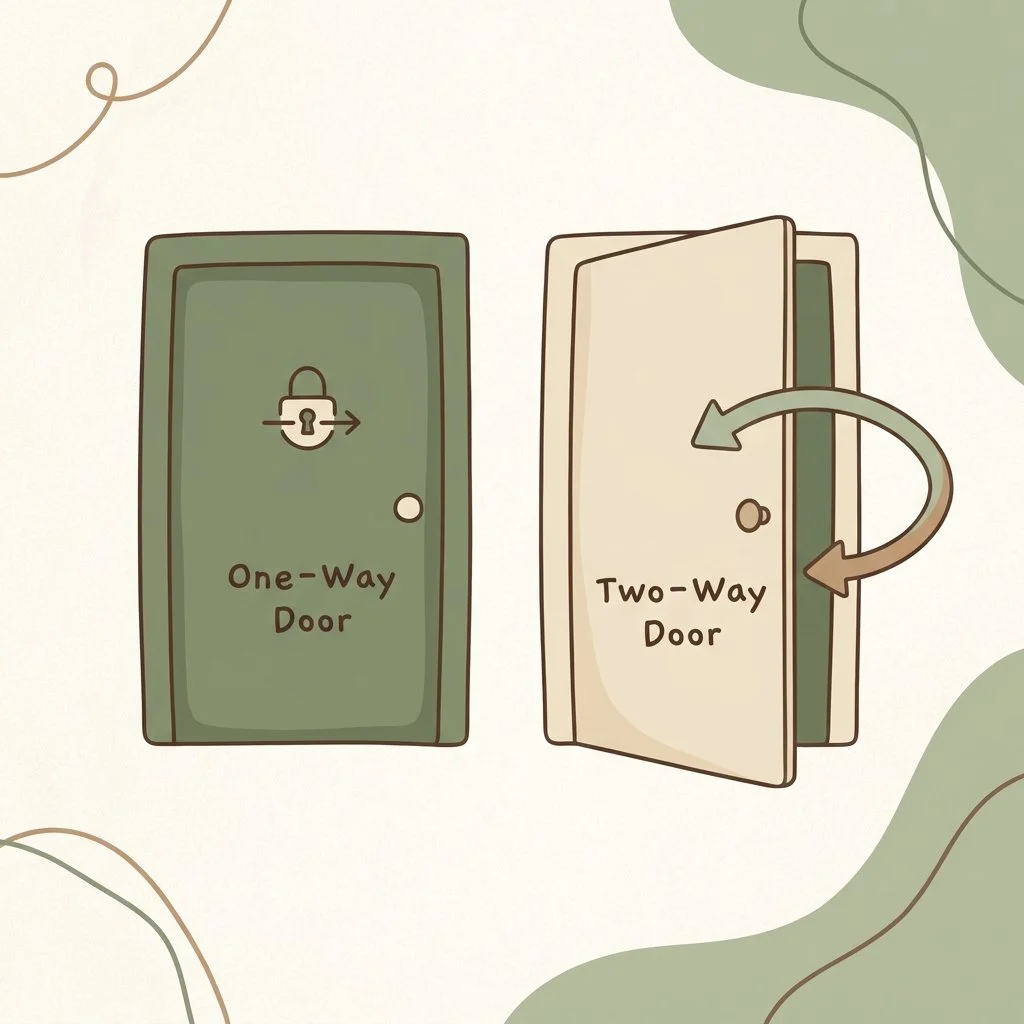
Most decisions are "two-way doors" you can walk back through. Save your deliberation for the ones you can't.
1. Sort by reversibility, not by stakes
Amazon's Jeff Bezos famously distinguishes between two kinds of decisions: "one-way doors" that are irreversible, and "two-way doors" you can walk back through. The mistake most of us make is treating two-way-door decisions like one-way-door decisions — agonizing over a restaurant choice as if we can't simply leave and go somewhere else next time.
Before deliberating, ask: if this turns out badly, can I undo it? If yes, set a tight time limit and just pick. Save your deliberation budget for the genuinely irreversible decisions.
2. Set a time box and a "good enough" threshold
Nobel laureate Herbert Simon coined the term satisficing — choosing the first option that's good enough rather than chasing the absolute best. He argued that satisficing isn't laziness; it's how minds with finite resources are actually designed to work.
This matters because research on "maximizers" — people who try to find the optimal option every time — finds they tend to be less happy than satisficers, even when they objectively make better choices. They land the higher-paying job and feel worse about it. They pick the better restaurant and second-guess it all night.
Two practical moves: set a deadline ("I'll decide by 6 p.m."), and decide in advance what threshold counts as good enough. "Any option that has these three features wins." When something clears the bar, pick it and stop.
3. The 10/10/10 reality check
Borrowed from author Suzy Welch: ask yourself, how will I feel about this decision in 10 minutes, 10 months, and 10 years?
Most decisions that feel enormous at the 10-minute mark are unrecognizable at the 10-month mark and irrelevant at the 10-year mark. The point isn't to diminish what you feel right now — it's to right-size the stakes so your anxiety system stops reacting as if everything is permanent.
4. Defuse from the "but what if" loop
When you're stuck in but what if I pick wrong, but what if they react badly, but what if it's the wrong move, you're not really evaluating options anymore. You're caught in a thought loop, and trying to argue your way out of it tends to make it stickier.
A technique from Acceptance and Commitment Therapy called cognitive defusion can help. Instead of "I'll regret this," try "I'm having the thought that I'll regret this." That tiny linguistic shift creates a little space between you and the thought — enough space, often, to act.
A meta-analysis of laboratory studies on ACT components found that brief defusion exercises reliably reduce how believable and distressing repetitive negative thoughts feel. You don't need to believe the thought is wrong. You just need to stop treating it as fact.
5. Let your values break the tie
When two options look equally rational, your brain will spin forever trying to figure out which is "better." It's often not — they're just different. In that case, ask: which option moves me toward the kind of person I want to be?
This sounds soft, but it's surprisingly fast. Values are stable in a way that pros-and-cons lists aren't. If two job offers look equivalent on paper but one is closer to the kind of work that matters to you, that's your answer.
When Analysis Paralysis Is Part of Something Bigger
Most of the time, analysis paralysis is a normal brain doing what brains do under pressure. Sometimes, though, it's a symptom of something that deserves more support.
Persistent indecisiveness is listed as a feature of major depression. It's also closely tied to generalized anxiety disorder, OCD — where the doubt-generating engine can make even small choices feel impossibly weighty — and ADHD.
If decision paralysis is showing up across multiple areas of your life, lasting for weeks, and meaningfully interfering with work or relationships, talking to a therapist can help. Evidence-based therapies can specifically target the intrusive "what if" thoughts and intolerance of uncertainty that fuel chronic stuck-ness. Reaching out for support is itself a decision worth practicing.
Key Takeaways
Before the FAQ, here are the essential points to remember:
✓ Analysis paralysis is overthinking that prevents action — a common pattern, not a personal failing, and not a formal diagnosis on its own
✓ Four overlapping drivers usually fuel it: a threat system on alert, perfectionism, cognitive overload from too many options, and for many people an ADHD-anxiety overlap
✓ Staying stuck is not free — open decisions drain energy, worsen mood, and quietly become the choice you didn't mean to make
✓ The fastest ways out are sorting by reversibility, setting a "good enough" threshold, using the 10/10/10 lens, defusing from "but what if" loops, and letting your values break ties
✓ If indecision is persistent and interfering, it may be a symptom of something deeper — and there are evidence-based therapies that help
Most decisions don't deserve the weight your anxious brain assigns them. The cost of "good enough" is almost always lower than the cost of staying stuck.
-Tim, Founder of Wellness AI
About the Author
Dr. Timothy Rubin holds a PhD in Psychology with expertise in cognitive science and AI applications in mental health. His research has been published in peer-reviewed psychology and artificial intelligence journals. Dr. Rubin founded Wellness AI to make evidence-based mental health support more accessible through technology.
Get Unstuck on the Decisions That Matter
Try Wellness AI for evidence-based support when overthinking won't let you choose.


Frequently Asked Questions
What is analysis paralysis?
Analysis paralysis is a pattern of overthinking that prevents you from making a decision. You weigh options, gather more information, and consider every angle — but never actually choose. It's not a formal psychiatric diagnosis, but it commonly shows up alongside anxiety, perfectionism, ADHD, and depression.
Is analysis paralysis a sign of anxiety?
It often is. Anxiety inflates the perceived cost of being wrong, which makes every option feel risky. People with high intolerance of uncertainty — a key feature of generalized anxiety — are especially prone to decision paralysis. It can also stem from perfectionism, ADHD, depression, or simply too many options at once.
How is analysis paralysis different in ADHD vs anxiety?
Anxiety-driven paralysis is usually about fear of the wrong outcome — your brain magnifies risk and demands more certainty. ADHD-driven paralysis is more about executive function: holding options in working memory is exhausting, and ADHD brains are especially averse to delay. The two often coexist, and the practical strategies for breaking the loop are similar for both.
How do I stop analysis paralysis in the moment?
First, ask whether the decision is reversible — if yes, set a 5-minute timer and just pick. Second, decide in advance what "good enough" looks like and pick the first option that clears the bar. Third, if you're caught in a "but what if" loop, try naming the thought ("I'm having the thought that I'll regret this") to create some distance from it.
Is decision fatigue a real thing?
Most people recognize the experience of running low on decision-making energy by the end of a hard day. The original laboratory model behind "decision fatigue" has had mixed results in larger replication studies, so the precise mechanism is still debated. Either way, batching small decisions earlier in the day is a low-cost strategy that helps.
What's the difference between analysis paralysis and procrastination?
Procrastination is delaying a task you've already decided to do. Analysis paralysis is being unable to make the decision in the first place. They often co-occur — chronic indecision becomes its own form of procrastination — but the cognitive bottleneck is different.
When should I see a therapist about indecision?
It's worth talking to a mental health professional if indecision is showing up across many areas of your life, lasting for weeks, and meaningfully interfering with your work, relationships, or wellbeing. Persistent indecisiveness can be a feature of depression, generalized anxiety, OCD, or ADHD — all of which respond well to evidence-based therapy.