Rejection Sensitivity in Adults: What RSD Really Means and How to Cope
Author: Dr. Timothy Rubin, PhD in Psychology
Originally Published: February 2026
Last Updated: February 2026
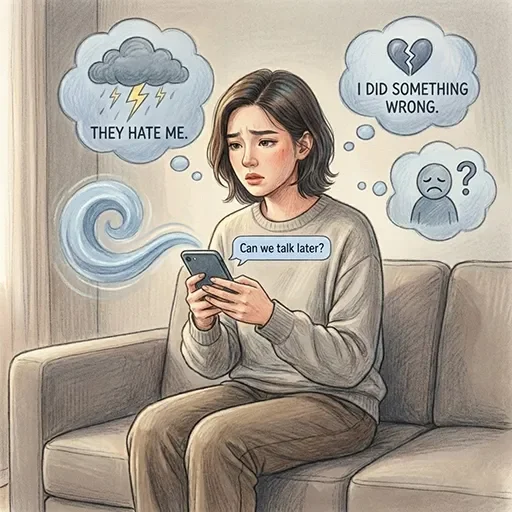
When you have high rejection sensitivity, a simple delayed text can trigger an avalanche of worst-case interpretations.
Contents
- What Is Rejection Sensitivity?
- Is "RSD" Actually Real?
- The ADHD Connection
- Why Rejection Hurts: The Brain Science
- Signs of High Rejection Sensitivity
- RSD vs. Anxious Attachment
- Evidence-Based Coping Strategies
- When to Seek Help
- FAQ: Rejection Sensitivity
You send a text to a friend and they don't reply for hours. A coworker gives you neutral feedback on a project. Your partner seems distracted during dinner. For most people, these moments pass without much thought.
But if you have high rejection sensitivity, your brain sounds an alarm—they hate me, I did something wrong, this relationship is over.
If this sounds familiar, you're not alone. And the pain you feel isn't weakness or overreaction—neuroscience research shows rejection activates the same brain regions as physical pain.
You may have heard the term "rejection sensitivity dysphoria" (RSD) on social media or in ADHD communities. While this term has helped many people feel validated, there's often confusion about what's clinically proven versus what's been coined more recently.
This guide separates what research actually shows from popular terminology—and offers practical coping strategies that work.
What Is Rejection Sensitivity?
Rejection sensitivity is a well-researched psychological concept that psychologist Geraldine Downey at Columbia University defined in 1996. It describes a tendency to anxiously expect rejection, perceive it in ambiguous situations, and react intensely when it seems to occur.
Think of it as having a very sensitive rejection radar. Where others might see a friend's delayed text as "they're probably busy," someone with high rejection sensitivity immediately jumps to "they're upset with me."
Research identifies three connected components: anxious expectation that others will reject you, heightened perception of rejection cues even when ambiguous, and intense emotional reactions when rejection is perceived.
Some rejection sensitivity is actually healthy—it helped our ancestors stay connected to social groups for survival. Problems arise when this detection system becomes overactive, creating self-fulfilling prophecies where fear-driven behavior actually pushes people away.
Is "RSD" Actually Real?
Here's where things get nuanced. Rejection sensitivity has nearly 30 years of peer-reviewed research. Rejection sensitivity dysphoria (RSD), however, isn't recognized in the DSM-5 or other diagnostic manuals.
The term "RSD" was coined by psychiatrist Dr. William Dodson in 2016, describing extreme emotional pain triggered by perceived rejection. The concept spread rapidly through ADHD communities, where many adults found it perfectly described their experiences.
So is RSD "real"? The experience it describes is absolutely real. The suffering is genuine. But RSD hasn't undergone the same scientific validation as rejection sensitivity.
CHADD, the leading ADHD organization, discusses emotional dysregulation and rejection while noting RSD isn't a formal diagnosis.
Why does this matter? Because rejection sensitivity appears across many conditions—not just ADHD. Assuming your reactions are "just RSD" might mean missing other treatable conditions like social anxiety or depression.
The ADHD Connection
While "RSD" isn't a formal diagnosis, substantial research links ADHD to heightened rejection sensitivity. Studies consistently show youth and adults with ADHD report higher rejection sensitivity than those without.
Why ADHD Brains May Be More Vulnerable
Neurological differences: The same brain circuits involved in ADHD affect emotion regulation. Difficulty inhibiting impulses extends to emotional impulses too.
Accumulated rejection: Research shows a bidirectional relationship—ADHD symptoms predict peer rejection, and peer rejection predicts worsening symptoms. Years of being told you're "too much" or "not trying hard enough" leave marks.
If you have ADHD and experience intense rejection sensitivity, you're not imagining it. For ADHD-specific strategies, see our guide on mindfulness for adult ADHD.
Why Rejection Hurts: The Brain Science
If rejection feels like physical pain, that's because your brain processes it similarly. Neuroimaging research shows social exclusion activates the same brain regions—the anterior cingulate cortex and anterior insula—that process physical pain.
This makes evolutionary sense. Social connection was essential for survival, so our brains borrowed existing pain circuitry to signal threats to our bonds.
People with high rejection sensitivity show less prefrontal activity during rejection—the brain region that normally helps regulate emotional responses. It's not a character flaw; it's a neurological pattern that can be addressed with practice.
Signs of High Rejection Sensitivity
Cognitive Patterns
- Catastrophizing: Neutral feedback becomes "I'm going to get fired"
- Mind-reading: Assuming others think negatively about you
- Personalizing: Experiencing constructive criticism as character attacks
Emotional Reactions
- Sudden, intense waves of shame, hurt, or anger
- Reactions that feel disproportionate to the situation
- Difficulty shaking rejection feelings for hours or days
Behavioral Patterns
- Avoidance: Declining opportunities to prevent possible rejection
- People-pleasing: Excessive accommodation at your own expense
- Preemptive rejection: Pushing people away first or sabotaging relationships
For strategies on managing people-pleasing, see our guide on setting healthy boundaries.
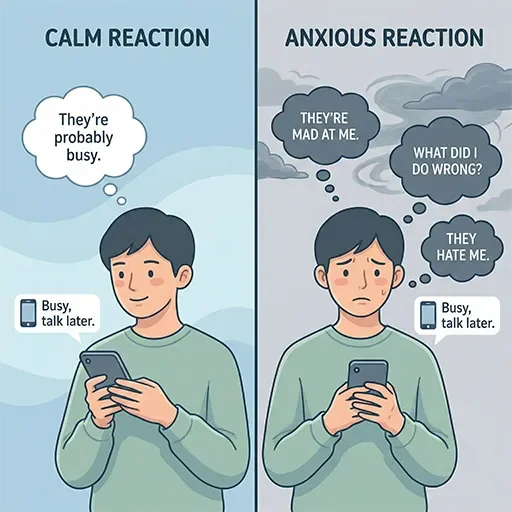
The same situation can be interpreted very differently depending on your rejection sensitivity level.
RSD vs. Anxious Attachment
If you've read about relationship anxiety and anxious attachment, you might notice similarities. Both involve fear of abandonment. But they're distinct concepts.
Anxious attachment is a global pattern affecting how you relate to close relationships, developed through early caregiver experiences.
Rejection sensitivity is more situation-specific and can develop from any repeated rejection—parental, peer, romantic, or social.
Research shows rejection sensitivity predicts outcomes beyond attachment measures alone. You can have secure attachment overall while showing elevated rejection sensitivity in specific contexts, like work criticism.
For more on related patterns, see our guide on text anxiety and anxious attachment.
Evidence-Based Coping Strategies
Cognitive Behavioral Techniques
CBT provides strong evidence for addressing rejection sensitivity by challenging cognitive distortions.
Identify thought patterns: What automatic thoughts arise when you feel rejected? Common distortions include catastrophizing, fortune-telling, and all-or-nothing thinking.
Challenge interpretations: What evidence supports this thought? What contradicts it? What would you tell a friend having this thought?
Run behavioral experiments: Test catastrophic predictions. Send that email you think is "too much" and track what actually happens. Often, feared rejection doesn't materialize.
For a deeper dive, see our guide on cognitive restructuring.
Acceptance and Commitment Therapy (ACT)
ACT offers a complementary approach when rejection thoughts are sticky and hard to challenge.
Cognitive defusion: Instead of arguing with "they think I'm worthless," observe it with distance: "I notice I'm having the thought that they think I'm worthless." This reduces the thought's power without requiring you to disprove it.
Values-based action: Identify what matters—connection, authenticity, growth—and commit to those values even when rejection fear shows up.
For more techniques, see our ACT for anxiety guide or explore defusion vs. restructuring.
Self-Compassion and Mindfulness
Self-compassion can protect against rejection sensitivity's effects. Unlike self-esteem, it provides stability regardless of others' responses.
Try this: When rejection sensitivity flares, place your hand on your heart and say, "This is a moment of suffering. Everyone fears rejection sometimes. May I be kind to myself."
Mindfulness—particularly nonjudging awareness—buffers against rejection sensitivity. It interrupts the self-critical judgments that amplify rejection pain.
For grounding practices, explore our guide on grounding techniques for panic and anxiety.
When to Seek Help
Professional support is worth considering when:
- Rejection sensitivity significantly impairs your functioning—you're avoiding meaningful opportunities, relationships, or career growth
- You experience panic symptoms (racing heart, difficulty breathing) in response to perceived rejection
- Self-help strategies aren't improving things after consistent effort
A therapist can help determine whether rejection sensitivity is the primary issue or a symptom of underlying conditions like ADHD, depression, or social anxiety that need targeted treatment.
Remember: seeking help isn't a sign that you've failed—it's a sign that you're taking your wellbeing seriously.
-Tim, Founder of Wellness AI
About the Author
Dr. Timothy Rubin holds a PhD in Psychology with expertise in cognitive science and AI applications in mental health. His research has been published in peer-reviewed psychology and artificial intelligence journals. Dr. Rubin founded Wellness AI to make evidence-based mental health support more accessible through technology.
Get Personalized Support for Emotional Wellbeing
Explore evidence-based CBT and ACT tools alongside calming guided meditations to help manage rejection sensitivity and build emotional resilience.


FAQ: Rejection Sensitivity
What is rejection sensitivity dysphoria (RSD)?
RSD describes intense emotional pain triggered by perceived rejection. While popular in ADHD communities, it's not a formal DSM-5 diagnosis—though the underlying experience is real and well-documented.
Is RSD only an ADHD thing?
No. Rejection sensitivity appears across many conditions including social anxiety, depression, and borderline personality traits. It's transdiagnostic—cutting across diagnostic categories.
Why does rejection hurt so much physically?
Brain imaging shows social rejection activates the same neural regions that process physical pain. Our brains evolved to treat social disconnection as a survival threat.
Can rejection sensitivity be treated?
Yes. CBT helps challenge distorted interpretations, ACT teaches you to observe rejection thoughts without being controlled by them, and self-compassion provides emotional stability.
What's the difference between rejection sensitivity and anxious attachment?
Anxious attachment is a global relationship pattern from early caregiver experiences. Rejection sensitivity is more situation-specific and can develop from any repeated rejection.
When should I seek professional help?
Consider support if rejection sensitivity significantly impairs functioning, causes panic symptoms, or doesn't improve with self-help. A therapist can identify underlying conditions that need treatment.