Overthinking After Texting: Why You Spiral and How to Stop
Author: Dr. Timothy Rubin, PhD in Psychology
Originally Published: June 2026
Last Updated: June 2026
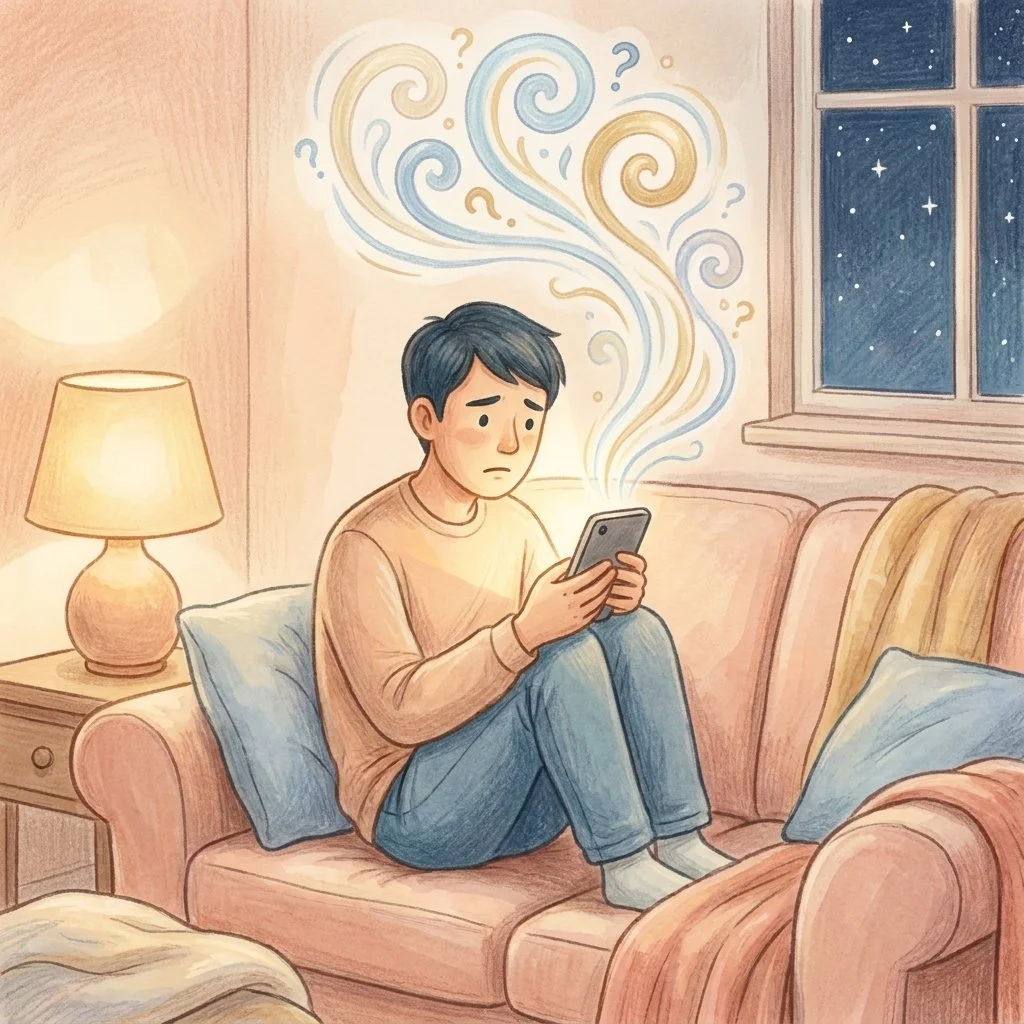
That moment right after you send a text - when the waiting begins - is when the spiral tends to start.
Contents
- The Spiral You Already Know Too Well
- Why Texting Hijacks an Anxious Brain
- The Attachment Lens: Why Silence Can Feel Like Danger
- Why Checking and Double-Texting Backfire
- Tools That Actually Help
- A 3-Minute "I Just Sent It - Now What?" Practice
- When It's Worth Deeper Work
- Frequently Asked Questions
You hit send. And then it starts.
You re-read what you wrote. You check whether it says Delivered. You watch for Read. You open the thread again to make sure the message actually went through. Three minutes pass with no reply, and your mind quietly fills in the silence with a story - usually the worst one. They're annoyed. I said too much. I shouldn't have texted first.
If that sounds painfully familiar, you're not broken and you're not "too much." Overthinking after texting is one of the most common forms of everyday anxiety, and it has surprisingly clear roots in how the brain handles closeness, uncertainty, and ambiguity. In this article we'll unpack why sending a text can hijack an anxious mind - and walk through practical, research-backed tools to calm the spiral when it starts.
The Spiral You Already Know Too Well
The "overthinking after texting" loop tends to follow a predictable script. First comes the re-reading: scanning your sent message for anything that could be taken the wrong way. Then the monitoring: refreshing the chat, watching the status change from Delivered to Read, checking when they were "last active."
Then the drafting and deleting. You type a follow-up, second-guess it, and erase it. Maybe you send it anyway. Maybe you send three.
And underneath all of it is the catastrophizing - the leap from "they haven't replied" to "they're pulling away." The silence becomes evidence, and your mind builds an entire case out of nothing but a pause. Recognizing this as a pattern, rather than a series of rational reactions to real danger, is the first step toward loosening its grip.
Why Texting Hijacks an Anxious Brain
Texting is, in many ways, the perfect storm for an anxious mind. It combines three ingredients that worry feeds on: ambiguity, delay, and the total absence of tone of voice or body language. Take away those cues, and your brain is left to guess - and an anxious brain rarely guesses kindly.
Your text loses its tone the moment you send it
Here's something most of us get wrong. When you write a message, you can "hear" the warmth or the joke or the gentle tone you intended - so you assume the other person hears it too. But researchers have found that we consistently overestimate how well our tone comes across in writing. What feels obviously light-hearted to you can land as flat, cold, or ambiguous to the person reading it - and you have no way of knowing which.
That gap matters, because when a message is open to interpretation, the reading isn't neutral. Studies of digital communication suggest that when signals are ambiguous, people tend to lean toward the more negative interpretation. So the same uncertainty that makes you anxious about their reply may also be shaping how they read what you sent.
Silence isn't blank - your brain treats it as a message
A delayed reply feels like information. And in a sense, it is - research on online communication describes how unexpected pauses and silences carry social meaning, the same way a long hesitation would in a face-to-face conversation. The problem is that silence is a blank screen your fears get to project onto.
There's no tone, no expression, no "give me a sec, I'm driving" - just absence, which an anxious mind reads as the answer to a question it never actually got answered.
The Attachment Lens: Why Silence Can Feel Like Danger
To understand why a non-reply can feel genuinely threatening - not just annoying - it helps to look at attachment. In adulthood, our close relationships activate the same emotional system that once kept us connected to caregivers as children. For people with a more anxious attachment style, that system is especially sensitive to any sign of distance.
When you send a text, you've essentially made a small bid for connection. If your attachment system runs anxious, a delay in response can register as a threat, switching on what psychologists call hyperactivation - a state of heightened vigilance for signs of rejection or abandonment. That's the re-reading, the status-checking, the scanning for hidden meaning. It isn't a character flaw; it's an old protective system doing exactly what it evolved to do. (We go deeper into this in our guide to text anxiety and anxious attachment.)
Protest behavior: the urge to do something
That same activated system also pushes you to re-establish closeness - fast. Attachment researchers call the result "protest behavior": the surge of attempts to regain contact and reassurance when a connection feels uncertain.
Double-texting, sending a "?", checking when they were last online, or firing off a "never mind, ignore that" are all versions of the same impulse - your nervous system trying to close a gap that suddenly feels dangerous.
When not-knowing feels unbearable
There's one more piece: how much discomfort uncertainty itself creates. Some of us have a low tolerance for not-knowing, and psychologists have found that difficulty sitting with uncertainty is a powerful driver of worry.
An unanswered text is a near-perfect uncertainty trap - you don't know what the silence means, and for a brain that finds ambiguity intolerable, "I don't know" is the most uncomfortable answer of all. So your mind does something that feels like solving the problem but isn't: it manufactures a worst-case story just to make the not-knowing stop.
Why Checking and Double-Texting Backfire
Here's the cruel twist. The very things you do to feel better - checking the chat, re-reading, sending a follow-up, asking "are we okay?" - work for about ninety seconds. Then the relief fades and the urge comes back, often stronger.
Psychologists call these "safety behaviors," and they share a frustrating feature: they provide short-term relief while quietly keeping the anxiety alive. Every time the checking soothes you, your brain learns two things: that the situation really was dangerous, and that the checking is what saved you. So next time, the pull to check is even harder to resist.
Relief and recovery, it turns out, are not the same thing - and reassurance you have to keep re-seeking tends to feed the loop rather than close it.
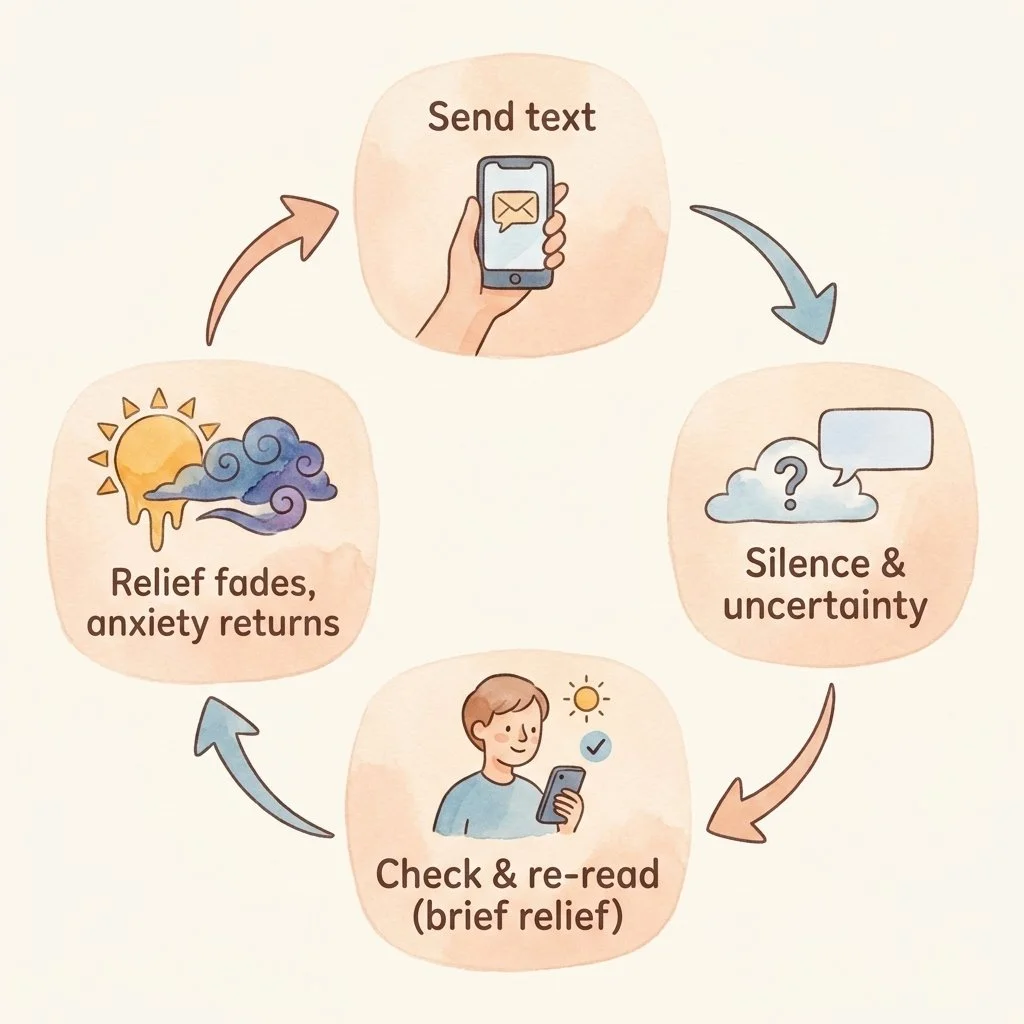
Checking brings a moment of relief - which is exactly what teaches the brain to keep checking.
Tools That Actually Help
The goal isn't to never feel the spike. It's to respond to it differently, so the loop loses its power over time. A few evidence-based moves work especially well here.
Name the thought instead of believing it
One of the most useful skills comes from Acceptance and Commitment Therapy (ACT): instead of arguing with an anxious thought, you change your relationship to it. "They're upset with me" becomes "I'm noticing the thought that they're upset with me."
This small shift - sometimes called cognitive defusion - reminds you that a thought is a mental event, not a verdict, and the National Institute of Mental Health notes that ACT-style approaches have a growing body of research behind them. You don't have to win the argument with the thought. You just have to stop treating it as a fact.
Reality-test the silence
A complementary tool from cognitive behavioral therapy (CBT) is decatastrophizing - gently questioning the worst-case story. CBT helps people notice automatic, inaccurate thoughts and examine them rather than accepting them at face value.
When the silence starts to feel like rejection, try listing three ordinary, non-catastrophic reasons for a delayed reply: they're in a meeting, their phone died, they're mid-task, or they're simply living their day. The point isn't forced positivity - it's reminding yourself that "they're mad" is one possibility among many, and rarely the likeliest one.
(If your mind tends to keep re-running the conversation long after, our piece on replaying conversations in your head goes further. For a side-by-side on these two approaches, see defusion vs. restructuring.)
Resist the urge to check (just a little longer each time)
This is the hardest one and the most powerful. Each time you let a silence sit without checking, re-reading, or double-texting - and discover that you survived it, and that the catastrophe didn't come - your brain gets a tiny, real lesson that the alarm was false.
Turning off read receipts, putting your phone in another room, or simply delaying the follow-up by ten minutes all give that lesson a chance to land. The discomfort will rise; then, if you let it, it will fall on its own.
A 3-Minute "I Just Sent It - Now What?" Practice
When you're mid-spike, you usually can't think your way calm - you have to come down through the body first. Here's a short practice for the moment right after you hit send:
- Put the phone down, face-down, just out of reach. You're not banning it - you're creating a small gap between the urge and the action.
- Breathe out slowly, longer than you breathe in. For about a minute, make each exhale a little longer than each inhale. Slow breathing is one of the most reliably calming tools for an anxious body in the moment.
- Name what's here. Silently: "I'm having the thought that they're upset. I'm feeling anxious. My body wants to check." Naming it creates distance.
- Offer one realistic alternative. "They might just be busy." You don't have to fully believe it - just hold it next to the worst-case story.
- Choose one small thing to do with your hands. Make tea, step outside, stretch. Give the wave somewhere to go besides your thumbs.
Three minutes won't erase the feeling, but it's often enough to keep you from doing the thing that feeds the loop.
When It's Worth Deeper Work
Occasional overthinking after texting is part of being human. But sometimes the pattern is bigger - when the checking eats up hours, when it strains your relationships, or when the anxiety shows up across many areas of life, not just your messages.
Persistent, distressing relationship-focused worry is recognized in the clinical literature and, importantly, it responds well to treatment. If that's you, talking to a CBT- or ACT-trained therapist is one of the most effective steps you can take.
Between sessions - or as a lower-cost starting point - many people also find structured digital tools helpful for practicing these skills in the moments they actually need them. Guided exercises, in-the-moment support, and approaches like those in our guide to using AI therapy for relationship anxiety can make the techniques easier to reach for when your phone is buzzing with silence. (Wellness AI is one such option, built around CBT- and ACT-informed support.)
The tools matter less than the practice itself: every time you meet the spiral with a slow breath instead of a double-text, you're teaching your nervous system something new.
About the Author
Dr. Timothy Rubin holds a PhD in Psychology with expertise in cognitive science and AI applications in mental health. His research has been published in peer-reviewed psychology and artificial intelligence journals. Dr. Rubin founded Wellness AI to make evidence-based mental health support more accessible through technology.
Calmer in the Moments That Spiral
Wellness AI offers CBT- and ACT-informed support and personalized meditations to help you ride out the wait without feeding the loop.


Frequently Asked Questions
Why do I overthink after texting someone?
Overthinking after texting comes from a mix of three things: the message loses its tone once it's sent, the wait creates uncertainty, and an anxious or sensitive attachment system can read silence as a sign of rejection. Your brain fills the ambiguous gap with a story - often the worst one - as a misguided way to feel more in control.
How do I stop overthinking after sending a text?
Try naming the thought instead of believing it ("I'm having the thought that they're mad"), listing a few ordinary reasons for the delay, and resisting the urge to re-check or double-text. Slowing your breathing for a minute or two also helps calm the physical spike so you can think more clearly.
Is overthinking text messages a sign of anxiety?
It can be a feature of anxiety, especially relationship anxiety or anxious attachment, but on its own it's very common and not a diagnosis. It becomes worth deeper attention when it's frequent, distressing, eats up significant time, or strains your relationships.
Why does waiting for a text back give me so much anxiety?
Waiting is a form of uncertainty, and many people find not-knowing genuinely hard to tolerate. A delayed reply offers no tone or explanation, so an anxious mind tends to fill the silence with a threatening interpretation that feels like an answer even though it's just a guess.
Should I turn off read receipts?
For many people, yes - at least temporarily. Read receipts give your mind one more thing to monitor and catastrophize about, so turning them off removes a common trigger for the checking loop.
Is double-texting actually bad?
Not inherently - sometimes a follow-up is perfectly reasonable. The issue is when double-texting is driven by anxiety rather than intention, since it tends to bring brief relief while quietly reinforcing the worry.
Does overthinking texts mean I have anxious attachment?
Not necessarily, but it's a common experience for people who lean anxious in their attachment style. Attachment patterns exist on a spectrum and can shift over time, especially with awareness and practice.
When should I talk to a therapist about this?
Consider reaching out if the overthinking is persistent, takes up hours of your day, causes real distress, or affects your relationships or daily functioning. Relationship-focused anxiety responds well to therapies like CBT and ACT, and a trained therapist can help you build these skills with personalized support.