When Your Partner Shuts Down During an Argument (and You’re Left Spiraling)
Author: Dr. Timothy Rubin, PhD in Psychology
Originally Published: September 2026
Last Updated: September 2026

When one partner withdraws mid-conflict, the other is often left activated, replaying the argument and unable to settle.
Contents
- What Stonewalling Actually Is
- Why Does My Partner Shut Down When We Argue?
- The Pursue-Withdraw Loop Neither of You Chose
- Why Being Shut Out Hurts This Much
- What Actually Helps in the Moment
- What Makes It Worse (and Why)
- When Silence Isn't Stonewalling
- When to Get Help
- FAQ: Being Stonewalled by a Partner
The door clicks shut and the apartment goes quiet. You're still standing in the kitchen with your heart going, the argument only half-finished, replaying the last thing you said.
Maybe there was no door. Maybe you got one-word answers, a turned back, or a phone picked up in the middle of a sentence. Maybe they're in the next room, the silence has lasted more than an hour, and you've written and deleted four versions of the same message.
Whatever shape it took, the pattern is the same. They've gone quiet, and you're the one left activated.
Most writing on this topic is aimed at the person who shuts down. This is for you: the one holding all the feeling, wondering what it means and what to do with the next twenty minutes.
What Stonewalling Actually Is
Stonewalling means withdrawing while a conversation is still happening. It does not mean ending the relationship or refusing to discuss the issue ever again. It means going flat and unresponsive mid-argument: no eye contact, minimal answers, a body turned away, or walking out.
The term comes from John Gottman's marital research, which grouped it with criticism, contempt and defensiveness as patterns far more common in distressed couples than in happy ones. That much is well established.
Knowing the term does not explain why it happened or tell you how to manage your own nervous system while it is happening. That is where we will focus.
Why Does My Partner Shut Down When We Argue?
It usually isn't calm indifference
Stonewalling can look cold from the outside. Inside, though, the experience is often very different.
People who go quiet during conflict are frequently the most physiologically stirred up in the room. Robert Levenson and John Gottman tracked couples' heart rate and arousal during a conflict discussion, then followed them up three years later. The more aroused a couple had been, the more their satisfaction had declined since.
In the same paper, the researchers noticed something that will sound familiar: in struggling marriages, it was often the husband who withdrew emotionally first, and the wife who worked harder to draw him back in.
This state is often called flooding. When someone is flooded, they are not calmly declining the conversation. They have passed the point of taking in what you are saying, so silence becomes a rough attempt to make the feeling stop.
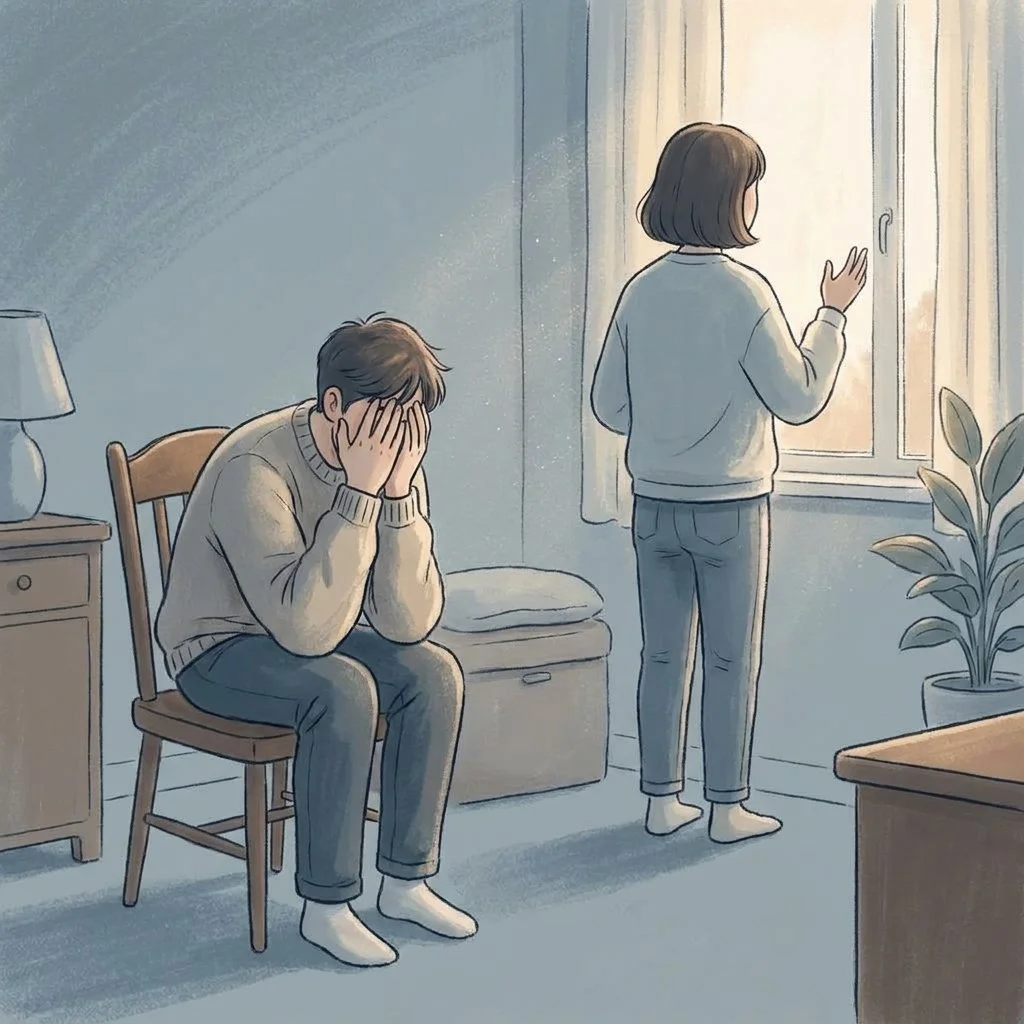
Withdrawal can look like indifference from the outside while the person withdrawing is physiologically overwhelmed.
What the research does and doesn't show
Two caveats matter here, because this subject is badly distorted online.
You'll see claims that these behaviors predict divorce with over 90% accuracy. Those figures come from models built on couples whose outcomes were already known, and they hold up far less well when applied to new couples. The behaviors matter. The percentages don't mean what they're usually made to mean, and your partner's silence tonight is not a verdict on your relationship.
Early research also found that men were more often the ones who withdrew. But who takes which role turns out to depend heavily on what's being discussed, as the next section explains. This is a pattern any two people can fall into.
The Pursue-Withdraw Loop Neither of You Chose
The pattern the two of you are caught in has a name, and learning it can change how the whole situation feels.
It's called demand-withdraw: one partner presses for a conversation or a change, the other pulls away, and each move makes the other stronger. The more you pursue, the more they retreat. The more they retreat, the more urgent pursuing feels.
The largest review of this research pooled 74 studies covering more than 14,000 people and found a consistent link between the pattern and lower satisfaction, poorer communication and reduced wellbeing. It's a meaningful, reliable association rather than a sentence you've been handed.
The finding that matters most is this. Andrew Christensen and his colleagues asked couples to discuss the husband's issue in one conversation and the wife's issue in another. When the topic was the wife's issue, wives demanded and husbands withdrew. When it was the husband's issue, that difference largely disappeared.
That finding changes the frame. The roles follow who wants the change, and they can shift with the topic rather than reflecting who someone is. The person asking for something different has to keep raising it, while the person being asked to change has every incentive to end the conversation. Change the topic and you may well change the roles.
You're not the needy one and they're not the cold one. You're two people standing at different ends of the same request.
Why Being Shut Out Hurts This Much
Being ignored registers as a real threat
If you are asking yourself whether you are overreacting, the research is clear that you are not.
Kipling Williams has spent decades studying ostracism, and the findings are strikingly consistent. Being ignored is detected fast and hurts immediately. It threatens four things people need: belonging, self-esteem, a sense of control, and the feeling that you matter.
The distress appears even in situations that seem absurd. People report being hurt by exclusion in a trivial computer ball-toss game, including when they were told the other players were following a script and when they were told they were playing against a computer. Being shut out by the person you live with is not something you should expect yourself to shrug off.
You may also have read that rejection is "the same as physical pain in the brain." That claim is more contested than popular articles suggest. The defensible version is simpler: rejection engages brain systems involved in distress, and what you're feeling is a real signal.
If you lean anxious in relationships
For some people, a partner pulling away comes close to a worst-case trigger.
Attachment researchers describe hyperactivating strategies: when someone high in attachment anxiety senses a partner is unavailable, the response is to intensify. More contact-seeking, more protest, more scanning for signs of rejection, more replaying.
That is why sending one more message can feel so physically urgent. It does not mean you are weak or manipulative. It is an alarm system doing what it evolved to do, even though its advice is wrong in this moment. Our guide to anxious attachment triggers covers how to bring that response down.
What Actually Helps in the Moment
1. Settle your own body first
You can't have a useful conversation from a flooded state, and neither can they. Before deciding what to say, do something that changes your physiology.
Slow breathing takes little effort and has real support behind it. A systematic review of slow breathing found consistent shifts toward parasympathetic activity and lower anxiety, while a meta-analysis of breathwork trials found reliable reductions in stress. The effects are modest rather than miraculous, and this option is available to you right now, for free, in the kitchen. Making the exhale longer than the inhale is the whole technique; our breathwork guide covers the variations.
We've written separately about calming down in the hours after a fight, in anxiety after an argument. That piece is about your own recovery. What follows is different: it's about what the two of you agree to before either of you walks away.
2. A break needs an agreed return time
Almost everyone skips this part, yet it determines whether a break helps or wounds.
A pause during a heated conversation can be useful. It gives both bodies time to come down. From the outside, a pause and abandonment can look identical. If your partner leaves without telling you when they will return, your nervous system cannot distinguish them and will assume the worst.
So the fix isn't the break. It's the return time. Hearing "I need twenty minutes, I'll come find you at eight" is very different from receiving silence, even though the twenty minutes are the same.
Agree on this when you're calm, not mid-argument. Pick a signal either of you can use, decide roughly how long, and commit to naming a time to come back. Then honor it, even if all you manage at eight is "I'm still not ready, can we try at nine?" A renegotiated return counts. A vanished one doesn't.

A break works when both people know when it ends. The agreed return time is what separates regulation from abandonment.
3. Don't spend the break rehearsing the argument
A break helps only when you use it to settle.
Spend those twenty minutes building your case and replaying their tone, and your body stays exactly where it was. Researchers call this perseverative cognition: worry and rumination keep the stress response switched on long after the event has ended. Stewing isn't a neutral way to pass the time. It prevents the recovery the break was meant to provide.
Do something absorbing instead. Walk, shower, put music on, handle a small task that takes attention. If the thoughts keep grabbing you, cognitive defusion techniques are built for this: not arguing with the thought, just loosening its grip enough to put it down.
4. Come back in gently
How you restart matters more than what you say first.
A conversation that starts with an accusation tends to end the way it started. Lead with one specific thing and one clear ask, framed around your own experience: "When it goes quiet I start to panic. Can we agree on what to do next time?" That lands very differently from "You always walk away from me."
Naming the softer feeling underneath, the fear or the hurt rather than the anger, invites far less defensiveness. It's also harder to do, which is why it works better after the twenty minutes than during them.
What Makes It Worse (and Why)
When someone withdraws, you may feel pulled to close the gap. Nearly everything that urge suggests tightens the loop. The next few examples show how.
Following them into the room. When someone is flooded, physical pursuit reads as escalation, not connection. Their system is already at capacity, so closing the distance makes retreating feel more necessary, not less.
The long message. Six paragraphs at midnight feels like clarity to write and like pressure to receive. A flooded person can't process it, so it goes unanswered, which increases your distress, which usually produces a seventh paragraph.
Escalating to force a response. Raising the stakes, threatening to leave, saying the sharpest true thing you know. It sometimes works, in that it produces a reaction. What it teaches is that this conversation is dangerous, which makes withdrawal more likely next time.
Asking for reassurance on a loop. "Are we okay? Are you sure? You'd tell me?" Each answer soothes briefly and then wears off, and the asking becomes the thing keeping the anxiety alive. We've written about why in relationship anxiety and reassurance loops.
None of these is a moral failing. They are what a threatened attachment system recommends. In this particular situation, the advice is poor, and knowing that ahead of time makes it easier not to follow.
When Silence Isn't Stonewalling
There is an important distinction here, and you can state it plainly without diagnosing anyone.
Withdrawing because you're overwhelmed, and then coming back, is a communication breakdown. Silence used deliberately and at length to punish, control or frighten someone is a different thing. The CDC classifies psychological aggression, including behavior intended to harm a partner emotionally or exert control, as a form of intimate partner violence.
If the silence in your relationship is one-sided, prolonged, and paired with isolation, monitoring or fear, that isn't a communication skills problem and breathing exercises aren't the answer. In the US, the National Domestic Violence Hotline is free, confidential and available 24/7 by phone, chat or text.
When to Get Help
If this pattern has become established, it is reasonable to seek outside help, and that help works reasonably well.
A meta-analysis of couples therapy trials found meaningful improvements in relationship satisfaction across the main approaches. It found no clear winner among them, and some gains faded over the following year. Taken together, the picture is of something helpful rather than magical, with better results when you go earlier.
Individual therapy is a legitimate route too, especially if the intensity of your own reaction is the hardest part to live with. You don't need your partner's agreement to start working on your end of the loop, and changing one end often changes the other.
-Tim, Founder of Wellness AI
About the Author
Dr. Timothy Rubin holds a PhD in Psychology with expertise in cognitive science and AI applications in mental health. His research has been published in peer-reviewed psychology and artificial intelligence journals. Dr. Rubin founded Wellness AI to make evidence-based mental health support more accessible through technology.
Somewhere to Take It at 2am
Wellness AI offers private therapy chat and personalized meditations for the hours after a conflict, when the house is quiet and your head isn't.


FAQ: Being Stonewalled by a Partner
My partner shuts down every time we argue. Does that mean the relationship is failing?
On its own, no. Withdrawing during conflict is common and often reflects physiological overwhelm rather than a lack of caring. The key question is whether your partner returns and engages with you afterward.
Is being stonewalled the same as the silent treatment?
They can look similar, but they are not the same. Shutting down during an argument usually comes from overwhelm and ends once the person settles. The silent treatment generally involves withholding contact for longer and more deliberately.
Why do I feel physically awful when my partner goes quiet?
Being ignored by someone close registers as a genuine threat. Research on social exclusion shows it rapidly threatens core needs like belonging and feeling that you matter, so your body is responding to a real signal.
How long should I wait before bringing it up again?
Both of you need enough time to become calm, which is usually longer than it feels. The better question is whether you agreed on a return time: a pause with a stated end point is repair, while a pause with no end point causes damage.
Is stonewalling a form of emotional abuse?
It can be, but usually it is not. Withdrawal caused by overwhelm differs from silence used on purpose to punish, control or isolate a partner. When silence comes with fear, monitoring or isolation, treat it as a safety issue.
Is it always the man who shuts down?
No. Early research found men more often in the withdrawing role, but later work showed the roles depend heavily on what's being discussed. Whoever wants the change tends to press, and the other tends to retreat.
What if I'm the one who shuts down sometimes?
Many people do, depending on the topic. That suggests the loop is tied to the situation rather than to either person's character. The same response applies: notice when you're flooded, ask for a break, and name a time to return.
Does couples therapy actually help with stonewalling?
Yes, to a moderate degree, according to the evidence. Randomized trials show meaningful improvements in relationship satisfaction across the main couples therapy approaches, although some gains fade over time and outcomes are better when you start earlier.