Why You Replay Conversations in Your Head (and How to Stop the Post-Conversation Spiral)
Author: Dr. Timothy Rubin, PhD in Psychology
Originally Published: May 2026
Last Updated: May 2026
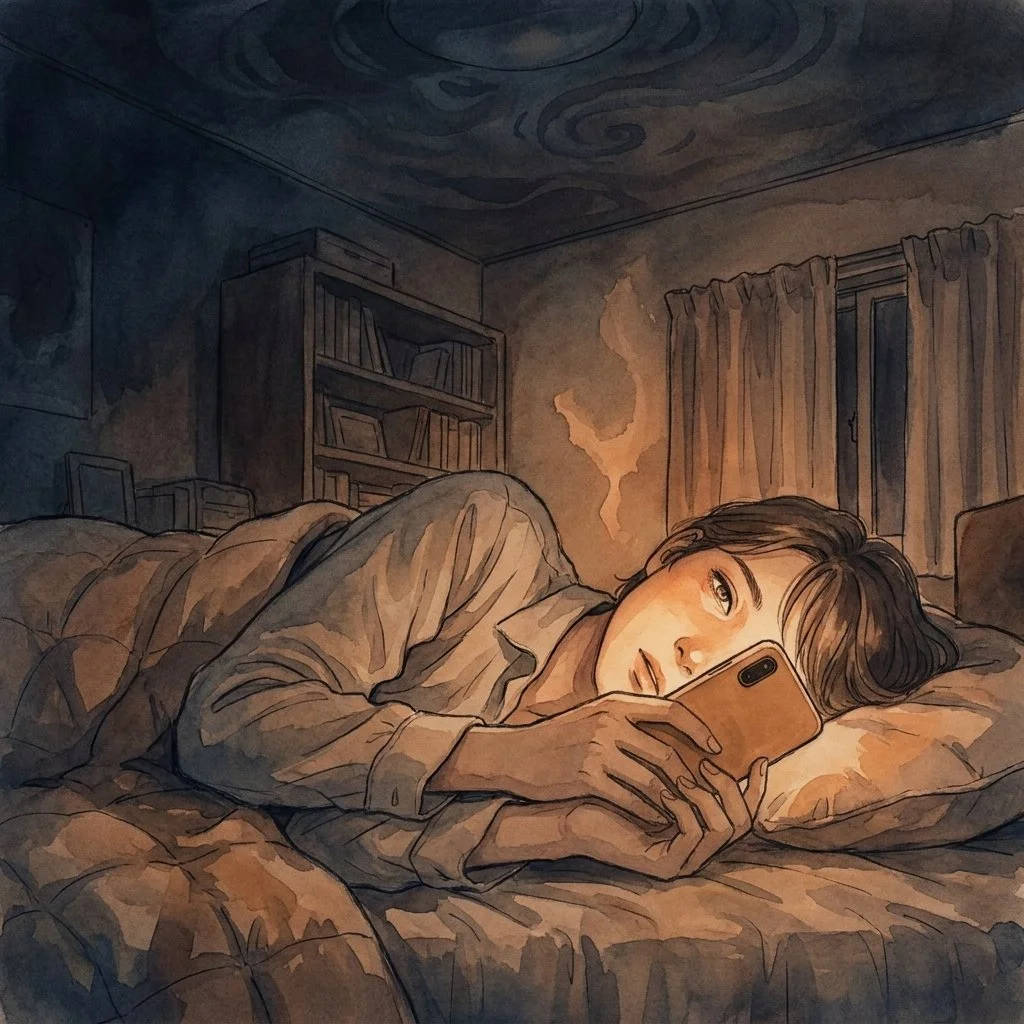
Post-conversation replay tends to surface in the quiet moments — especially at night.
Contents
- Why Your Brain Replays Conversations
- Rumination vs. Reflection: The Critical Difference
- Why It Gets Worse at Night
- 5 Evidence-Based Techniques to Stop the Spiral
- When Post-Conversation Replay Becomes Something Bigger
- Key Takeaways
- Frequently Asked Questions
It's 11pm. You're lying in bed, and your brain has decided that the most important thing to do right now is play back a comment you made at lunch — analyzing the word you chose, the look on the other person's face, whether you came across "wrong."
If this is familiar, you're in very good company. Replaying conversations in your head is one of the most universal experiences in modern social life — a brain habit so common that researchers have spent decades studying it under the broader name of rumination.
In this article, we'll look at why your brain does this, why it tends to spike at night, how to tell the difference between healthy reflection and unhelpful rumination, and five evidence-based techniques to interrupt the loop.
Why Your Brain Replays Conversations
Your brain treats social information as survival-relevant data. For most of human history, getting along with the people around you was how you stayed alive — so your brain evolved to take social interactions seriously, replaying them and scanning them for errors. That system is still running today, even though the stakes are usually much smaller.
The Social-Threat System
When you worry about how a conversation went, you're activating the same neural circuitry that handles physical threat. Research has consistently found that the brain processes social pain — rejection, embarrassment, perceived judgment — through some of the same regions involved in physical pain. That's part of why a comment from this morning can still genuinely sting tonight, and why social memories can be "re-felt" in a way physical pain usually can't.
This isn't a flaw. It's a feature working a little too hard.
The Spotlight Effect
Here's a finding that should provide some relief: other people notice and remember far less of what you do than you assume they do.
Psychologists call this the spotlight effect — our tendency to dramatically overestimate how much others pay attention to us. In classic experiments, people wore embarrassing T-shirts into a room of strangers and predicted how many would notice. Roughly twice as many people predicted noticing as actually did. The same pattern shows up for things we say in groups: speakers think their contributions stood out far more than listeners actually remember.
The implication: that awkward thing you said? Most of the room either didn't register it or has already forgotten.
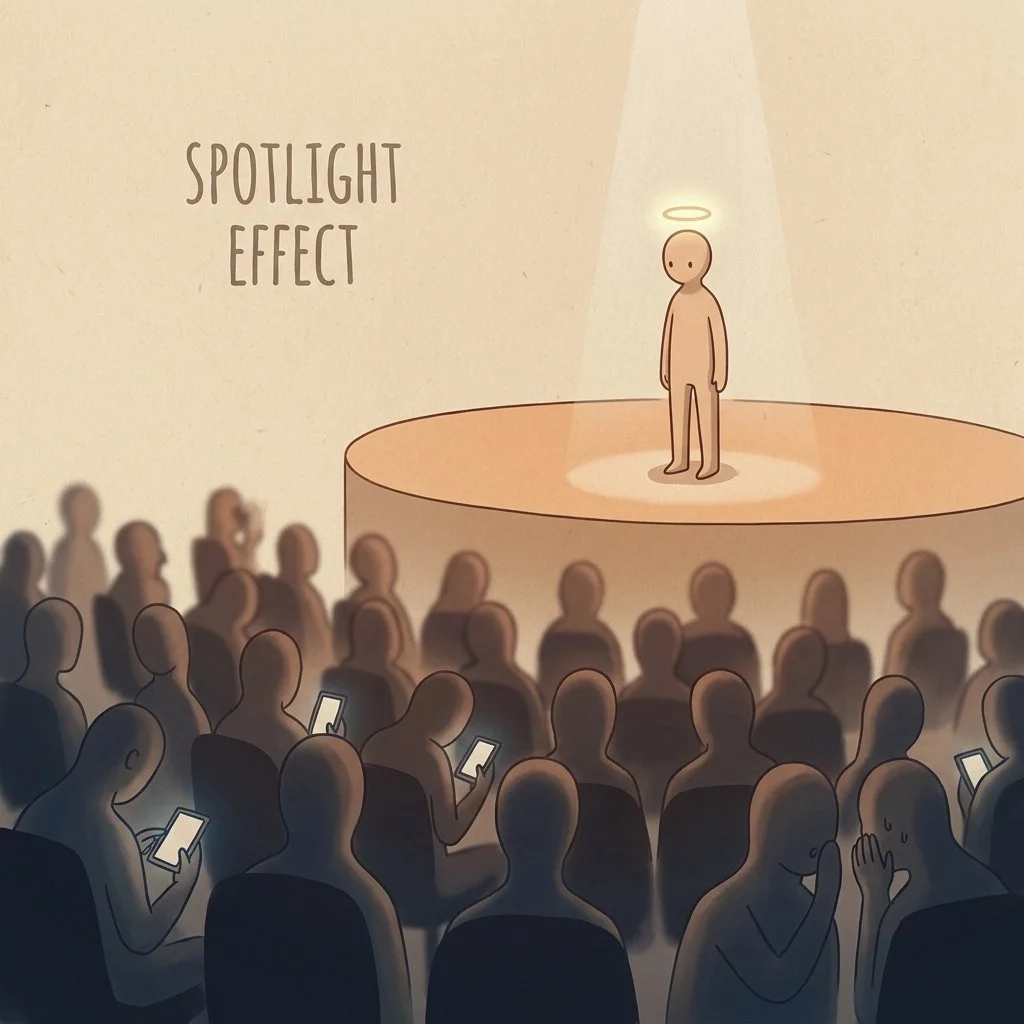
We tend to assume we're in the spotlight far more than we actually are.
Why Perfectionism Makes It Worse
If you tend toward perfectionism — high standards for yourself, sensitivity to how you "come across" — your brain runs the social post-mortem harder. Studies link perfectionism to higher levels of rumination and worry, which in turn predict anxiety and low mood. The same wiring that makes you a thoughtful friend can also make your brain replay conversations more.
The "Always-On" Network in Your Brain
When you're not actively focused on a task, your brain switches into a "default" mode — quietly reviewing your day, simulating future situations, replaying memories. Brain imaging research has shown that this default mode network is especially active during rumination, particularly after experiences involving perceived criticism or social evaluation. In other words, the moment you stop doing something demanding, the replay turns on.
Rumination vs. Reflection: The Critical Difference
Not all internal review is harmful. The key is whether you're reflecting or ruminating — and the difference matters more than most people realize.
| Aspect | Rumination | Reflection |
|---|---|---|
| Pattern | Repetitive, looping | Bounded, ends with insight |
| Tone | Evaluative, self-critical | Curious, problem-solving |
| Outcome | Produces distress | Produces understanding |
| Key Question | "Why am I like this?" | "What can I learn?" |
| Effect on Mood | Lowers it | Improves or stabilizes it |
Rumination is repetitive, passive, evaluative thinking about your distress — and it loops without resolving. Decades of research by Susan Nolen-Hoeksema show that rumination doesn't help you understand your situation. It deepens negative mood, impairs problem-solving, and is one of the strongest predictors of depression and anxiety.
Reflection is different. It's bounded, curious, and produces actual insight. A follow-up study refined this further: people who engaged in brooding — passively comparing their current state to some ideal they hadn't reached — got worse over time, while those who engaged in reflective pondering — purposeful, problem-solving turning inward — actually got better.
From the inside, these can feel similar. The tell is whether your thinking is moving toward an answer or just looping. If twenty minutes have passed and you're not closer to understanding anything, that's rumination. If you noticed something useful and you're done, that's reflection.
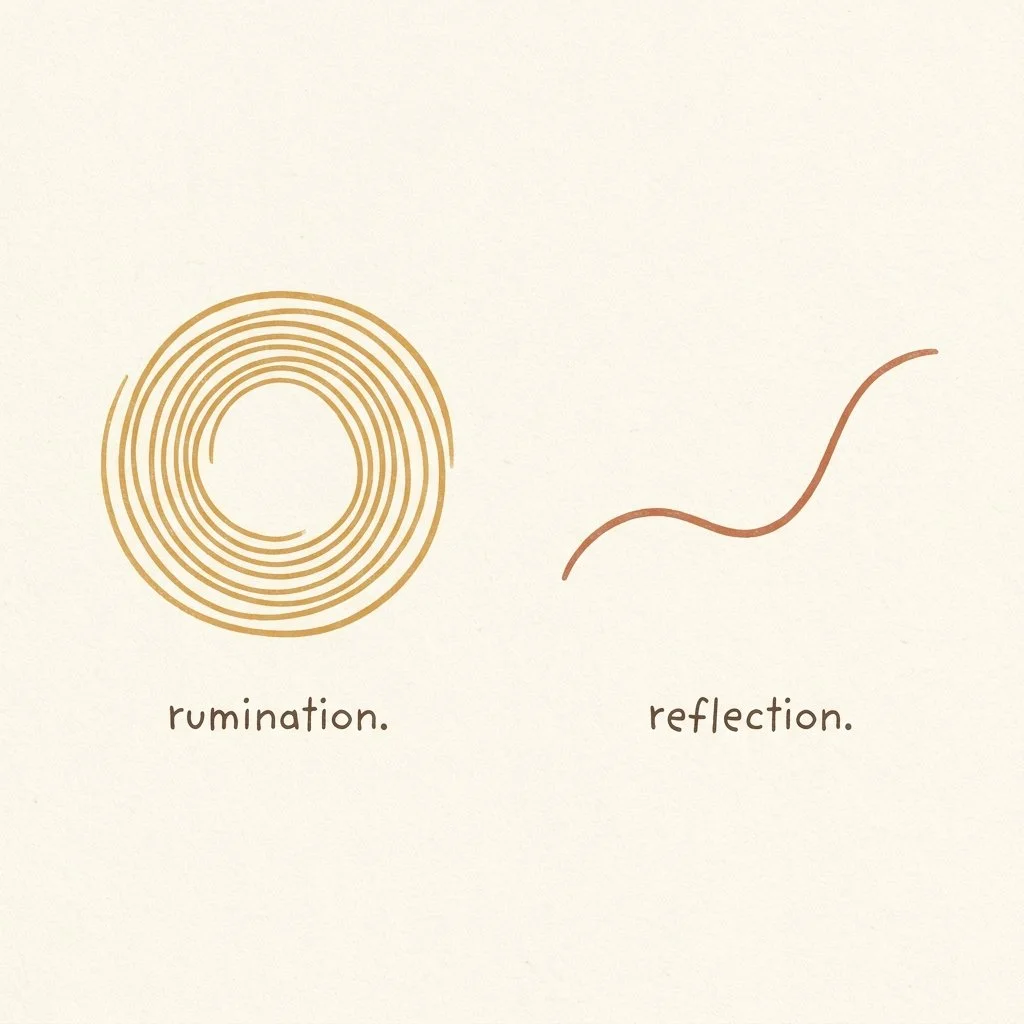
Reflection moves forward. Rumination loops back.
Why It Gets Worse at Night
Almost everyone who experiences post-conversation replay notices it spikes after the lights go out. There are real reasons for this.
Fewer distractions are competing for your attention. During the day, work, errands, and other people crowd out the replay. At night, that competition disappears, and the brain's default activity — the kind that drives rumination — has the floor.
Stress hormones don't settle the same way for habitual ruminators. Cortisol, the body's main stress hormone, normally drops in the evening. But research has found that people who ruminate a lot show elevated cortisol at bedtime, even after controlling for how stressed their day was. The biology of the replay is keeping the body activated when it should be winding down.
Your brain consolidates emotionally charged content right before sleep. The pre-sleep window is when the day's events get processed and stored. If the most emotionally weighted thing that happened was a social interaction, that's what your brain reaches for.
For a fuller treatment of nighttime overthinking, see our guide to quieting racing thoughts at night.
5 Evidence-Based Techniques to Stop the Spiral
The good news is that the loop is interruptible. The techniques below come from clinical psychology research — pick one or two that fit you.
1. Cognitive Defusion: Label the Thought as a Thought
When you're inside a replay, the thought "I said that wrong" feels like a fact. Cognitive defusion — a core technique from Acceptance and Commitment Therapy — works by changing your relationship to the thought rather than arguing with its content.
The simplest version is a linguistic trick: instead of "I sounded so awkward," try "I'm noticing the thought that I sounded so awkward." That small reframe creates distance. You're not arguing with the thought, you're just observing that your brain produced it.
Experimental studies have found that this kind of defusion reduces both the believability and the emotional sting of negative self-thoughts more effectively than trying to suppress or distract from them. For more on how this differs from challenging thoughts directly, see our deep dive on cognitive defusion vs. cognitive restructuring.
2. Reality-Check the Spotlight
When the replay starts, ask yourself: "Realistically, how much are they still thinking about this?"
Given what we know about the spotlight effect, the answer is almost always "much less than you think." The other person is likely replaying their own conversations from the day — not yours.
A useful follow-up question is whether you'd remember the moment if the roles were reversed. Usually, no.
3. Schedule a "Replay Window"
This one sounds odd until you try it. Scheduled worry, sometimes called worry postponement, is a technique with strong research support for reducing intrusive worry and improving sleep.
Here's how: when a replay surfaces, instead of trying to suppress it or engage with it, tell yourself you'll think about it during a designated 15-minute window tomorrow — say, 5pm. Write the topic down if it helps. Then return to whatever you were doing.
Two things tend to happen. First, the brain accepts the postponement more easily than you'd expect, because you're not refusing to think about it — just rescheduling. Second, by the time tomorrow's window arrives, most of the replays no longer feel urgent.
4. The Self-Compassion Break
Post-conversation rumination is almost always tangled up with self-criticism. Researcher Kristin Neff's work on self-compassion suggests that the antidote isn't more self-discipline but a brief, deliberate shift in how you talk to yourself.
The practice has three parts, and the whole thing takes about two minutes:
- Acknowledge the moment: "This is hard. I'm having a difficult moment."
- Recognize you're not alone: "Other people have this experience too. Replaying conversations is part of being human."
- Offer yourself kindness: "May I be patient with myself. May I give myself the same understanding I'd give a friend."
Research has found that one of the main ways self-compassion improves anxiety and mood is by directly reducing rumination. Our self-compassion guide for anxiety covers the practice in more depth.
5. Body-Based Grounding
Sometimes the loop is too tight for any cognitive technique to land — your mind is racing too fast to talk to. In those moments, shift the work to your body.
A few options that have research behind them:
- Slow exhale breathing. Inhale for four counts, exhale for six or eight. The extended exhale activates the parasympathetic nervous system, which is the body's "brake" on the stress response.
- Progressive muscle relaxation. Tense and release each muscle group, head to toe. Clinical research shows this lowers heart rate, blood pressure, and stress hormones. Our PMR guide walks through the full sequence.
- The 5-4-3-2-1 technique. Name five things you can see, four you can hear, three you can feel, two you can smell, one you can taste. This pulls attention out of the replay and into present-moment sensory input.

Body-based techniques are especially useful when the loop is too tight for thinking your way out.
When Post-Conversation Replay Becomes Something Bigger
Most replay is just a busy brain doing what brains do. But there are patterns worth paying attention to. Consider talking to a mental health professional if:
- The replay disrupts your sleep most nights of the week
- It lasts hours or days after a typical conversation
- You start avoiding social situations to prevent it
- It's paired with persistent low mood, hopelessness, or relationship distress
- You find yourself compulsively re-reading messages or seeking reassurance about what someone "really" meant
These patterns can show up in social anxiety disorder, where post-event "post-mortems" of social interactions are a well-documented maintenance mechanism. They can also appear in OCD, particularly in patterns involving relational doubt or intrusive thoughts about social interactions. Generalized anxiety and depression also commonly involve heavy rumination.
Effective treatments exist for all of these. None of them require you to have hit some threshold of "bad enough" before reaching out.
Key Takeaways
Replaying conversations isn't a character flaw — it's a brain pattern with a name and several ways out. Here are the essential points to remember:
✓ Replaying conversations is universal - It's driven by social-threat circuitry and the brain's default network, not by anything wrong with you
✓ You're almost certainly in less of a spotlight than you feel - Research consistently shows others notice and remember far less than we assume
✓ Rumination loops; reflection resolves - The difference is whether your thinking is moving toward insight or just circling
✓ Night makes it worse - Distractions disappear, stress hormones don't settle the same way, and the brain consolidates emotional content before sleep
✓ Five techniques have strong evidence - Cognitive defusion, reality-checking the spotlight, scheduled replay windows, self-compassion breaks, and body-based grounding
-Tim, Founder of Wellness AI
About the Author
Dr. Timothy Rubin holds a PhD in Psychology with expertise in cognitive science and AI applications in mental health. His research has been published in peer-reviewed psychology and artificial intelligence journals. Dr. Rubin founded Wellness AI to make evidence-based mental health support more accessible through technology.
Quiet the Post-Conversation Spiral
Try Wellness AI for personalized therapy chat and calming meditations designed to break the rumination loop.


Frequently Asked Questions
Is it normal to replay conversations in my head?
Yes. Replaying conversations is a near-universal experience and reflects how the human brain processes social information. It only becomes a problem when it's persistent, distressing, disrupts sleep, or drives avoidance of future social situations.
Why do I replay embarrassing memories from years ago?
Emotionally charged memories — especially socially embarrassing ones — get encoded more deeply because the brain treats them as important. When something cues that memory, the brain pulls it back up. This is normal, though frequent distressing replays can sometimes signal anxiety worth addressing with a professional.
What's the difference between rumination and overthinking?
Rumination is the more specific clinical term — repetitive, passive, evaluative thinking that loops without resolution. Overthinking is a broader everyday word that can include rumination but also covers problem-solving and reflection that eventually leads somewhere useful.
Is replaying conversations a sign of anxiety?
It can be, but not always. Occasional replay is normal. Frequent, distressing replay that disrupts sleep, mood, or social life can be a feature of social anxiety, generalized anxiety, or OCD — but on its own, it's not diagnostic of anything.
How do I stop overthinking what I said?
Try labeling the thought as a thought ("I'm noticing the thought that..."), reality-checking how much the other person is likely still thinking about it, scheduling a 15-minute window tomorrow to think about it, or shifting to slow-exhale breathing if your mind is moving too fast for cognitive techniques to land.
Why is post-conversation anxiety worse at night?
Daytime distractions disappear, the brain consolidates emotionally charged content before sleep, and people who tend to ruminate often show elevated stress hormones at bedtime. The result is that the same brain that managed fine during the day suddenly has nothing to do except replay the conversation.
Can therapy help with post-conversation rumination?
Yes. Both Cognitive Behavioral Therapy (CBT) and Acceptance and Commitment Therapy (ACT) have strong evidence for reducing rumination and related anxiety. If post-conversation replay is significantly affecting your sleep, mood, or social life, talking to a therapist is one of the most effective things you can do.