Progressive Muscle Relaxation for Anxiety: Complete Guide & Techniques
Author: Dr. Timothy Rubin, PhD in Psychology
Originally Published: February 2026
Last Updated: February 2026
Progressive muscle relaxation teaches you to release physical tension, helping calm both body and mind.
Contents
- What Is Progressive Muscle Relaxation?
- The Science: Why PMR Works for Anxiety and Sleep
- How to Practice PMR: Step-by-Step Guide
- Adapting PMR for Different Situations
- Tips for Building a PMR Practice
- Frequently Asked Questions
If you've ever noticed your shoulders creeping up toward your ears during a stressful day, or felt your jaw clenching without realizing it, you already know that anxiety lives in the body. Our muscles tense up when we're stressed—often without us even noticing—and that physical tension can fuel the cycle of worry and unease.
Progressive muscle relaxation (PMR) is a simple, research-backed technique that breaks this cycle. By deliberately tensing and then releasing muscle groups throughout your body, you teach your nervous system to shift from "fight or flight" mode into a calmer state. It's been used for nearly a century to help people manage anxiety, improve sleep, and find relief from chronic stress.
What Is Progressive Muscle Relaxation?
Progressive muscle relaxation was developed in the 1920s by American physician Edmund Jacobson, who discovered something important: mental tension and muscle tension go hand in hand. When your mind is anxious, your body tenses up. But the reverse is also true—when you deeply relax your muscles, your mind tends to follow.
Jacobson spent years using early muscle-monitoring equipment to prove this connection. His key insight? You can't feel anxious when your muscles are truly relaxed. PMR uses this principle by having you systematically tense each muscle group for a few seconds, then release that tension and notice the contrast.
How PMR Triggers Your Relaxation Response
When you practice PMR, you're activating what researchers call the relaxation response—a term coined by Harvard physician Herbert Benson. This is essentially the opposite of your stress response. Instead of elevated heart rate, shallow breathing, and tense muscles, your body shifts into a calmer state.
During PMR, your parasympathetic nervous system takes over. Your heart rate slows, blood pressure drops, and stress hormones like cortisol decrease. This isn't just subjective—studies have measured significant physiological changes during and after PMR practice, including reduced cortisol levels and improved heart rate variability (a marker of stress resilience).
The Science: Why PMR Works for Anxiety and Sleep

PMR works by creating contrast between tension and relaxation, helping you recognize and release stress held in your body.
Research on PMR for Anxiety
PMR is one of the most well-researched relaxation techniques available. A comprehensive meta-analysis published in BMC Psychiatry analyzed 27 studies and found that relaxation training (including PMR) produces significant reductions in anxiety—effects that hold up across different populations and settings.
More recent research confirms these findings. A 2024 systematic review examining 46 studies across 16 countries found consistent benefits of PMR for reducing anxiety, stress, and depression symptoms. The technique has been shown to help with generalized anxiety, health-related anxiety, and stress in both clinical and everyday settings.
PMR for Better Sleep
If racing thoughts keep you awake at night, PMR might be particularly helpful. Research published in the Journal of Sleep Research found that people who practiced PMR before sleep spent significantly more time in slow-wave sleep—the deep, restorative stage that's essential for feeling refreshed.
This is why PMR is now a standard component of Cognitive Behavioral Therapy for Insomnia (CBT-I), the gold-standard treatment for sleep problems. The American Academy of Sleep Medicine recommends relaxation therapy as part of a comprehensive approach to insomnia treatment.
How to Practice PMR: Step-by-Step Guide
The beauty of PMR is its simplicity. You don't need any equipment, apps, or special training to get started. Here's how to practice the technique:
Getting Started
- Find a comfortable position. You can sit in a chair with your feet flat on the floor, or lie down on your back. Loosen any tight clothing.
- Set aside 10-20 minutes. A full PMR session takes about 15-20 minutes, though shorter versions work too once you're familiar with the technique.
- Minimize distractions. Find a quiet space where you won't be interrupted. Some people like to dim the lights or close their eyes.
- Take a few deep breaths. Before you begin, take 3-4 slow, deep breaths to start settling your nervous system.
The Muscle Group Sequence
Work through the following muscle groups in order. For each one: tense the muscles for 5-7 seconds, then release and relax for 15-20 seconds, noticing the contrast between tension and relaxation.
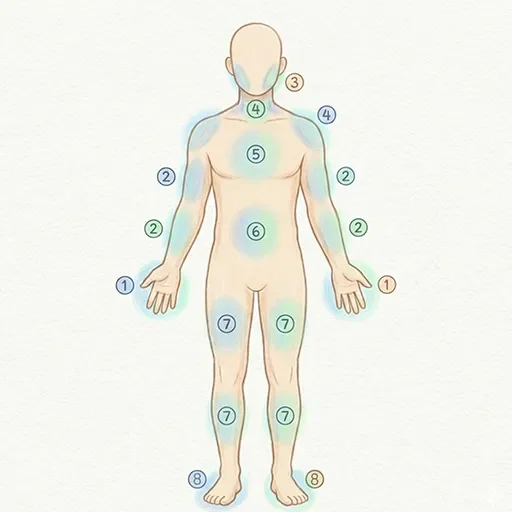
PMR typically progresses from your hands and arms down through your body to your feet.
- Hands and forearms: Make a fist and squeeze tightly. Release and let your hands go limp.
- Upper arms (biceps): Bend your elbows and tense your biceps. Release and let your arms fall relaxed.
- Forehead: Raise your eyebrows as high as you can, wrinkling your forehead. Release and feel your forehead smooth out.
- Eyes and cheeks: Squeeze your eyes shut tightly. Release and let the muscles around your eyes soften.
- Jaw and mouth: Clench your jaw and press your tongue to the roof of your mouth. Release, letting your jaw hang slightly open.
- Neck: Gently press your head back (if lying down) or tilt your chin toward your chest. Release and let your neck relax.
- Shoulders: Shrug your shoulders up toward your ears. Release and let them drop down.
- Chest: Take a deep breath and hold it, tensing your chest muscles. Exhale and release.
- Stomach: Tighten your abdominal muscles as if bracing for impact. Release and let your belly soften.
- Thighs: Squeeze your thigh muscles tightly. Release and feel them go heavy.
- Calves: Point your toes away from you, tensing your calf muscles. Release.
- Feet: Curl your toes under tightly. Release and let your feet relax completely.
After completing all muscle groups, spend a minute or two simply resting, noticing the overall sense of relaxation in your body. When you're ready, slowly open your eyes and gently move your fingers and toes before getting up.
Adapting PMR for Different Situations
Once you've learned the basic technique, you can adapt PMR to fit different needs and time constraints:
Quick Version (5-7 minutes)
Combine muscle groups to speed things up. For example: tense both arms at once, then your whole face, then shoulders and chest together, then your entire core, then both legs. This abbreviated approach works well when you're short on time or need quick relief during a stressful moment.
For Sleep
Practice PMR in bed as part of your wind-down routine. Move through the sequence slowly, and don't worry if you fall asleep before finishing—that's actually the goal! Combine with sleep meditation techniques for even better results.
Combined with Breathing
Sync your breathing with the tension-release cycle. Inhale as you tense each muscle group, then exhale slowly as you release. This adds an extra layer of relaxation and pairs well with grounding techniques for anxiety.
At Your Desk
You can do a discreet mini-PMR at work by focusing on just a few muscle groups—hands, shoulders, and face are easy to tense and release without anyone noticing. Check out our guide on meditation for work stress for more workplace-friendly techniques.
Tips for Building a PMR Practice
- Start with guided practice. Audio guidance can help you learn the technique and maintain focus, especially when you're starting out.
- Practice consistently. Like any skill, PMR gets easier and more effective with regular practice. Aim for once daily, even if it's just the short version.
- Don't force the tension. Tense your muscles firmly but not to the point of pain or cramping. The goal is noticeable tension, not maximum strain.
- Notice the contrast. Pay close attention to the difference between the tense and relaxed states—this awareness is key to the technique's effectiveness.
- Be patient. Some people feel deeply relaxed after their first session; others need a week or two of practice before the benefits really click.
PMR pairs well with other evidence-based techniques for managing anxiety. Many people find it helpful to use PMR alongside body scan meditation or guided visualization as part of a broader relaxation toolkit.
-Tim, Founder of Wellness AI
About the Author
Dr. Timothy Rubin holds a PhD in Psychology with expertise in cognitive science and AI applications in mental health. His research has been published in peer-reviewed psychology and artificial intelligence journals. Dr. Rubin founded Wellness AI to make evidence-based mental health support more accessible through technology.
Try Guided Relaxation for Anxiety Relief
Wellness AI offers personalized relaxation meditations tailored to your needs.


Frequently Asked Questions
What is progressive muscle relaxation?
Progressive muscle relaxation (PMR) is a technique where you systematically tense and then release different muscle groups throughout your body. The contrast between tension and release helps your muscles relax deeply and activates your body's natural calming response.
How long does PMR take to work for anxiety?
Many people feel calmer immediately after a single session. However, benefits tend to build with regular practice over 1-2 weeks. Research shows consistent daily practice produces the strongest anxiety reduction.
Can I do progressive muscle relaxation in bed for sleep?
Yes! Lying down is actually one of the recommended positions. Many people practice PMR in bed as part of their wind-down routine, and research shows it can increase deep, restorative sleep.
Is progressive muscle relaxation the same as meditation?
Not exactly. PMR involves actively tensing and releasing muscles, while most meditation focuses on mental attention like watching thoughts or focusing on breath. However, they complement each other well and can be combined.
How often should I practice PMR?
For best results, aim for once or twice daily. Morning practice can set a calm tone for your day, while evening practice supports better sleep. Even a few sessions per week provides noticeable benefits.
Are there any people who shouldn't do PMR?
PMR is generally very safe. However, if you have muscle injuries, chronic pain, or a history of muscle spasms, consult your doctor first. You can also modify the technique by using gentler tension or skipping affected areas.