Relationship OCD (ROCD): When Doubt Takes Over Love
Author: Dr. Timothy Rubin, PhD in Psychology
Originally Published: June 2026
Last Updated: June 2026

Relationship OCD turns ordinary moments of doubt into a loop that's hard to switch off — but the doubt is a symptom, not a verdict on your love.
Contents
- What Is Relationship OCD (ROCD)?
- Relationship OCD Symptoms: Obsessions and Compulsions
- Why It's OCD, Not a Relationship Problem
- The Reassurance and Checking Trap
- Am I in Love, or Is It OCD?
- What Actually Helps
- Retroactive Jealousy and Other ROCD Themes
- Day-to-Day Coping and When to See a Specialist
- The Doubt Is a Symptom, Not a Verdict
- Key Takeaways
- Frequently Asked Questions
Most of us, at some point, have wondered whether we're with the right person. We notice a flaw, compare our relationship to someone else's, or have a fleeting "do I really love them?" moment. For most people, these thoughts pass like weather.
But for some, that doubt digs in and won't let go. It loops for hours, demands an answer, and turns an otherwise loving relationship into a source of constant anxiety. This pattern has a name: Relationship OCD, or ROCD — a recognized presentation of obsessive-compulsive disorder in which the relationship itself becomes the focus of obsessions and compulsions.
This article is psychoeducation, not a diagnosis or a treatment plan. If you see yourself in it, my hope is that it helps you understand what's happening — and points you toward the kind of specialist care that genuinely helps.
What Is Relationship OCD (ROCD)?
Relationship OCD is a form of OCD that fixates on your romantic relationship or your partner. The unwanted, intrusive doubts latch onto the relationship, and so do the compulsions you use to quiet them. It isn't a separate diagnosis; it's one of the many themes OCD can take, much like contamination fears or fears of harm.
The concept was first described by clinical psychologists Guy Doron and Danny Derby, who noticed that some people came to therapy with classic OCD patterns aimed entirely at their relationships. At first these looked like ordinary relationship dilemmas. It became clear they were something else: an obsessive-compulsive cycle that didn't respond to the usual relationship advice.
Today ROCD is recognized by OCD specialists as a genuine and treatable presentation of OCD. And research suggests it can be as distressing as other forms of OCD — this is not "just overthinking."
Two ways ROCD shows up
Researchers describe two main flavors, which often overlap:
- Relationship-centered obsessions focus on the relationship itself: Is this the right relationship? Do I really love them? Do they really love me? What if my feelings aren't strong enough?
- Partner-focused obsessions fixate on a partner's perceived flaws — their appearance, intelligence, social skills, or character — in a way that feels impossible to stop scrutinizing.
Someone can experience one, the other, or both. A nagging worry about a partner's "flaw" can spiral into doubt about the whole relationship, and vice versa.
Relationship OCD Symptoms: Obsessions and Compulsions
Like all OCD, ROCD has two moving parts. Obsessions are the intrusive, unwanted thoughts and doubts. Compulsions are the things people do — physically or mentally — to relieve the anxiety those doubts create.
The obsessions in ROCD are the looping questions: Do I love them enough? Is this normal? Their laugh annoyed me — does that mean something? Was their ex a better match? These intrusive thoughts arrive uninvited, feel urgent, and resist every attempt to settle them.
The compulsions are the attempts to feel certain again. Common ones include:
- Checking your own feelings — mentally scanning for proof of love or attraction ("Do I feel it right now?").
- Comparing your relationship or partner to other couples, exes, or idealized images online.
- Seeking reassurance from your partner, friends, family, or search engines.
- Mentally reviewing memories, hunting for evidence that you're "sure."
- Testing the relationship or the partner to confirm they measure up.
- Avoiding triggers — romantic films, "perfect" couples, conversations that stir doubt.
The key thing to notice: the doubt is the obsession; the checking, comparing, and reassurance-seeking are the compulsions. As we'll see, effective help targets those compulsions — not the content of the doubt.
Why It's OCD, Not a Relationship Problem
Here's the heart of it: in ROCD, the doubt is the disorder — not evidence that your relationship is wrong.
A defining feature of these doubts is that they feel intrusive and unwanted. They clash with what you actually feel and want. People with ROCD are often distressed precisely because they love their partner and these thoughts contradict that love. That's very different from ordinary relationship doubts, which tend to fit how you genuinely feel and ease once you talk things through.
Several mental habits keep the cycle spinning. One is intolerance of uncertainty — treating "I can't be 100% sure" as a danger rather than a normal part of life. ROCD attaches this to a question that has no certain answer: no one can prove a relationship is "the one."
Another is the tendency to treat thoughts as facts — assuming a passing doubt must mean something important. Add in perfectionistic beliefs ("if it were right, I'd never doubt it") and the habit of over-monitoring your own emotions, and you have a loop that feeds itself. Understanding this is why specialist OCD care looks so different from standard couples counseling — and why our guide to CBT for OCD emphasizes working with the process of OCD rather than debating its content.
The Reassurance and Checking Trap
Compulsions feel like they help — and that's exactly the trap.
When you seek reassurance ("Do you still love me?") or check your feelings and get a moment of relief, your brain quietly learns the wrong lesson: that doubt was dangerous, and the checking saved me. So the next time the doubt appears, the urge to check is even stronger. The relief never lasts, because reassurance doesn't resolve uncertainty — it feeds it.
This is why "answering" the doubt is both impossible and counterproductive. Each reassurance generates a new but what if? These reassurance loops can also wear on a relationship, as a partner asked again and again to prove their love starts to feel mistrusted. The way out isn't a better answer — it's a different relationship to the question.
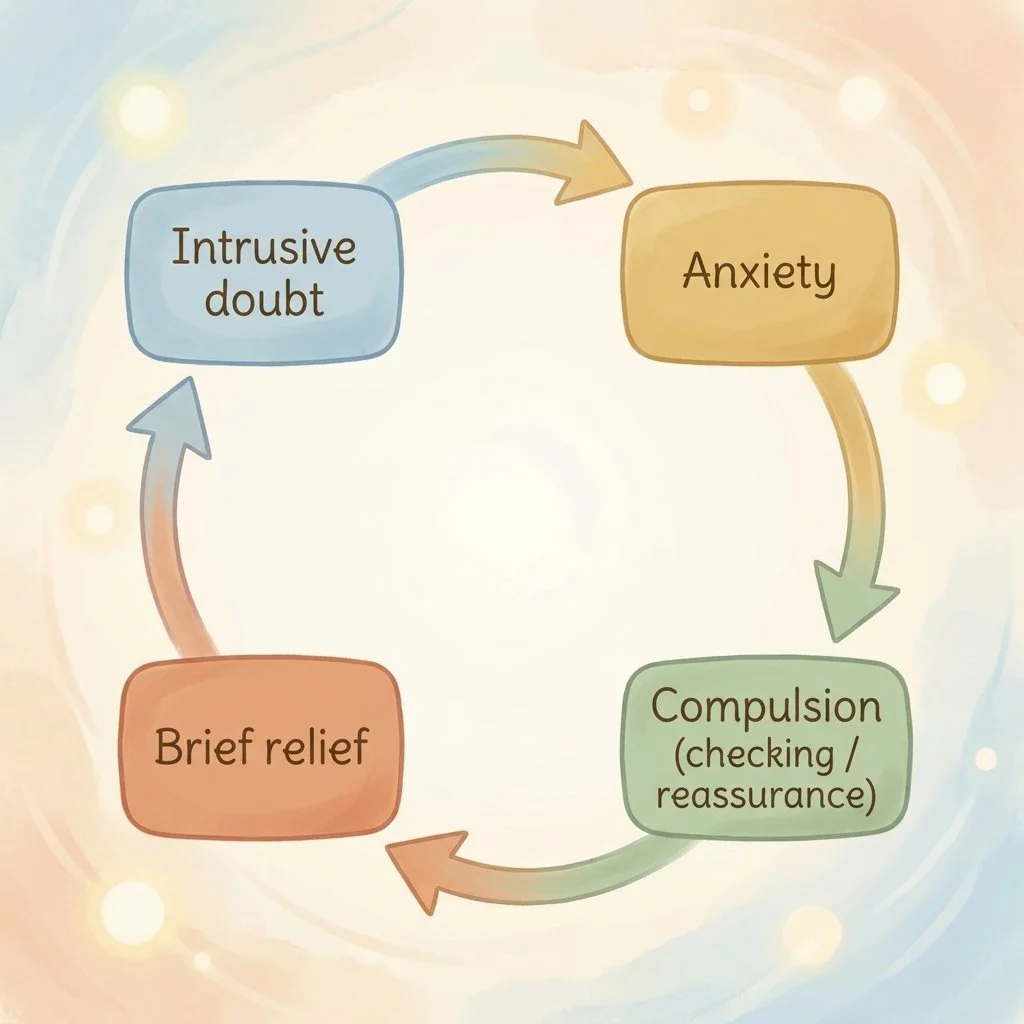
The OCD cycle: an intrusive doubt creates anxiety, a compulsion brings brief relief, and the doubt returns — often stronger. Each loop reinforces the next.
Am I in Love, or Is It OCD?
This is the question that brings many people to a therapist — and, honestly, you can't answer it by analyzing harder. The analyzing is part of the trap.
That said, a few clues tend to point toward ROCD rather than a genuinely mismatched relationship. The doubt feels intrusive and "not like you." It often flares even when things are going well. Reassurance helps only briefly. The worries are abstract ("do I love them enough?") rather than tied to specific, recurring problems. And similar doubts may have haunted past relationships, too.
Genuine incompatibility usually feels more consistent and values-based, and it tends to ease when you address the real issue rather than circle it. If you're stuck between these — especially if this overlaps with broader relationship anxiety — a licensed OCD specialist can help you tell the difference. Importantly, good treatment never pushes you to stay or leave; it lifts the OCD fog so you can decide from your real experience.
What Actually Helps
The most important point in this article: OCD, including ROCD, is treatable — and the gold-standard treatment is delivered by a licensed OCD specialist, not by self-help alone.

Exposure and Response Prevention (ERP), guided by a licensed OCD specialist, is the gold-standard treatment for OCD — including ROCD.
The front-line, evidence-based treatment is Exposure and Response Prevention (ERP), a specialized form of CBT and the most established treatment for OCD. ERP has two parts: gradually facing the thoughts and situations that trigger your obsessions (exposure), while resisting the compulsions that usually follow (response prevention). Over time, this teaches your brain that uncertainty and anxiety are survivable and don't require a ritual to fade.
For ROCD, ERP means learning to sit with doubt — watching a romantic film without checking your feelings, letting "maybe I don't love them enough" exist without seeking reassurance, making decisions without waiting to feel completely sure. Crucially, ERP doesn't try to answer "do I really love them?" It helps you live and love fully with uncertainty in the background. This is also why general talk therapy that reassures or argues with the obsessions can backfire — it can accidentally become another compulsion.
Acceptance and Commitment Therapy (ACT) and cognitive defusion are valuable complements. They help you relate to a thought as a passing mental event rather than a command — "I'm having the thought that I don't love them," instead of "I don't love them." If you'd like to explore that mindset shift, our piece on defusion versus restructuring walks through it in depth. Medication (often an SSRI) helps some people and is a conversation for a qualified prescriber.
The common thread: this isn't something to self-treat. A specialist can distinguish ROCD from genuine incompatibility, build a safe exposure plan, and coach you through it.
Retroactive Jealousy and Other ROCD Themes
A related presentation is retroactive jealousy OCD — obsessions centered on a partner's romantic or sexual past. People may be tormented by thoughts like "Was their ex better than me?" or "How many people have they been with?" and respond by interrogating their partner, scrolling old social media, or replaying imagined scenarios.
As with other ROCD themes, these compulsions bring only fleeting relief and tend to feed the cycle — reassurance often just surfaces new details to fixate on. The same evidence-based approaches (ERP, often alongside ACT) apply. And having these thoughts doesn't make you a jealous or untrusting person; people in this loop usually want a healthy relationship and feel ashamed of thoughts they recognize as irrational.
Day-to-Day Coping and When to See a Specialist
The following are supportive ideas for between sessions — ways to understand and steady yourself. They are not a treatment for OCD and not a substitute for specialist care:
- Name the compulsion. Quietly labeling "that's a checking urge" or "that's reassurance-seeking" creates a little space.
- Resist the urge to seek reassurance — from your partner, your friends, or a search bar. Each search tightens the loop.
- Practice allowing uncertainty. You can move forward without a complete, certain answer.
- Try defusion. Notice a doubt as a thought passing through, not a verdict to act on.
- Be kind to yourself. Shame and harsh self-talk only add fuel.
Used wisely, digital tools — journaling apps, guided mindfulness, or AI-based reflection tools — can offer supportive, between-session practice. But they are a complement to professional care, never a replacement, and no app should claim to diagnose or cure OCD.
It's time to see a licensed OCD specialist when relationship doubts cause significant distress, eat up large parts of your day, interfere with work or social life, or strain the relationship. The International OCD Foundation maintains a directory of specialists, which is a good place to start.
The Doubt Is a Symptom, Not a Verdict
If you live with ROCD, please hold onto this: the presence of doubt is not proof that the doubt is true.
OCD latches onto what matters most to us — which is exactly why it goes after love. The torment comes because the intrusive thoughts contradict your real feelings. Experiencing intrusive relationship doubts doesn't make you a bad, disloyal, or broken partner. It's common, it's recognized, and it responds to the right help. Many people feel a genuine shift the moment they realize their doubts are symptoms, not secret truths — my brain is firing a false alarm, rather than something is wrong with my love.
Key Takeaways
- ROCD is a recognized presentation of OCD in which intrusive doubts about a relationship or partner — not real relationship problems — drive distress and compulsions.
- The doubt is the disorder. It thrives on the impossibility of certainty, not on evidence that your relationship is wrong.
- Reassurance and checking backfire, offering brief relief while strengthening the cycle.
- ERP, delivered by a licensed OCD specialist, is the gold-standard treatment, often supported by ACT and defusion. Self-help and apps are supportive only.
- Having these thoughts doesn't make you a bad partner. ROCD is common, treatable, and not a reflection of your love.
Relationship OCD can make love feel like a test you're always failing — but the test is rigged by the disorder, not by your relationship. The doubts are loud and exhausting, and they are also a recognized, treatable pattern that many people move through with the right support. If this resonates, the most useful next step isn't to finally "figure out" whether you love your partner; it's to reach out to a licensed OCD specialist who can help loosen the grip of the doubt — so you can return your attention to actually living your relationship, uncertainty and all.
-Tim, Founder of Wellness AI
About the Author
Dr. Timothy Rubin holds a PhD in Psychology with expertise in cognitive science and AI applications in mental health. His research has been published in peer-reviewed psychology and artificial intelligence journals. Dr. Rubin founded Wellness AI to make evidence-based mental health support more accessible through technology.
Support Between Sessions
Wellness AI offers therapy-style chat and personalized meditations for everyday stress and relationship worries — a supportive companion alongside professional care, not a replacement for it.


Frequently Asked Questions
Is relationship OCD a real diagnosis?
ROCD isn't a separate diagnosis in the DSM-5, but it's a well-recognized presentation of OCD, which is a diagnosable condition. OCD specialists and researchers widely acknowledge ROCD, and it responds to the same evidence-based treatments as other forms of OCD.
What are the main relationship OCD symptoms?
The core symptoms are intrusive doubts (about your love, your partner's love, the "rightness" of the relationship, or a partner's perceived flaws) paired with compulsions to relieve them — checking your feelings, comparing, seeking reassurance, mentally reviewing, testing, or avoiding triggers. The doubts feel unwanted and hard to switch off.
Am I in love, or is it OCD?
You can't reliably answer this by analyzing harder, since analyzing is part of the pattern. Clues that point toward ROCD include doubts that feel intrusive and "not like you," flare even when things are good, ease only briefly after reassurance, and stay abstract rather than tied to specific problems. A licensed OCD specialist can help you tell the difference — and good treatment never pushes you to stay or leave.
What is the best relationship OCD treatment?
Exposure and Response Prevention (ERP), delivered by a licensed OCD specialist, is the front-line, evidence-based treatment. It involves facing the doubts while resisting compulsions like reassurance-seeking and checking. ACT and cognitive defusion are helpful complements, and medication helps some people. Self-help tools can support the work but aren't a substitute for professional care.
What is retroactive jealousy OCD?
It's an ROCD theme focused on a partner's romantic or sexual past — recurring intrusive thoughts and compulsions like questioning the partner, checking old social media, or replaying imagined scenarios. It's treated with the same evidence-based approaches (ERP, often with ACT), and having these thoughts doesn't mean you're an untrusting person.
Does having doubts mean I'm with the wrong person?
Not on its own. In ROCD, doubt is a symptom of the disorder, not evidence about the relationship. The doubt is fueled by an intolerance of uncertainty rather than a genuine mismatch — which is exactly why "resolving" it never works and why specialist care focuses on changing your response to doubt.
Can relationship OCD be cured?
OCD is highly treatable, and many people experience meaningful, lasting relief with ERP. It's more accurate to talk about effective management and substantial improvement than a guaranteed permanent "cure" — outcomes vary and the work takes effort — but ERP is the best-supported path to feeling better.
Should I tell my partner about my ROCD?
Many people find that understanding ROCD as a symptom-driven condition eases distress for both partners. Partner education can also help your partner avoid accidentally becoming a source of reassurance compulsions. An OCD specialist can guide how and when to involve them.