How to Do a Thought Record (CBT), Step by Step
Author: Dr. Timothy Rubin, PhD in Psychology
Originally Published: June 2026
Last Updated: June 2026

A thought record helps you slow down and examine an anxious thought instead of simply believing it.
Contents
- What Is a Thought Record?
- Why Writing Your Thoughts Down Works
- The 7 Columns of a Thought Record
- A Blank Thought Record Template
- A Worked Example, Start to Finish
- Five Common Mistakes to Avoid
- Making It a Habit
- Frequently Asked Questions
Most of us carry on a running commentary in our heads all day long, and we rarely stop to check whether it's accurate. When that commentary turns anxious or self-critical, it can quietly shape how we feel for hours. A thought record is one of the simplest, best-studied tools in cognitive behavioral therapy (CBT) for catching those thoughts and putting them under a gentle, fair microscope.
The good news is that you don't need a therapist or any special training to start. In this guide we'll walk through what a thought record is, why writing things down works, and exactly how to fill one out, column by column, with a blank template you can copy and a fully worked example from start to finish. By the end, you'll be able to complete one on your own.
What Is a Thought Record?
A thought record is a structured worksheet that helps you capture a stressful moment, the thoughts that ran through your mind, and the feelings that followed, and then weigh how accurate those thoughts really were. The NHS describes it as a practical way to capture and examine your thoughts and feelings about a situation using a set of simple prompts.
It grew out of the cognitive model developed by psychiatrist Aaron Beck. The core idea, explained by the Beck Institute, is that it's not events themselves that upset us, but our interpretation of them. Two people can face the same situation, think very different things about it, and end up feeling completely differently as a result.
Those quick, knee-jerk interpretations are called automatic thoughts - they pop up without invitation and often feel like simple facts. A thought record makes them visible so you can ask a fair question: is this thought actually true, or is it just the first story my mind reached for?
Why Writing Your Thoughts Down Works
You might wonder why you can't just do all this in your head. You can, but writing changes the experience in a useful way.
When a thought stays in your mind, it tends to feel like the truth. Writing it down creates a little distance - psychologists sometimes call this decentering - so you can look at the thought as a mental event rather than a fact you're trapped inside. It's the difference between being lost in a story and reading it on the page.
Putting thoughts on paper also slows down the automatic process. Anxiety thrives on speed; a worry can race from "my friend hasn't replied" to "nobody likes me" in half a second. Writing forces each step out into the open, where you can spot the leaps. And because the page holds the details for you, you're free to think clearly instead of juggling everything at once.
This isn't just intuition. Cognitive restructuring - the broader skill a thought record trains - is one of the central techniques in CBT, and research suggests it's associated with meaningful reductions in anxiety and low mood. CBT itself is recommended by major health bodies, including the UK's NICE and the US National Institute of Mental Health, as a first-line approach for both depression and anxiety. Encouragingly, one study found that even a single thought-record exercise can start to shift unhelpful beliefs.
The 7 Columns of a Thought Record
The most widely used version is the 7-column thought record, popularized in the classic CBT workbook Mind Over Mood. Don't let seven columns intimidate you - each one is just a short, plain-language prompt. Here's what goes in each.
1. Situation. Briefly note what was happening when your mood shifted. Stick to the facts: who, what, when, where. ("Texted my friend Sam two days ago, still no reply.")
2. Emotion (and intensity). Name the feeling - anxious, sad, angry, embarrassed - and rate how strong it was from 0 to 100%. This rating matters, because you'll compare it again at the end.
3. Automatic thought (and the "hot thought"). Write down the thoughts that went through your mind. There's usually more than one, so look for the hot thought - the single thought tied most strongly to your strongest feeling. Clinical guidance suggests finding it by asking which thought, if it were true, would be the most upsetting. That's the one worth examining.
4. Evidence for the hot thought. List the facts that genuinely support the thought. The key word is facts - things you could point to in a court of law, not feelings or assumptions.
5. Evidence against the hot thought. Now list the facts that don't fit. This is often the column people skip, yet it's where the shift usually happens. Ask what a kind, level-headed friend might point out that you're overlooking.
6. Balanced (alternative) thought. Pull both columns together into a thought that accounts for all the evidence. The goal isn't cheerful positivity - it's accuracy. A balanced thought usually feels more believable, and a bit more relieving, than the original.
7. Re-rate your emotion. Return to the feeling from column 2 and rate its intensity again from 0 to 100%. This is your built-in progress check.
Simpler and Longer Versions
If seven columns feels like a lot to begin with, start with a 3-column thought record - just situation, automatic thought, and emotion. The US Department of Veterans Affairs offers a free 3-column version that's perfect for building the habit of noticing thoughts before you try to challenge them.
Longer variants exist too. Some add a column for cognitive distortions (the thinking traps, like catastrophizing or mind-reading, behind the thought) or an action-plan column for what you'll do next. The seven columns below are a reliable middle ground - enough structure to be useful, simple enough to finish.
A Blank Thought Record Template
Copy this template into your notes app or a notebook and keep it handy. Filling one out soon after your mood dips - while the moment is still fresh - tends to work best.
| Situation | Emotion (0–100%) | Automatic thought (circle the hot thought) | Evidence for the hot thought | Evidence against the hot thought | Balanced / alternative thought | Re-rate emotion (0–100%) |
|---|---|---|---|---|---|---|
A Worked Example, Start to Finish
Let's walk through a relatable everyday scenario. Imagine you texted a close friend two days ago to make plans, and you still haven't heard back. Your mind starts filling in the silence. Here's how a thought record might capture it - though the same steps work just as well for a worry about work, health, money, or anything else.
| Situation | Emotion (0–100%) | Automatic thought (hot thought in bold) | Evidence for | Evidence against | Balanced / alternative thought | Re-rate emotion |
|---|---|---|---|---|---|---|
| Texted my friend Sam two days ago to make plans. Still no reply. | Anxious 75%, sad 50% | "Sam is annoyed with me." "Did I do something wrong?" "Sam is pulling away and our friendship is fading." | Sam usually replies within a day. It's been two days. | Sam mentioned a big work deadline this week. We had a warm chat last weekend. Sam's gone quiet when busy before and always came back. I sometimes take days to reply when life is hectic. | "Sam is most likely swamped with the work deadline. A slow reply doesn't mean the friendship is fading - that's happened before and we've always picked right back up." | Anxious 35%, sad 20% |
Notice what happened. The original hot thought - "our friendship is fading" - felt completely true at 75% anxiety. But once the evidence was laid side by side, a more accurate story emerged, and the feeling dropped by roughly half. Nothing about the situation changed; Sam still hadn't replied. What changed was the interpretation, and with it, the feeling. That's the whole mechanism in miniature.
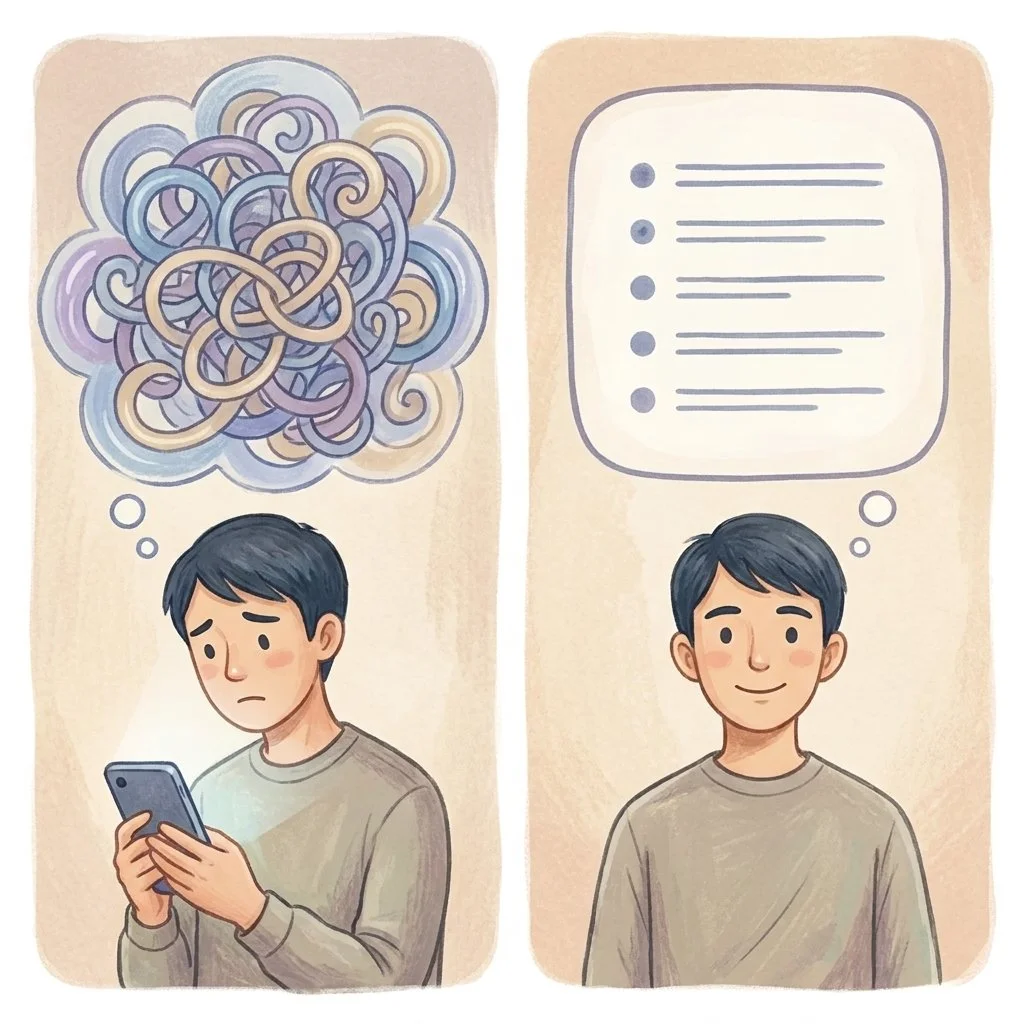
The situation stays the same - what shifts is how clearly you can see the thought behind the feeling.
Five Common Mistakes to Avoid
Thought records are simple, but a few predictable slip-ups can stop them from working. Here's what to watch for.
1. Forcing positive thinking. A balanced thought is not a relentlessly cheerful one. As mental health educators emphasize, healthy thinking means weighing the positive, negative, and neutral parts of a situation - not papering over real concerns. The NHS makes the same point: CBT isn't about "thinking positively". A thought you don't believe won't bring your distress down.
2. Treating feelings as evidence. "It feels true" is not evidence. In the evidence columns, stick to facts - observable, verifiable things - and keep opinions and emotions out of them. Feeling unlikable isn't proof that you are.
3. Arguing with yourself instead of weighing evidence. The aim isn't to win a debate against your own mind; it's to put the thought on trial and let the evidence speak. If you find yourself locked in a back-and-forth, return to the two evidence columns and simply gather facts.
4. Challenging the wrong thought. If your distress barely moves, you may have examined a side thought rather than the hot one. Go back and find the thought most responsible for the strongest feeling - that's the one that needs the spotlight.
5. Skipping the re-rating. That final column isn't optional. Re-rating your emotion tells you whether the exercise actually helped. If the number hasn't budged, it's a useful signal - usually that the balanced thought needs to feel more believable, or that you challenged the wrong thought.
Making It a Habit
Like any skill, thought records get easier and faster with repetition. At first, writing one out might take ten minutes. After a few weeks, you may find yourself running through the columns in your head almost automatically when a worry strikes.
A few tips help it stick. Try to fill one out soon after you notice your mood drop, while the details are fresh. Aim for one a day at the start, even for small upsets - practising on minor worries builds the muscle for bigger ones. This kind of between-session practice is part of why CBT works; research suggests that people who regularly practise these skills outside of therapy tend to see better results.
For doing this on the go, a phone is often easier than carrying a worksheet. You can keep a blank template in your notes app, or use a guided digital tool - apps such as Wellness AI can walk you through the steps conversationally so you're not staring at a blank page. The format matters less than the habit of pausing to examine the thought.
It's also worth knowing the limits. Thought records are a self-help skill for everyday automatic thoughts, not a crisis tool or a replacement for professional care. If your distress feels overwhelming or persistent, a therapist can guide you further - in the UK you can self-refer to NHS Talking Therapies, and elsewhere a licensed mental health professional can help.
Thought records pair naturally with other CBT skills. If you'd like to go deeper, our post on cognitive restructuring expands on the reframing step, our post on Socratic questioning gives you the exact questions to ask when you're weighing the evidence, our guide to CBT techniques for anxiety puts the tool in context, and our roundup of evidence-based CBT techniques shows how it fits alongside others. And if a thought feels too sticky to challenge head-on, our piece on defusion versus restructuring offers a complementary, acceptance-based approach.
About the Author
Dr. Timothy Rubin holds a PhD in Psychology with expertise in cognitive science and AI applications in mental health. His research has been published in peer-reviewed psychology and artificial intelligence journals. Dr. Rubin founded Wellness AI to make evidence-based mental health support more accessible through technology.
Support for Anxious Thoughts, Anytime
Wellness AI offers CBT- and ACT-informed support and personalized meditations to help you work through anxious thinking, whenever you need it.


Frequently Asked Questions
What is a CBT thought record?
A CBT thought record is a worksheet that helps you write down a stressful situation, the automatic thoughts and emotions it triggered, and the evidence for and against those thoughts - so you can replace them with a more balanced, accurate view.
How do I do a thought record step by step?
Note the situation, name and rate your emotion, write down your automatic thoughts and pick the "hot" one, list the evidence for and against it, form a balanced alternative thought, then re-rate your emotion to see if it eased.
What is a "hot thought"?
The hot thought is the automatic thought tied most strongly to your most intense emotion. It's the thought that would be the most upsetting if it were true, which makes it the most useful one to examine.
What's the difference between a 3-column and a 7-column thought record?
A 3-column record covers just the situation, thought, and emotion - great for noticing patterns. A 7-column record adds evidence for, evidence against, a balanced thought, and a re-rating, which is where the actual reframing happens.
Is a thought record the same as positive thinking?
No. The goal is balanced thinking, not positive thinking - you weigh all the evidence to reach an accurate thought, not force an optimistic one you don't believe.
How often should I do a thought record?
Daily practice helps when you're learning, even for small worries. With time the process becomes more automatic, and many people shift to doing it mainly when a strong or recurring thought comes up.
Do thought records actually work?
Cognitive restructuring is a core, well-studied CBT skill, and research suggests it's associated with reduced anxiety and depressive symptoms. CBT built around it is recommended by major health bodies for treating both conditions.
Can I do a thought record without a therapist?
Yes. Many people use thought records on their own with a template or app. If your distress is severe or persistent, though, working with a licensed therapist is the better route.