CBT for OCD: Evidence-Based Techniques That Work
Author: Dr. Timothy Rubin, PhD in Psychology
Originally Published: May 2026
Last Updated: May 2026

ERP — the form of CBT proven to work for OCD — helps you face fears and let go of the rituals that keep them alive.
Contents
- Introduction
- Why "CBT for OCD" Really Means ERP
- Exposure and Response Prevention: A Closer Look
- Theory A vs. Theory B
- How to Build an ERP Hierarchy
- What the Guidelines Recommend
- OCD Comes in Many Themes
- What ERP Feels Like in Practice
- Digital Tools and Self-Help
- Tips for Everyday Practice
- Final Thoughts
- FAQ
Introduction
If you've searched for "cognitive behavioral therapy for OCD," you've probably noticed something confusing. Some sources say CBT is the answer. Others insist the treatment for OCD is something called ERP. So which is it?
Here's the short version: they're closely related, but the distinction genuinely matters. Standard CBT — the kind that helps you identify and challenge anxious thoughts — was developed mainly for depression and generalized anxiety. When applied to OCD without modification, it can fall flat or even make things worse. The form of CBT that works for OCD is Exposure and Response Prevention (ERP), and every major guideline body names it as the first-line psychological treatment.
This guide explains what ERP is, why it works, and what to expect if you try it. OCD is one of the most distressing conditions a person can live with, and it deserves an honest, evidence-based explanation — not vague reassurance. We'll keep the science accessible, link to trustworthy sources throughout, and never promise a cure. What we can say is that, for many people, the right kind of therapy makes a real and lasting difference. (For the broader picture, see our parent guide on CBT techniques for anxiety.)
Why "CBT for OCD" Really Means ERP
Classic cognitive therapy treats anxious thoughts as distortions to be examined and corrected. For many anxiety problems, that works beautifully. But OCD has a trap built into it.
People with OCD already spend enormous mental energy analyzing their intrusive thoughts — checking, reviewing, and trying to reason their way to certainty. If a therapist simply hands them another tool for "challenging the thought," the OCD often hijacks it. The challenging itself becomes a new compulsion: more reassurance-seeking, more mental review, more chasing of a certainty that never quite arrives. As one OCD specialist resource notes, general CBT that isn't tailored for OCD can sometimes be unhelpful or even worsen symptoms.
This is why "CBT for OCD" has come to mean something specific. The treatment that works is ERP — also written ExRP or EX/RP — which pairs deliberate exposure to feared triggers with the deliberate choice not to perform the usual ritual. Light cognitive work still has a place, but its job is to motivate exposure, not to argue you out of your obsessions.
The consensus here is unusually strong. The APA's Division 12 lists ERP as a treatment with strong research support. The International OCD Foundation calls ERP the proven, most effective first-line therapy for OCD in adults, children, and adolescents. The UK's NICE guideline and the National Institute of Mental Health point in the same direction. When the major bodies agree this clearly, it's worth paying attention.
Exposure and Response Prevention: A Closer Look
ERP has two halves, and both are essential — the name tells you so.
Exposure means intentionally facing the situations, thoughts, images, or sensations that trigger your obsessional anxiety. Response prevention means resisting the compulsion that usually follows. Exposure without response prevention is just provocation. Response prevention without exposure is just white-knuckling. Together, they break the cycle that keeps OCD running.
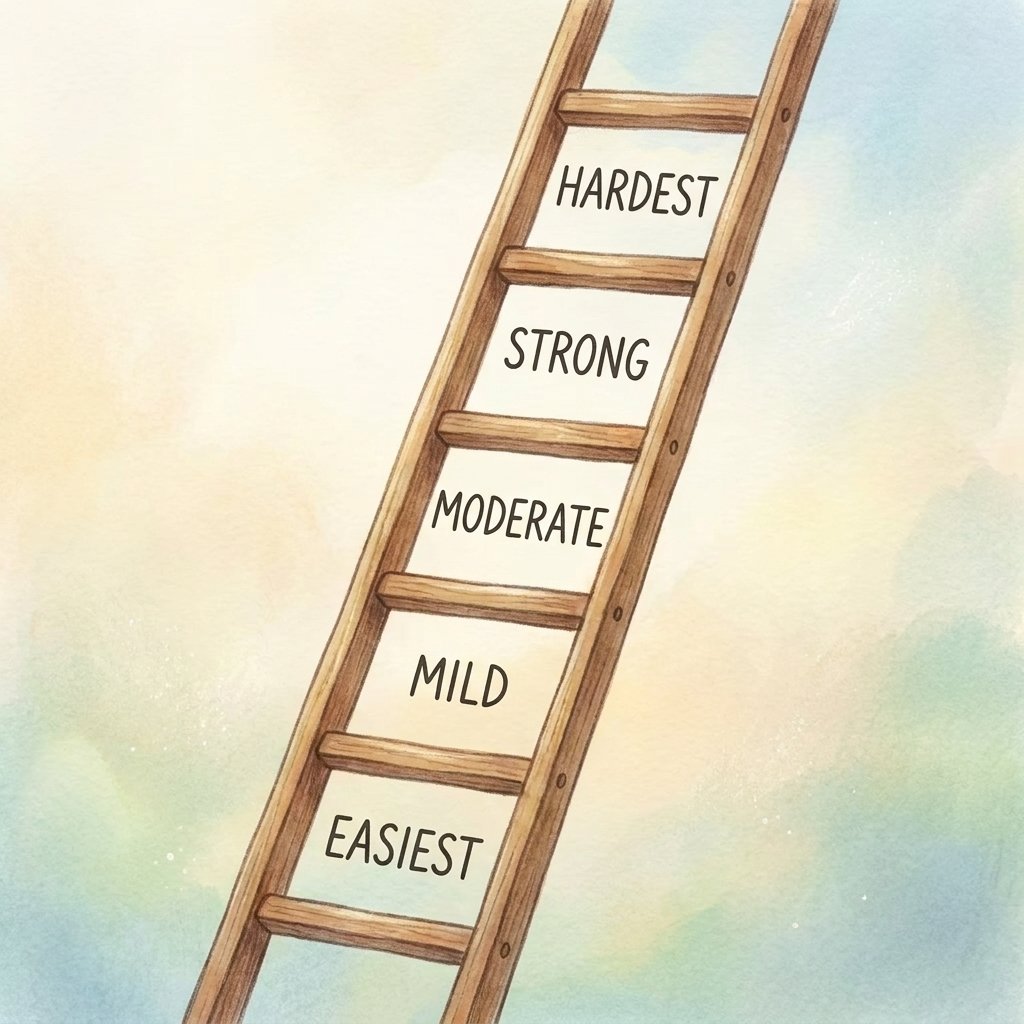
ERP works step by step, climbing a hierarchy of fears from manageable to challenging.
The logic is simple even though the practice is hard. Every time you perform a compulsion, you get a flash of relief — and that relief teaches your brain that the obsession was a real danger and the ritual is what kept you safe. ERP interrupts that lesson. By facing the trigger and skipping the ritual, you give your brain the chance to learn something new.
Building a Fear Hierarchy
ERP doesn't start with your worst fear. It starts with a map.
Together with a therapist — or, for milder OCD, on your own — you list the situations that trigger your obsessions and rate each one using SUDS, or Subjective Units of Distress. SUDS is just a 0-to-100 gut estimate of how distressing a trigger would feel right now without doing the compulsion: 0 is no distress, 100 is unbearable.
Ranked from lowest to highest, that list becomes your fear hierarchy or "ladder." You begin with moderate steps, not the terrifying ones, and work upward as each rung becomes manageable. This is what makes ERP doable rather than overwhelming.
In-Vivo vs. Imaginal Exposure
Not every fear can — or should — be faced in real life.
In-vivo exposure means confronting triggers directly: touching a "contaminated" surface, leaving the stove unchecked, sending an email without rereading it ten times. It's the most common form of ERP and the natural fit for contamination or checking themes.
Imaginal exposure uses detailed written or recorded scripts to face a feared outcome that can't be acted out — for example, the fear of having harmed someone, or a taboo intrusive thought. This matters enormously for so-called "Pure-O" presentations, where the compulsions are almost entirely mental. As the Anxiety and Depression Association of America explains, OCD without visible rituals is still OCD — and imaginal exposure is often the key to treating it.
The Compulsions You Can't See
When people picture OCD, they picture handwashing or lock-checking. Those overt compulsions are real — but the hidden ones often matter more.
Covert, or mental, compulsions include silent reassurance, mentally reviewing events, "neutralizing" a bad thought with a good one, counting in your head, praying compulsively, and replaying memories to check them. They look like nothing from the outside, which is exactly why they're so easily missed.
ERP only works if response prevention covers these too. You can perfectly resist washing your hands and still keep your OCD fully fueled with mental rituals. (For more on living alongside intrusive thoughts, see Managing Intrusive Thoughts: OCD, Anxiety, and Mindfulness.)
How ERP Actually Rewires Fear
For decades, ERP was explained through habituation: stay in the feared situation long enough and your anxiety naturally comes down.
Modern research has refined that picture. The inhibitory learning model, developed by psychologist Michelle Craske and colleagues, suggests the real engine of change is expectancy violation — discovering that the feared outcome simply doesn't happen. Your brain builds a new, safer association that competes with the old fearful one.
The practical implication is freeing. Your anxiety doesn't have to drop during an exposure for it to work. What matters is that you find out the predicted catastrophe didn't occur — or that you coped even when the discomfort lingered. That's why ERP encourages you to predict the outcome before you start: it sets up the moment of learning.
This is also where pure cognitive restructuring can backfire. If your goal is to argue away the thought, you're still treating the thought as a problem to be solved. ERP asks something different — to let the thought be there, drop the ritual, and let real experience do the teaching. (For a deeper look at this distinction, see Cognitive Defusion vs. Cognitive Restructuring.)
Theory A vs. Theory B
If ERP is the behavioral heart of OCD treatment, Theory A vs. Theory B is the cognitive piece that makes it click.
The framework comes from British psychologist Paul Salkovskis, whose cognitive model of OCD — first published in 1985 — reshaped how the disorder is understood. (It's sometimes applied to health anxiety too, but its origin is firmly OCD.) Salkovskis showed that intrusive thoughts themselves are normal; OCD develops from how those thoughts are interpreted, often through an inflated sense of responsibility for preventing harm.
Theory A and Theory B are two competing explanations of your problem:
- Theory A: "My problem is that the bad thing is real. I really am contaminated, dangerous, or about to cause harm — so I need my rituals to stay safe."
- Theory B: "My problem is that I'm excessively worried about the bad thing. The checking, washing, and reassurance are what keep the worry alive."
Rather than the therapist insisting Theory B is correct, you examine the evidence together. Which theory better fits the lived data of your life? Most people, looking honestly, find that Theory B explains far more — the feared catastrophe has never actually happened despite thousands of intrusive thoughts. The work then becomes behavioral: acting as if Theory B is true for a set period, doing ERP, and watching what happens. As Salkovskis framed it, the invitation isn't "trust me" — it's "test it out for yourself."
How to Build an ERP Hierarchy
Here's a simplified, consumer-friendly version of the process. For mild OCD this can be a useful self-help structure; for moderate-to-severe OCD, it should be done with a trained specialist.
- Map your obsessions and compulsions. Write down every recurring intrusive thought, image, or fear — and every behavior or mental act you do to relieve the distress, including subtle ones like reassurance-seeking, mental review, and avoidance.
- Rate each trigger on a 0–100 SUDS scale. Give each one your honest gut estimate of how distressing it would be to face right now without doing the compulsion.
- Rank the list into a hierarchy. Put the lowest-distress items at the bottom and the hardest at the top. Aim for around 10–15 items spread across the full range.
- Choose a starting exposure. Pick something in the moderate range — doable, but high enough to genuinely trigger the obsession. Decide in advance exactly which compulsion you will not perform.
- Predict what will happen. Before you start, write down what you expect ("If I touch this and don't wash, I'll get sick within a day"). This sets up the all-important moment of expectancy violation.
- Run the exposure — and skip the ritual, including mental ones. The goal isn't to make anxiety vanish. It's to find out the predicted disaster doesn't arrive, or that you can cope when discomfort lingers.
- Repeat, then climb. Practice each step until the distress reliably eases or you've clearly shown yourself the feared outcome doesn't materialize. Then move up to the next rung.
What the Guidelines Recommend
The UK's National Institute for Health and Care Excellence (NICE) publishes one of the most widely cited treatment frameworks for OCD: guideline CG31. It remains the current live guideline, though a full update is expected in early 2027 — so the framework below reflects current guidance.
NICE uses a stepped-care model — matching treatment intensity to symptom severity, so no one is over- or under-treated:
- Mild OCD: Low-intensity CBT including ERP — typically guided self-help with ERP, brief individual sessions, or computer-assisted CBT, usually within around 10 therapist hours.
- Moderate OCD: A choice between more intensive CBT including ERP (more than 10 therapist hours) or medication (an SSRI). Both are considered effective, and patient preference guides the decision.
- Severe OCD: Combined treatment — intensive CBT including ERP together with an SSRI — with specialist support.
The SSRIs commonly used for OCD include fluoxetine, sertraline, paroxetine, fluvoxamine, and escitalopram, with clomipramine sometimes used when first-line medications don't help. Medication and ERP are fully compatible, and many people do both at once. Decisions about medication should always be made with a doctor.
OCD Comes in Many Themes
OCD isn't one fixed picture — it shows up in different "themes," and ERP is tailored to each:
- Contamination / cleaning: Touching feared surfaces and refraining from washing — the classic ERP target.
- Checking: Locking the door or turning off the stove once, with attention, then resisting the urge to re-check.
- Symmetry / "just right": Deliberately leaving things uneven or "wrong" and tolerating the discomfort.
- Harm OCD: Imaginal exposure to feared scenarios, paired with dropping mental rituals and reassurance-seeking.
- Sexual, scrupulosity, and relationship OCD ("Pure-O"): Heavy use of imaginal and script-based exposure, with a firm focus on stopping reassurance and mental review. This is among the most misunderstood — and most treatable — presentations. We take a closer look at this presentation in our relationship OCD (ROCD) explainer.
One important note: hoarding is now classified separately as Hoarding Disorder in the DSM-5, and standard ERP is not the right treatment for it. Hoarding has its own specialized cognitive behavioral protocol. If hoarding is the main concern, look for a clinician who treats it specifically.
What ERP Feels Like in Practice
Let's be honest: ERP is hard. Pretending otherwise would do you a disservice.

ERP is challenging work — but for moderate-to-severe OCD, a trained specialist makes the climb far more manageable.
In the early stages, anxiety reliably spikes during exposures. That spike isn't a sign something is going wrong — it's a sign the exposure is doing its job. ERP works because it's uncomfortable. The new learning depends on your brain actually experiencing the feared situation without the safety behavior to lean on.
"Sitting with discomfort" is a skill, and like any skill it gets easier with practice. Most people find that what felt impossible in week one feels merely difficult by week four. None of this means ERP is a grim slog with no relief — many people describe a growing sense of freedom as the rituals lose their grip.
One more thing worth knowing: well-meaning reassurance from family ("you'd never actually do that, you're a good person") can quietly feed OCD. It soothes the obsession for a moment, which is exactly how a compulsion works. Loved ones help more by offering warmth without answering the OCD's questions — for example, "I can see this is really hard, and I'm not going to answer that one, because that's part of your treatment."
For moderate-to-severe OCD, working with a trained OCD specialist is strongly recommended — not just any therapist. The International OCD Foundation and the Association for Behavioral and Cognitive Therapies both offer directories to help you find one.
Digital Tools and Self-Help
For mild OCD, self-directed ERP using a reputable workbook or a guided digital program can be a reasonable starting point, and there's a growing body of research supporting therapist-guided digital ERP.
AI-based wellness apps, including Wellness AI, can play a supporting role — offering psychoeducation, a space to reflect between sessions, and supportive conversation. These tools can complement care, especially for milder symptoms or alongside specialist treatment.
It's important to be clear about the limits, though. Wellness AI is not a substitute for a trained OCD specialist, and it does not deliver formal ERP. Moderate-to-severe OCD specifically benefits from structured ERP guided by a clinician with OCD expertise. Think of digital tools as scaffolding around treatment, not the treatment itself.
Tips for Everyday Practice
- Treat exposures like appointments. Schedule them, write them down, and follow through even when motivation dips. Consistency beats intensity.
- Watch for hidden rituals. Mental reviewing and reassurance-seeking are easy to overlook. If response prevention feels suspiciously easy, look for the compulsion you've missed.
- Resist reassurance — yours and others'. Asking "but I'm fine, right?" feels harmless, but it keeps the cycle turning. Notice the urge and let it pass.
- Expect setbacks. A hard day or a missed exposure isn't failure; it's data. Note it and continue.
- Vary your practice. Doing exposures in different places, times, and moods deepens the learning and makes it stick.
- Bring in support thoughtfully. Let trusted people know how to help — with encouragement, not answers to the OCD's questions.
Final Thoughts
OCD can feel like a closed loop with no exit. It isn't. The form of CBT built specifically for OCD — Exposure and Response Prevention — has decades of research behind it, and for many people it brings meaningful, lasting relief.
It's worth being realistic about what the evidence shows. Across studies, roughly six in ten people who complete a full course of ERP see significant improvement, and about half reach remission. At the same time, around a third don't get a clinically meaningful response from a first course — and that's worth knowing, not hiding. ERP is the best treatment we have, not a guaranteed cure, and intensive programs like the Bergen 4-Day Treatment are a promising sign of how much is possible.
If you recognize yourself in this guide, the most important step is reaching out to a professional who specializes in OCD. The work is hard, but it's the kind of hard that leads somewhere — toward a life that's no longer organized around fear. (For related skills, you may also find our guide on cognitive restructuring helpful as background.)
Important Medical Disclaimer
This content is for educational and informational purposes only and is not intended as medical advice. The information provided should not be used for diagnosing or treating a health condition. If you are struggling with OCD, please consult a qualified mental health professional.
About the Author
Dr. Timothy Rubin holds a PhD in Psychology with expertise in cognitive science and AI applications in mental health. His research has been published in peer-reviewed psychology and artificial intelligence journals. Dr. Rubin founded Wellness AI to make evidence-based mental health support more accessible through technology.
Mental Health Support at Your Fingertips
Try Wellness AI for supportive, evidence-informed conversations and custom guided meditations to complement your mental wellness journey.


FAQ
Is CBT effective for OCD?
It depends on the type. Standard cognitive therapy alone is not the recommended treatment for OCD and can sometimes backfire. The form of CBT proven to work is Exposure and Response Prevention (ERP), which every major guideline body — including NICE, the APA, and the International OCD Foundation — names as the first-line psychological treatment.
What is the difference between CBT and ERP for OCD?
ERP is a specialized form of CBT. While general CBT focuses on identifying and challenging distorted thoughts, ERP focuses on facing feared triggers and resisting the compulsions that follow. For OCD, this behavioral focus is what makes the difference — trying to "think your way out" of obsessions often becomes a new compulsion.
How long does ERP therapy take?
Standard outpatient ERP is typically delivered over roughly 12–20 weekly sessions, though this varies with severity and individual progress. Intensive formats, such as the Bergen 4-Day Treatment, compress the work into a few concentrated days. Many people notice meaningful change within a couple of months of consistent practice.
Does ERP work for "Pure-O" OCD without visible compulsions?
Yes. "Pure-O" is a bit of a misnomer — the compulsions are still there, they're just mental (reassurance, reviewing, neutralizing). ERP for these presentations relies heavily on imaginal exposure and on dropping those hidden mental rituals. It's a treatable form of OCD, even though it's often misunderstood.
Can I do ERP on my own, or do I need a therapist?
For mild OCD, self-directed ERP using a reputable workbook or guided digital program can be reasonable. For moderate-to-severe OCD, working with a trained OCD specialist is strongly recommended — the structure, coaching, and accountability significantly improve outcomes.
Does ERP cure OCD?
ERP is the most effective treatment available, but it isn't a guaranteed cure. Across studies, roughly six in ten people who complete a full course see significant improvement and about half reach remission, while around a third don't get a meaningful response from a first course. For many people, ERP brings lasting relief — but honest expectations matter.
Should I take medication along with ERP?
It's an individual decision made with a doctor. NICE guidance suggests medication (an SSRI) as one option for moderate OCD and recommends combining medication with ERP for severe OCD. The two treatments are fully compatible, and many people do both.
Why doesn't reassurance from family help with OCD?
Reassurance feels caring, but it functions like a compulsion-by-proxy. It briefly soothes the obsession, which reinforces the OCD cycle and teaches the brain that the fear needed answering. Loved ones help more by offering warmth and support without answering the OCD's specific questions.