
If you've ever said "yes" while your body quietly said "no," this post is for you.
People-pleasing can look like kindness on the outside—being helpful, agreeable, "easy to work with." But when your default is to keep the peace at the expense of your own needs, it stops being generosity and starts becoming self-erasure.
In research, people-pleasing overlaps with patterns like self-silencing (suppressing your feelings to preserve connection) and unmitigated communion (extreme focus on others that crowds out the self). Both have been linked to psychological distress and depressive symptoms.
The good news: boundary-setting is a learnable skill. You can learn how to say no nicely—firm and kind.
Do You People-Please? Common Patterns to Recognize
People-pleasing can be subtle. You might:
- Apologize reflexively, even when you've done nothing wrong
- Feel anxious or guilty when someone seems disappointed
- Say "yes" before fully processing the request
- Rarely express preferences in group decisions
- Feel responsible for others' emotions
- Overexplain your "no" or soften it with extensive reasoning
If these feel familiar, you're not alone—and you're not broken. These are learned protective strategies.
Why People-Pleasing Feels So Hard to Stop
Most people-pleasing isn't about wanting attention. It's more often about wanting safety—emotional safety, relational safety, social safety.
Fear of Rejection Is a Powerful Motivator
In psychology research, rejection sensitivity refers to the tendency to anxiously expect, quickly perceive, and intensely react to rejection. Research suggests that when rejection feels likely, people may accommodate "too much" to prevent it, then feel hurt or angry when they still don't feel secure.
Neuroscience adds another layer: social exclusion can activate brain regions associated with distress. That doesn't mean rejection and physical pain are identical—but it helps explain why your nervous system may treat "saying no" as a threat.
People-Pleasing Often Looks Like Self-Silencing
Self-silencing research describes suppressing preferences and emotions to maintain closeness. Studies on unmitigated communion—being highly invested in others while neglecting yourself—consistently link it with psychological distress and depression symptoms.
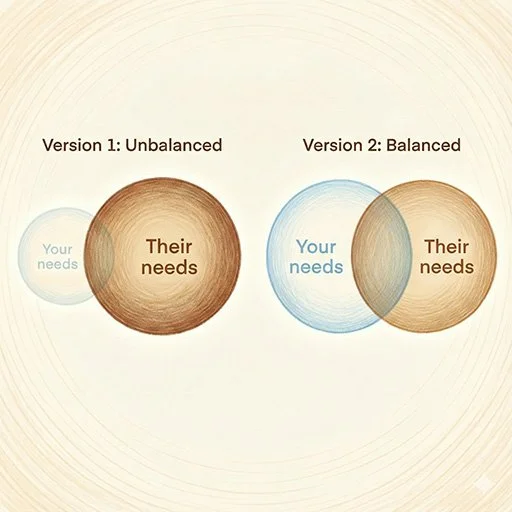
Healthy boundaries create overlap while preserving your identity.
Why Setting Boundaries Supports Mental Health
Boundaries aren't punishments. They're guidelines for how you can show up sustainably—without resentment or chronic stress.
Research shows that assertiveness training is an evidence-based approach that can reduce anxiety symptoms and improve self-esteem. Studies also show assertiveness skills are associated with reductions in stress and anxiety.
The CDC's National Institute for Occupational Safety and Health has published guidance on setting healthy boundaries to reduce stress, especially in caregiving roles where overextension is common.
If you're struggling with anxiety around disappointing others, this guide may help: Cognitive restructuring: how to reframe anxious thoughts.
How to Say No Nicely: 3 Scripts That Work
You don't need a perfect speech. You need a repeatable structure.
1) The "Warm No" (Short, Appreciative, Firm)
- "Thanks for thinking of me, but I can't."
- "I'm flattered you asked—no, I'm not able to take that on."
- "I can't commit to that right now."
2) The "No + Alternative" (Only If You Genuinely Mean It)
- "I can't meet this week, but I could do a 15-minute call next Tuesday."
- "I can't take the whole project, but I can review the first draft."
3) The "Broken Record" (For Pushback)
- "I hear you. And my answer is still no."
- "I understand this matters to you. I'm not able to do it."
30-Second Mindfulness Technique Before Saying Yes
People-pleasing often happens in the gapless moment—request → automatic yes. The goal is to create a gap.
Try this breathing technique:
- Inhale gently through your nose for 4 seconds
- Exhale slowly for 6–8 seconds
- Ask: "If I say yes, what do I lose? If I say no, what do I protect?"
Research suggests diaphragmatic breathing may decrease physiological and psychological stress. A meta-analysis of breathwork interventions found beneficial effects on stress and mental health outcomes.
Quick variations when 30 seconds isn't available:
- The 3-breath reset: Three slow, deep breaths while asking "What do I actually want here?"
- The body check: Quick scan—where do I feel tension? That's usually where my real answer lives.
- The future-self test: "Will future-me thank me for this yes?"
For more grounding techniques during emotional overwhelm, see: Coping with emotional overwhelm using evidence-based grounding techniques.
What to Do With the Guilt Afterward
Guilt is common when you stop people-pleasing—not because you're doing something wrong, but because you're breaking an old safety strategy.
Two reframes that help:
- Guilt is a feeling, not a verdict
- Discomfort is part of skill-building
If guilt shows up as "I'm selfish," cognitive reframing can help you reality-check that thought. Ask yourself: "Would I call my friend selfish for protecting their energy?"

Guilt is a feeling to notice, not a verdict to obey
Why Boundaries Can Improve Relationships (Not Ruin Them)
Trying to secure acceptance by suppressing yourself can backfire. Research shows that self-silencing toward a prospective partner predicted greater post-rejection hostility—suggesting that over-accommodation can fuel resentment.
Long-term relationship research on unmitigated communion shows that "overgiving" and relationship quality change together over time, not separately.
In healthier relationships, boundaries create clarity. People aren't guessing what you want. And your "yes" starts to mean something again.
If you struggle with anxiety in relationships, this resource may help: Relationship anxiety and anxious attachment: origins, symptoms, and healing.
When Boundaries Feel Impossible (Family, Work, Power Dynamics)
Some situations are genuinely harder—especially where there's dependence, culture, hierarchy, or history.
A few principles that help:
- Scale your boundary to the risk. Start with small, behavioral boundaries before bigger emotional ones.
- Use policies, not personalities. "I don't discuss finances outside a planned time" is easier to enforce than "You're always pressuring me."
- Practice first. Rehearsal matters—try it out loud before the real conversation.
If anxiety is a big part of your people-pleasing, values-based approaches can help you tolerate discomfort while acting in line with what matters. You may like: ACT for anxiety: Acceptance & Commitment Therapy guide.
For workplace stress specifically, see: Meditation for work stress: practical mindfulness techniques.
About the Author
Dr. Timothy Rubin holds a PhD in Psychology with expertise in cognitive science and AI applications in mental health. His research has been published in peer-reviewed psychology and artificial intelligence journals. Dr. Rubin founded Wellness AI to make evidence-based mental health support more accessible through technology.
Discover Personalized Support for Your Journey
Try Wellness AI for personalized support for people-pleasing and related mental health challenges.


Frequently Asked Questions
What are the signs of people-pleasing?
Common signs include apologizing reflexively, feeling anxious when someone seems disappointed, saying yes before fully processing requests, rarely expressing preferences, and feeling responsible for others' emotions.
How do I set boundaries with family who don't respect them?
Start with one concrete, repeatable boundary and one calm response. Use the "broken record" technique—repeat your boundary calmly. If needed, end the conversation when the boundary isn't respected.
Can I be assertive without feeling guilty?
Guilt often shows up first when breaking old patterns. Over time, as your brain learns that saying no doesn't mean losing connection, the guilt typically decreases.
Is setting boundaries selfish?
No. Boundaries prevent resentment and burnout, allowing you to show up more honestly in relationships. They're a form of sustainable self-care.
How do I say no at work without damaging relationships?
Use clear trade-offs: "I can do X by Friday, but I can't add Y without moving the deadline." This approach is both firm and collaborative.
How long does it take to stop people-pleasing?
It varies by person, but many people notice shifts within weeks of consistent practice. The key is starting with small boundaries and building from there.