Author: Dr. Timothy Rubin, PhD in Psychology
Originally Published: February 2025
Last Updated: February 2025

Learning to rest without guilt isn't laziness—it's essential for your wellbeing and, ironically, your productivity.
Contents
- What Is Productivity Guilt?
- Why Do I Feel Guilty When I'm Not Working?
- Your Brain Actually Needs Downtime
- Why Rest Can Feel Uncomfortable
- CBT Techniques for Challenging Productivity Guilt
- Mindfulness and Self-Compassion: Making Peace with Rest
- Practical Strategies That Actually Work
- FAQ: Productivity Guilt
You finally have a free afternoon. No deadlines, no obligations. You could read that book, take a nap, or just... do nothing. But instead of feeling relieved, you feel a knot in your stomach. A voice in your head whispers that you should be doing something useful.
If this sounds familiar, you're experiencing productivity guilt—the uncomfortable feeling that rest is wasteful or undeserved. It's surprisingly common, and it actively undermines both your wellbeing and your effectiveness.
The good news? This pattern can be changed. Let's explore where productivity guilt comes from and evidence-based strategies to help you embrace rest without anxiety.
What Is Productivity Guilt?
Productivity guilt is the shame or anxiety that surfaces when you're not being "productive." It's that nagging feeling that you should always be accomplishing something, and that taking a break means you're lazy or falling behind.
Research from 2021 found that people who view leisure as wasteful report lower happiness and greater depression, anxiety, and stress. Critically, they also enjoy their downtime less—creating a cycle where rest feels neither refreshing nor guilt-free.
This isn't just about being a hard worker. Productivity guilt often reflects deeper beliefs about self-worth—specifically, the idea that your value as a person depends on what you produce.
Why Do I Feel Guilty When I'm Not Working?
The Achievement-Worth Connection
Many of us have internalized the message that busyness equals worthiness. Research on workaholism shows that people often work compulsively to preserve feelings of self-worth, driven by the need for social approval.
When your sense of value is tied to achievement, rest feels threatening. Taking a break can trigger anxiety because it temporarily removes the thing that makes you feel "good enough."
Perfectionism's Role
Perfectionism is one of the strongest predictors of productivity guilt. A meta-analysis of 284 studies found perfectionism strongly linked to depression, anxiety, and OCD symptoms.
When you hold impossibly high standards, there's always something more you "should" be doing. As researchers note, perfectionists become "overwhelmed with self-set demands, which preclude them from rest, relaxation, and self-care."
If you struggle with perfectionist thinking, you might find our guide on ACT for anxiety helpful—it teaches how to hold high standards while still making room for rest.
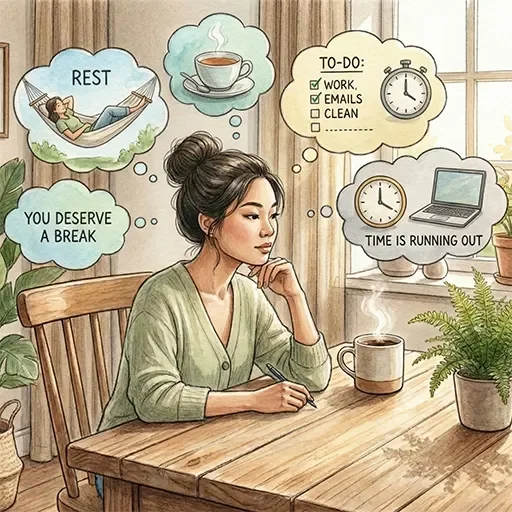
Perfectionism creates a cycle where there's always something more you "should" be doing, making rest feel impossible.
Your Brain Actually Needs Downtime
Here's something that might help quiet your inner critic: your brain genuinely needs rest to function well.
Neuroscientists have discovered the default mode network (DMN)—a system of brain regions that becomes most active when you're not focused on external tasks. During wakeful rest, this network supports memory consolidation, creative thinking, and self-reflection.
Research shows that the DMN helps create coherent internal narratives and supports planning for the future. When you're constantly task-focused, you're actually preventing important cognitive processing from happening.
A 2025 meta-analysis found that brief periods of wakeful rest significantly improve memory retention—effects that last even a week later. This isn't productivity guilt talking; this is neuroscience confirming that rest makes you more effective, not less.
For more on how rest supports mental health, explore our guide on body scan meditation.
Why Rest Can Feel Uncomfortable
For some people, the problem goes beyond guilt—relaxation itself triggers anxiety. This phenomenon, called relaxation-induced anxiety, affects 17-53% of adults.
Why would relaxing make you anxious? Researchers at Penn State found that people with anxiety may unconsciously maintain worry to avoid emotional vulnerability. If you're already tense, staying tense feels safer than relaxing and potentially facing a sharp emotional drop if something bad happens.
If you notice anxiety spiking when you try to rest, know that this is a recognized pattern—not a personal failing. Gradual exposure to relaxation, perhaps starting with just a few minutes of guided meditation, can help desensitize this response over time.
CBT Techniques for Challenging Productivity Guilt
Cognitive Behavioral Therapy offers the most extensively researched approach to perfectionism and guilt. Meta-analyses show large effect sizes for CBT's impact on perfectionism, with benefits for both depression and anxiety.
Identify Your Cognitive Distortions
Productivity guilt often involves predictable thinking patterns. Common ones include:
- All-or-nothing thinking: "If I'm not being productive, I'm being lazy"
- "Should" statements: "I should always be doing something useful"
- Discounting the positive: "That break didn't count—I was still thinking about work"
For a deeper dive into recognizing these patterns, see our cognitive restructuring guide.
Try This: The Thought Record
When you notice guilt about resting, try this exercise:
- Situation: Write down what happened (e.g., "Sat down to watch TV on Sunday afternoon")
- Automatic thought: What went through your mind? ("I'm wasting time. I should be cleaning.")
- Evidence for: What supports this thought?
- Evidence against: What contradicts it? (Did you work all week? Is rest actually wasteful?)
- Balanced thought: A more realistic perspective ("Rest is part of being healthy. I worked hard this week and deserve downtime.")
This technique from CBT for anxiety helps you examine whether your guilt is based on facts or unhelpful assumptions.

Writing down and examining your thoughts about rest can reveal how unrealistic your guilt actually is.
Mindfulness and Self-Compassion: Making Peace with Rest
While CBT helps you challenge guilty thoughts, mindfulness and self-compassion help you change your relationship to them entirely.
The Power of Self-Compassion
Self-compassion researcher Kristin Neff defines it as treating yourself with the same kindness you'd offer a friend. Her research shows that self-compassion reduces depression, anxiety, and—importantly—guilt.
A 2023 meta-analysis found that self-compassion interventions produce significant reductions in depression, stress, and anxiety. The key insight: you can hold yourself to high standards while still being kind to yourself when you fall short—or when you simply need rest.
Try This: The Self-Compassion Break
When productivity guilt strikes, try this three-step practice:
- Mindfulness: "This is a moment of guilt. This feels uncomfortable."
- Common humanity: "Many people struggle with feeling they should always be productive. I'm not alone in this."
- Self-kindness: "May I be kind to myself. Rest is a human need, not a weakness."
This approach draws from Mindfulness-Based Cognitive Therapy (MBCT), which combines mindfulness with cognitive techniques for lasting change.
Practical Strategies That Actually Work
Schedule Rest Like an Appointment
If rest feels like "wasted" time, try treating it as a non-negotiable commitment. Research on psychological detachment shows that intentionally disconnecting from work improves wellbeing and prevents burnout.
Put "rest" or "downtime" in your calendar. When the guilt voice says you should be working, you can respond: "This time is already allocated."
Start with Micro-Breaks
If longer rest feels impossible, start small. A 2022 meta-analysis found that even brief micro-breaks improve energy and reduce fatigue—especially when the break involves non-work activities.
Try five minutes of stepping away from your desk, or a short grounding exercise. These small doses of rest can help you build tolerance for longer periods of downtime.
Reframe Rest as Productive
If your brain insists everything must serve a purpose, remind it: rest is productive. It consolidates memories, sparks creativity, prevents burnout, and makes your working hours more effective.
You're not choosing between productivity and rest. You're choosing between sustainable productivity and eventual burnout.
Address Boundary Issues
Sometimes productivity guilt is reinforced by poor boundaries—saying yes to everything, or feeling responsible for others' needs. If this resonates, our guide on setting healthy boundaries may help.
Moving Forward
Productivity guilt is common, but it's not inevitable. By understanding its roots—perfectionism, achievement-based self-worth, and cultural messages about busyness—you can start to loosen its grip.
The research is clear: rest isn't the enemy of productivity. Guilt about rest is. Your brain needs downtime. Your body needs recovery. And you deserve care that isn't contingent on constant output.
Start small. Challenge one guilty thought. Take one five-minute break without justifying it. And remember: learning to rest well is itself an accomplishment worth celebrating.
-Tim, Founder of Wellness AI
About the Author
Dr. Timothy Rubin holds a PhD in Psychology with expertise in cognitive science and AI applications in mental health. His research has been published in peer-reviewed psychology and artificial intelligence journals. Dr. Rubin founded Wellness AI to make evidence-based mental health support more accessible through technology.
Build a Healthier Relationship with Rest & Productivity
Try Wellness AI for CBT techniques and guided meditations that help you embrace downtime without guilt.


FAQ: Productivity Guilt
Why do I feel guilty when I'm not working?
Productivity guilt often stems from tying your self-worth to achievement. Cultural messages that equate busyness with value, combined with perfectionist tendencies, can make rest feel undeserved.
How can I relax without feeling anxious about my to-do list?
Try scheduling rest as a non-negotiable appointment and practice mindfulness to stay present. CBT techniques can help challenge thoughts like "I should be doing something productive."
Is it normal to feel anxious when trying to rest?
Yes—relaxation-induced anxiety affects 17-53% of adults. Some people unconsciously stay tense to avoid feeling vulnerable. Gradual exposure to rest through short meditations can help.
What is productivity guilt?
Productivity guilt is the shame or anxiety that arises when you're not being "productive." It's rooted in beliefs that rest must be earned and that your value depends on constant output.
Can CBT help with productivity guilt?
Yes, CBT is highly effective for perfectionism and related guilt. Techniques like cognitive restructuring help identify and challenge unhelpful beliefs about productivity and self-worth.
How do I stop feeling like I always need to be productive?
Start by identifying the beliefs driving this feeling, then practice self-compassion and schedule intentional rest. Remember: rest improves—not hinders—your actual productivity.