Health Anxiety Help: CBT Techniques to Stop Googling Symptoms
Author: Dr. Timothy Rubin, PhD in Psychology
Published: January 2026

Health anxiety can turn a simple symptom search into hours of worried scrolling. CBT techniques can help break the cycle.
Note: This article is for education, not medical advice. If you have severe or rapidly worsening symptoms (such as chest pain, trouble breathing, or thoughts of self-harm), seek urgent medical care or emergency services.
Contents
- Why Googling Symptoms Makes Anxiety Worse
- What Health Anxiety Looks Like
- The CBT Model: Why Reassurance Backfires
- 4 CBT Techniques to Stop the Googling Habit
- Digital Tools and When to Seek Help
- FAQ: Health Anxiety and Symptom Checking
If you've ever Googled a symptom "just to be safe" and ended up more scared than before, you're not alone.
Online health searching is incredibly common. CDC data shows nearly 60% of adults use the internet to look up health information each year. But for some people, symptom-checking becomes a loop that feeds anxiety rather than calming it.
Research on "cyberchondria" finds that higher health anxiety is linked with more frequent and more distressing online searches. This post explains how that loop works—and shares practical CBT techniques to break it.
What Health Anxiety Looks Like
Most people worry about health sometimes. Health anxiety becomes a problem when that worry is persistent, hard to control, and starts running your day—especially when reassurance only calms you briefly.
Clinically, some people meet criteria for Illness Anxiety Disorder. Clinical reviews describe it as a preoccupation with serious illness plus behaviors like repeated checking, reassurance seeking, or avoidance.
Common Signs of Health Anxiety
- Googling symptoms multiple times daily
- Checking your body repeatedly for signs of illness
- Seeking reassurance from doctors, family, or online forums
- Feeling temporary relief after reassurance—but the worry returns
- Avoiding health information entirely (the opposite extreme)
- Difficulty concentrating on work or relationships due to health fears
One important point: health anxiety isn't "fake." Anxiety can create real physical sensations—tightness, nausea, tingling, racing heart. The issue is that the brain interprets these sensations as danger, then uses checking behaviors to try to feel certain.
The CBT Model: Why Reassurance Backfires
Cognitive Behavioral Therapy (CBT) is one of the best-studied treatments for health anxiety. Meta-analyses confirm CBT reduces health anxiety compared with control conditions.
CBT focuses on understanding the maintenance loop that keeps health anxiety alive:
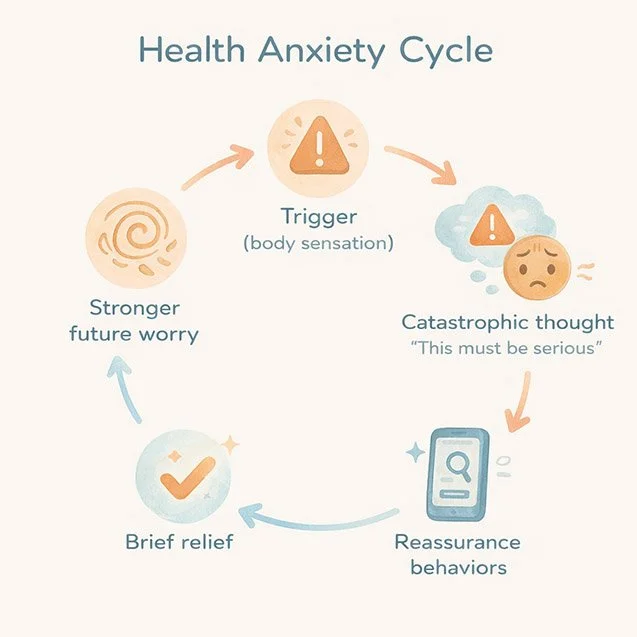
The health anxiety cycle: reassurance provides short-term relief but strengthens long-term worry.
- Trigger: A sensation, story, headline, or memory
- Catastrophic interpretation: "This must be serious"
- Anxiety + body sensations: Which feel like "proof"
- Reassurance behaviors: Googling, checking, asking, retesting
- Short-term relief
- Long-term cost: Your brain learns "checking = safety," so the urge returns faster next time
A classic cognitive-behavioral paper by Salkovskis & Warwick explains why reassurance maintains health anxiety rather than resolving it. Each time you check and feel relief, your brain strengthens the connection between "uncertainty = danger" and "checking = safety."
4 CBT Techniques to Stop the Googling Habit
You don't need to do everything perfectly. Pick one technique to practice daily for a week before adding another.
1. Write a Balanced Thought
Health anxiety often jumps from a sensation straight to a diagnosis: "Headache → tumor" or "Chest tightness → heart attack." Instead of debating internally, write one balanced sentence:
"This is uncomfortable and I'm anxious. Serious causes are possible, but common, benign causes are also likely. I can take a measured next step."
This is classic cognitive restructuring—not dismissing your concern, but responding proportionally rather than catastrophically.
2. Turn Googling Into a Scheduled Choice
When Googling is used to neutralize fear, it acts like a compulsion. The goal isn't "never look anything up"—it's to stop treating uncertainty like an emergency.
Try this three-part plan:
- Delay: When the urge hits, set a timer for 10 minutes. Re-rate the urge (0-10). Delay again if needed.
- Rule: "No symptom searching outside my planned window."
- Replace: During the delay, do a grounding activity—walk, stretch, breathe, shower.
This builds new learning: "I can feel uncertainty and it passes."

Replacing the urge to Google with grounding activities helps retrain your brain's response to uncertainty.
3. Reduce Reassurance Behaviors Gradually
Reassurance behaviors include checking your body, re-reading test results, asking loved ones repeatedly, or visiting multiple health forums. These behaviors lower anxiety short-term but keep the brain stuck in "threat mode."
CBT targets them with graded reduction:
- Week 1: Cut one behavior by 25%
- Week 2: Cut by another 25%
- Week 3: Replace with a coping skill
Research comparing cognitive therapy vs exposure therapy for health anxiety found both approaches effective. The key is gradually facing uncertainty rather than avoiding it.
4. Contain Worry with Scheduled Worry Time
If worry is "on" all day, try giving it a container. This technique, sometimes called "worry postponement," has been studied as a way to reduce daily worry.
How to practice worry time (20 minutes/day):
- Pick a daily window (not right before bed)
- Outside that window, write the worry down: "Later"
- During worry time, problem-solve what's actionable and practice letting go of what isn't
Combine this with brief mindfulness: Label what's happening without adding a diagnosis—"Tightness," "warmth," "tingle." Then anchor to the present (feet on the floor, breath, sounds). Research shows mindfulness interventions can improve anxiety symptoms.
For more on combining mindfulness with cognitive techniques, see our guide on Mindfulness-Based Cognitive Therapy (MBCT).
Digital Tools and When to Seek Help
Evidence-based digital CBT can help when access to in-person therapy is limited. A randomized trial found internet-based CBT improved severe health anxiety. In a larger study, internet-delivered CBT was comparable to face-to-face CBT for health anxiety.
AI-powered mental health apps can provide accessible support for practicing CBT techniques between therapy sessions. Look for tools that teach evidence-based skills like cognitive restructuring and mindfulness rather than just providing general reassurance.

Digital CBT tools can provide structured support for managing health anxiety between therapy sessions.
When to Seek Professional Help
Consider working with a CBT-trained therapist if:
- Health worry has persisted for months
- It interferes with sleep, work, or relationships
- Self-help techniques aren't providing sufficient relief
- You're avoiding medical care entirely due to fear
A clinician can help you target the maintenance loop faster and provide structured exposure exercises tailored to your specific fears.
-Tim, Founder of Wellness AI
About the Author
Dr. Timothy Rubin holds a PhD in Psychology with expertise in cognitive science and AI applications in mental health. His research has been published in peer-reviewed psychology and artificial intelligence journals. Dr. Rubin founded Wellness AI to make evidence-based mental health support more accessible through technology.
Break the Worry Cycle with Personalized Support
Try Wellness AI for CBT-based techniques and calming meditations tailored to your needs.


FAQ: Health Anxiety and Symptom Checking
When does normal health concern become health anxiety?
When worry is frequent, hard to control, and disrupts daily life—especially if reassurance only helps briefly before the worry returns.
How can I stop Googling symptoms when the urge feels overwhelming?
Use delay and rules: wait 10 minutes before searching, then only search during a planned window. Replace the urge with a grounding activity like walking or deep breathing.
Does CBT really work for health anxiety?
Yes. Meta-analyses find CBT significantly reduces health anxiety. Internet-based CBT has also been shown effective for severe health anxiety.
What if my symptom is actually serious?
It's always okay to seek medical care for red-flag symptoms or new/worsening issues. CBT is about responding proportionally, not ignoring legitimate health concerns.
Should I seek professional help for health anxiety?
If health worry lasts months, interferes with sleep or work, or feels consuming, a clinician trained in CBT can help you target the cycle faster.
Are online CBT programs effective for health anxiety?
Yes. Trials show internet-based CBT can be comparable to face-to-face CBT for health anxiety, making it a viable option when access to therapy is limited.