Meditation for Breakups: Stop Rumination and Rebuild Self-Worth (with CBT)
Author: Dr. Timothy Rubin, PhD in Psychology
Originally Published: January 10, 2026
Last Updated: January 10, 2026

Meditation for breakups isn’t about “getting over it fast.” It’s about creating enough calm to grieve, think clearly, and rebuild.
Contents
- Why breakups hurt so much
- Rumination vs. reflection
- How meditation helps you stop ruminating after a breakup
- Guided meditation for breakup anxiety spikes (4-minute script)
- Rebuild self-worth with compassion-focused meditation
- Meditation and CBT for breakups: 3 anti-rumination tools
- Journaling prompts for breakup recovery
- Digital supports (without doomscrolling)
- When to get extra help
Breakups can make even steady, capable people feel emotionally “hijacked.” One minute you’re fine, and the next you’re replaying a conversation from months ago like it’s live footage.
If you’re searching for meditation for breakups or how to stop ruminating after a breakup, you’re probably not looking for vague advice. You want something practical that calms the spike, loosens the mental loop, and helps you rebuild your sense of self.
This guide is research-informed and designed for real life. We’ll cover why heartbreak can feel physical, what rumination is (and isn’t), and how to combine meditation with a few CBT-style tools to reduce “what if” spirals—without pretending grief should be quick or neat.
Why breakups hurt so much
Heartbreak isn’t “just emotional.” In a classic neuroimaging study, researchers found that social exclusion activates pain-related brain regions. In plain terms: rejection can register like injury.
There’s also an identity piece. Romantic relationships don’t just add someone to your life—they often become part of how you define yourself. Research suggests breakups can temporarily disrupt that inner stability; one study found self-concept clarity drops after a breakup.
And then there’s attachment. When a bond ruptures, your nervous system can interpret it as a threat: “Find them. Fix this. Don’t lose this.” Studies on attachment and breakups show that attachment processes shape post-breakup adjustment, and that attachment-related patterns can interact with rumination in a way that keeps the distress going (attachment and rumination findings).
None of this means you’re broken. It means your mind is doing what minds do: trying to protect you after a loss.
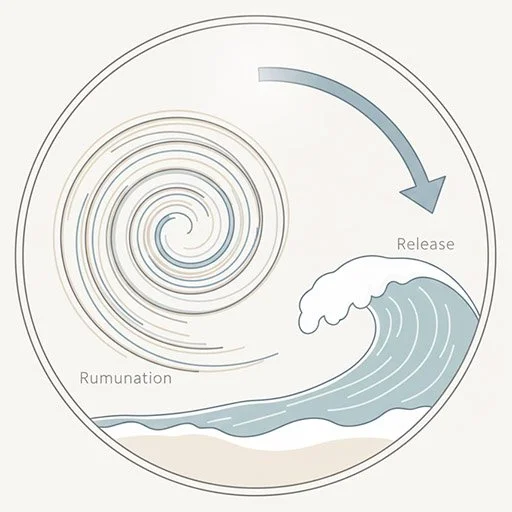
Rumination often feels like a loop. Meditation helps you experience it more like a wave—rising, cresting, and passing.
Rumination vs. reflection
Rumination is repetitive, sticky thinking that goes in circles. It’s the “why did this happen?” loop, the “what did I do wrong?” spiral, or the mental bargaining that never resolves.
Researchers have long linked rumination to longer-lasting distress, including depression and mixed anxiety/depression symptoms (rumination and mood symptoms). That doesn’t mean every painful thought is harmful. It means the pattern matters.
A helpful distinction:
- Reflection moves you forward (insight, learning, closure steps).
- Rumination keeps you stuck (replay, self-blame, endless “what if”).
If you notice the same thought arriving with the same emotional punch multiple times a day, it’s likely rumination—not productive reflection.
How meditation helps you stop ruminating after a breakup
Mindfulness isn’t about forcing yourself to “think positive.” It’s training attention—so you can notice a thought as a thought, instead of being dragged behind it.
In clinical research, mindfulness-based approaches have been associated with reductions in depressive rumination; a systematic review and meta-analysis found mindfulness-based interventions can reduce rumination. One mechanism is often described as decentering—the ability to observe thoughts and feelings with a bit more distance. Work on MBCT suggests decentering can increase through mindfulness-based training.
For breakups, this matters because rumination is attention glued to the past. Meditation helps you practice a different move: “I notice my mind is replaying. I can return to what’s here.”
Three micro-skills that make a big difference:
- Labeling: “This is rumination.” (Not “this is truth.”)
- Body anchoring: shifting attention from storyline to sensation.
- Gentle returning: coming back to breath, sound, or touch—again and again.
That’s the core of meditation for breakups: not deleting pain, but changing your relationship to it.
Guided meditation for breakup anxiety spikes (4-minute script)
This is a short guided meditation for a breakup moment—when your chest tightens, your thoughts speed up, or you feel the urge to text, scroll, or “check” for proof you still matter.
Set a timer for 4 minutes. If that feels like too much, do 90 seconds. Smaller counts.
4-minute “urge-surfing + self-soothing” practice
- Arrive (10 seconds): Put a hand on your chest or belly. Feel the contact.
- Name the wave (20 seconds): Silently say: “This is a heartbreak spike.”
- Track the body (60 seconds): Where do you feel it? Tight throat, heavy stomach, buzzing hands? Describe sensations (pressure, heat, tingling) without explaining them.
- Breathe with it (60 seconds): Inhale normally. Exhale a little longer. Imagine the exhale making space around the sensation.
- Offer a steady phrase (60 seconds): Try: “This hurts, and I can stay with it.” Or: “I don’t have to solve this right now.”
- Choose one kind next step (30 seconds): Drink water. Step outside. Text a friend. Write one line in a note. Do one small, stabilizing action.
This practice works best when it’s paired with a concrete follow-up. If you want extra grounding ideas for intense moments, see our guide on how to calm emotional overwhelm.
Rebuild self-worth with compassion-focused meditation
Breakups often damage self-worth—not because you suddenly became unlovable, but because rejection (or abandonment) can trigger a harsh inner critic.
Self-compassion is one evidence-informed antidote. A meta-analysis found self-compassion is associated with lower psychopathology. And loving-kindness style practices have also shown beneficial effects across mental health outcomes in meta-analytic research (loving-kindness meta-analysis).
The goal isn’t to “forgive everything instantly.” It’s to practice a different inner tone: supportive, truthful, and steady.

Compassion-focused imagery helps rebuild a sense of inner safety—especially when your self-worth feels shaken.
Morning or evening compassion imagery (3–5 minutes)
- Step 1: Picture a version of you who is hurting (today-you, or you from the hardest moment). Notice their face and posture.
- Step 2: Imagine offering them what they needed most: warmth, reassurance, a safe place to rest. Keep it simple.
- Step 3: Say one sentence you actually believe, like: “You’re allowed to grieve.” “You’re still worthy.” “You will not feel like this forever.”
If this style resonates, you might also like our deeper guide to loving-kindness meditation (it’s not breakup-specific, but the skills transfer surprisingly well).
Meditation and CBT for breakups: 3 anti-rumination tools
Meditation helps you notice thoughts. CBT helps you work with them—especially when the thought is distorted, self-blaming, or catastrophizing.
One targeted approach, rumination-focused CBT, has been tested in clinical contexts; a randomized trial reported benefits for residual depressive symptoms (rumination-focused CBT trial). You don’t need to run a formal protocol to borrow a few core moves.
Tool 1: The “thought record lite” (2 minutes)
- Trigger: What set me off?
- Story my mind tells: (One sentence.)
- Balanced alternative: Something more accurate and less brutal.
Need a refresher on thought reframing? Here’s our guide to cognitive restructuring.
Tool 2: “Maybe yes, maybe no” (uncertainty practice)
Many breakup spirals are fueled by certainty cravings: “I need to know why,” “I need to know if they’ll come back,” “I need closure now.”
Try this: “Maybe yes, maybe no.” Then return to what you can actually do today. This isn’t giving up—it’s reducing the brain’s urge to keep chasing an answer that isn’t available.
Tool 3: Scheduled rumination (yes, really)
Pick a 10-minute window each day called “rumination time.” When thoughts hit outside the window, write a 3-word note (e.g., “miss them,” “what if,” “anger”) and postpone to the window.
Paradoxically, containment often reduces frequency. Your mind learns: “We’re not doing this all day.”
Journaling prompts for breakup recovery
Journaling helps when it moves you from replay to meaning-making. If you write and feel worse, that’s a sign to shorten the time or use more structured prompts.
Try one prompt per day (5–10 minutes)
- “The story my mind is telling is…” (Then: “A kinder, truer story could be…”)
- “What I needed in that relationship was…” (No judgment—just clarity.)
- “What I can control this week is…” (Tiny, specific, doable.)
- “The values I want to carry forward are…” (Love, honesty, steadiness, play, etc.)
- “One way I’ll practice self-respect today is…”
If you notice your journaling is mostly about fear of abandonment, reassurance seeking, or “I’m not enough,” it may help to learn about anxious attachment patterns. Here’s a related guide: relationship anxiety and anxious attachment.

Structured journaling can turn “mental replay” into clarity—without feeding the spiral.
Digital supports (without doomscrolling)
Digital tools can support healing—especially for guided audio, structured journaling, and CBT worksheets. They can also make things worse if you use them to monitor, compare, or re-open the wound.
A simple rule: choose tools that move you toward regulation and values (breathing, mindfulness, reflection prompts), and limit tools that keep you stuck in threat scanning (checking an ex’s profile, rereading old messages, endless “breakup advice” loops).
If you’re using an app or audio practice, try pairing it with one real-world step: a short walk, a shower, a meal, or one supportive message to a friend. Nervous systems heal faster with both internal and external safety cues.
When to get extra help
Grief after a breakup is normal. It often comes in waves, and it can include anger, bargaining, sadness, and relief—sometimes all in the same day. The National Institute on Aging has a clear overview of grief and mourning.
If your mood is persistently low, you can’t function, or you’re noticing symptoms consistent with depression, the National Institute of Mental Health offers a helpful starting point on depression.
If you’re in the U.S. and you’re in emotional crisis or having thoughts of self-harm, contact the 988 Suicide & Crisis Lifeline (call, text, or chat). If you’re outside the U.S., consider your local emergency number or local crisis resources.
-Dr. Timothy Rubin
About the Author
Dr. Timothy Rubin holds a PhD in Psychology with expertise in cognitive science and AI applications in mental health. His research has been published in peer-reviewed psychology and artificial intelligence journals. Dr. Rubin founded Wellness AI to make evidence-based mental health support more accessible through technology.
Find Calm Support After a Breakup
Try Wellness AI for guided meditations and CBT-inspired tools to help reduce rumination and rebuild self-worth.


FAQ: Meditation for Breakups
Can meditation help me get over a breakup?
Meditation won’t erase grief, but it can reduce rumination and emotional reactivity so healing has more room to happen.
Why can't I stop ruminating after a breakup?
Rumination is often your mind’s attempt to solve an unsolvable loss; it can become a habit that keeps your nervous system on alert. Meditation and CBT tools help you notice the loop and redirect it.
What meditation is best for heartbreak anxiety?
Short “spike” meditations (breath + body scanning + self-soothing) help in the moment, while self-compassion or loving-kindness practice can build steadiness over time.
What if meditation makes me cry or feel worse?
That can be normal—breakups bring real grief. Keep sessions brief, focus on grounding sensations, and pause if you feel overwhelmed.
Should I combine meditation and CBT for breakups?
Often yes: mindfulness helps you observe thoughts, and CBT helps you test and reframe the ones that keep you stuck in self-blame or “what if” spirals.
When should I get professional help after a breakup?
If your mood is persistently low, you can’t function, or you have thoughts of self-harm, consider professional support. In the U.S., you can contact the 988 Lifeline via SAMHSA.