Nighttime Anxiety: Why Anxiety Gets Worse at Night and How to Cope
Author: Dr. Timothy Rubin, PhD in Psychology
Originally Published: April 2026
Last Updated: April 2026

Nighttime anxiety is driven by real changes in your brain and body — and there are evidence-based ways to cope.
Contents
- Why Is Anxiety Worse at Night?
- Nighttime Anxiety vs. Insomnia: What's the Difference?
- How to Cope with Anxiety at Bedtime
- When to Seek Professional Help
- FAQ: Nighttime Anxiety
If you've ever felt calm during the day only to be hit with a wave of worry the moment your head hits the pillow, you're not alone. Nighttime anxiety is incredibly common — and it's not just in your head. There are real biological and psychological reasons why anxiety gets worse at night.
The good news? Once you understand what's happening, you can work with your brain instead of against it. Let's break down exactly why bedtime can feel so overwhelming, and what you can do about it tonight.
Why Is Anxiety Worse at Night?
You might notice that worries which felt manageable at 2 PM become catastrophic at 2 AM. That shift isn't random — it's the result of several systems in your body and mind converging at once.
Your Stress Hormones Follow a Daily Rhythm
Your body's primary stress hormone, cortisol, follows a predictable daily cycle. It peaks about 30 minutes after you wake up and gradually declines throughout the day, reaching its lowest point around midnight.
For many people with anxiety, though, this evening decline doesn't happen as smoothly. Research shows that flatter cortisol patterns — where stress hormones stay elevated into the evening — are linked to worse mental health outcomes. At the same time, your body's calming counterpart, melatonin, is supposed to rise as cortisol falls. When stress keeps cortisol elevated, it can suppress melatonin production, leaving you wired when you should be winding down.
Your Brain's "Wandering" Network Takes Over
During the day, your brain is busy processing tasks, conversations, and decisions. But when those external demands drop away at night, a network of brain regions called the default mode network becomes more active. This is the part of your brain responsible for self-reflection, planning, and — unfortunately — rumination.
Think of it this way: during the day, your brain has a job to do. At night, it's unemployed — and it starts filling the silence with "what ifs." Research confirms that this network becomes hyperactive in people prone to worry, creating a loop of self-focused anxious thinking that's hard to break without the distraction daytime naturally provides.
Darkness Triggers Ancient Alarm Systems
There's an evolutionary reason you feel more on edge in the dark. Studies have found that darkness increases your startle response — your body's threat-detection system becomes more sensitive, not because anything dangerous is happening, but because for most of human history, darkness meant vulnerability.
This isn't a conscious process. It's your amygdala activating a state of sustained vigilance that made perfect sense on the savanna but is decidedly unhelpful in your bedroom.
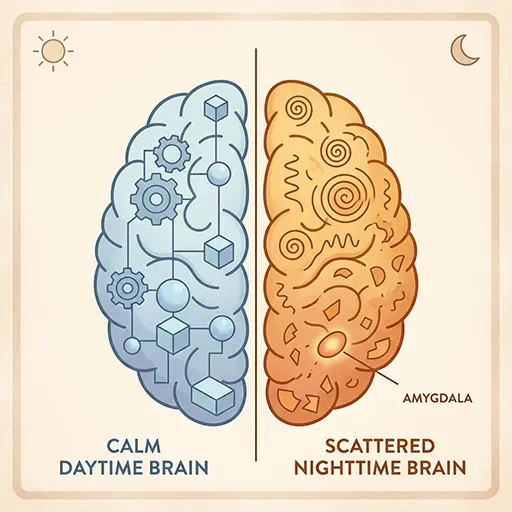
At night, your brain's emotional centers become more active while the rational, calming prefrontal cortex grows fatigued.
Your Brain's "Brakes" Get Tired
Your prefrontal cortex — the rational, calming part of your brain — works hard all day to regulate your emotions. By evening, it's fatigued. Brain imaging studies show that sleep loss dramatically amplifies emotional reactivity in the amygdala while weakening the prefrontal cortex's ability to keep it in check.
Even without full sleep deprivation, the natural circadian dip in prefrontal function during evening hours means you're less equipped to talk yourself out of anxious spirals at night. Researchers have proposed that nocturnal wakefulness creates a particularly vulnerable window for negative thinking and emotional dysregulation. The rational voice that says "this probably won't happen" gets quieter just as the anxious voice gets louder.
Worry Fills the Silence
During the day, you're surrounded by tasks, conversations, and stimuli that compete for your attention. At bedtime, all of that disappears — and your mind rushes to fill the void with unfinished concerns and worst-case scenarios.
There's a well-documented psychological phenomenon at work here: incomplete tasks and unresolved worries continue to occupy mental space until you either complete them or make a plan. At bedtime, when there's nothing else to focus on, those unfinished items come flooding forward. And trying to suppress them often backfires — making them even more intrusive, especially when your mental resources are low.
If you struggle with this pattern, our guide to quieting racing thoughts at night covers additional techniques for breaking out of these loops.
Nighttime Anxiety vs. Insomnia: What's the Difference?
It's worth noting that nighttime anxiety and insomnia are related but distinct. Anxiety-driven sleep problems typically involve racing thoughts, catastrophizing, and a sense of dread that extends beyond sleep into other areas of your life. Primary insomnia, on the other hand, involves difficulty sleeping that's specifically conditioned around the bed and sleep environment without widespread daytime anxiety.
The relationship between them is bidirectional — anxiety increases your risk of developing insomnia, and insomnia increases your risk of developing anxiety. Research shows that anxiety precedes insomnia in the majority of comorbid cases, while insomnia can go on to worsen existing anxiety. The encouraging takeaway? Treating either one tends to improve the other.
One important phenomenon to be aware of: nocturnal panic attacks. These are sudden episodes of intense fear that wake you from sleep, typically during non-REM sleep rather than during dreams. Research suggests they affect a significant proportion of people with panic disorder and are distinct from nightmares. If you're waking in terror with a pounding heart and shortness of breath, it's worth discussing with a healthcare provider.
How to Cope with Anxiety at Bedtime
Understanding why nighttime anxiety happens is the first step. The second is having practical strategies that target the specific mechanisms behind it. Here are the approaches with the strongest research support.
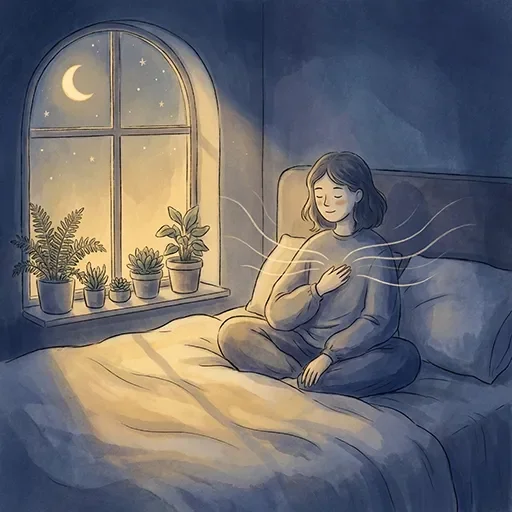
Evidence-based techniques like breathing exercises and progressive muscle relaxation can directly counter nighttime anxiety.
Try Progressive Muscle Relaxation
When your body is stuck in fight-or-flight mode, progressive muscle relaxation (PMR) can directly counter that physiological arousal. The technique involves systematically tensing and releasing muscle groups, which activates your body's relaxation response and reduces both physical tension and anxious thoughts.
Among all relaxation techniques studied for nighttime anxiety, PMR consistently shows the largest improvements in both sleep quality and anxiety reduction. It takes about 15 minutes and can be done lying in bed.
Use Slow Breathing to Activate Your Vagus Nerve
Slow, controlled breathing — particularly techniques where you exhale longer than you inhale — directly stimulates the parasympathetic nervous system and shifts your body out of stress mode. Even a few minutes of breathing at a pace of six breaths per minute can lower heart rate, reduce blood pressure, and calm anxious thoughts.
The popular 4-7-8 technique (inhale for 4 counts, hold for 7, exhale for 8) applies this principle. For more on how this works, see our guide to vagus nerve exercises for anxiety.
Schedule Your Worry — Seriously
This might sound counterintuitive, but designating a specific "worry time" earlier in the day — say, 15 to 30 minutes in the early evening — can significantly reduce bedtime worry. The technique works by giving your brain permission to postpone anxious thoughts: "I'll deal with that during worry time tomorrow."
Research on stimulus control for worry shows that this approach reduces both anxiety and insomnia symptoms. When anxious thoughts arise at bedtime, you're not suppressing them — you're redirecting them to a designated time and place.
Write a To-Do List Before Bed
One of the simplest evidence-based techniques for nighttime anxiety is writing a brief to-do list for tomorrow. A sleep lab study found that participants who wrote specific to-do lists fell asleep significantly faster than those who journaled about what they'd already accomplished that day. The more specific the list, the faster they fell asleep.
This works because it offloads those "unfinished business" thoughts your brain keeps cycling through. By writing them down, you're essentially telling your mind: "It's handled. You can let go."
Practice a Body Scan Meditation
A body scan meditation gently redirects your attention from anxious thoughts to physical sensations, moving your focus systematically through your body. This engages a different attentional mode than rumination and can help break the worry cycle.
Body scans are most effective as part of a broader mindfulness practice, but even a single session can help shift your nervous system from "thinking" mode to "sensing" mode at bedtime. You can also try guided visualization for sleep for a similar effect.
Optimize Your Sleep Environment
Small environmental changes can support your body's natural wind-down process. Research-backed adjustments include keeping your bedroom cool (around 65°F / 18°C is ideal), avoiding screens for at least an hour before bed since blue light suppresses melatonin, and reserving your bed exclusively for sleep — not scrolling, working, or problem-solving.
That last point matters more than you might think. When you routinely do anxiety-producing activities in bed, your brain starts associating the bed with wakefulness and arousal rather than sleep. For a deeper dive, check out our guide to effective sleep improvement techniques.
Try Cognitive Defusion for Bedtime Thoughts
Rather than arguing with anxious thoughts or trying to suppress them, cognitive defusion techniques help you step back and observe thoughts without getting caught up in them. Simple techniques include mentally adding "I'm having the thought that..." before each worry, or imagining your thoughts as clouds passing through the sky.
Research shows that even brief defusion exercises reduce how believable and distressing negative thoughts feel, which is exactly what you need when your mind is spinning at midnight. For more on these approaches, our guide to evidence-based CBT techniques covers both defusion and restructuring strategies. If you also struggle with emotional overwhelm at night, grounding techniques can help bring you back to the present moment.
When to Seek Professional Help
Occasional nighttime anxiety is a normal part of life, especially during stressful periods. But if your anxiety at bedtime is happening most nights, lasting for months, and affecting your ability to function during the day, it may be time to talk to a professional.
The National Institute of Mental Health recommends seeking help when anxiety interferes with daily activities, feels impossible to control, or seems always present. Cognitive behavioral therapy for insomnia (CBT-I) is the recommended first-line treatment for chronic sleep difficulties, and it's highly effective — often more so than medication in the long run.

With the right strategies, peaceful nights are within reach — you don't have to keep lying awake with your worries.
-Tim, Founder of Wellness AI
About the Author
Dr. Timothy Rubin holds a PhD in Psychology with expertise in cognitive science and AI applications in mental health. His research has been published in peer-reviewed psychology and artificial intelligence journals. Dr. Rubin founded Wellness AI to make evidence-based mental health support more accessible through technology.
Find Calm at Bedtime
Try Wellness AI for personalized therapy and guided meditations designed to ease nighttime anxiety.


FAQ: Nighttime Anxiety
Why does my anxiety spike right when I get into bed?
Your brain has fewer distractions at bedtime, so anxious thoughts take center stage. If you've been worrying in bed regularly, your brain may also have developed a conditioned association between your bed and anxious arousal, turning the bed itself into a trigger.
Is nighttime anxiety a sign of an anxiety disorder?
Not necessarily. Occasional bedtime anxiety is normal during stressful periods. However, if it happens most nights for six months or more and significantly impairs your daily functioning, it may meet criteria for generalized anxiety disorder — a clinician can help you assess this using standardized screening tools.
Can nighttime anxiety cause panic attacks while sleeping?
Yes. Nocturnal panic attacks are real and relatively common among people with panic disorder. They occur during non-REM sleep, not during dreams, and involve waking suddenly with intense fear, rapid heartbeat, and difficulty breathing. If this is happening to you, consult a healthcare provider.
What is the fastest way to calm anxiety at night?
Slow breathing exercises tend to produce the quickest relief. Try breathing in for 4 counts, holding for 7, and exhaling for 8 — this activates your parasympathetic nervous system within minutes. Pairing it with progressive muscle relaxation deepens the calming effect.
Does melatonin help with nighttime anxiety?
Melatonin may help indirectly — research suggests it has mild calming properties beyond its sleep-promoting effects. However, it's not a substitute for addressing the underlying anxiety, and you should consult your doctor before using it regularly.
Should I get out of bed if I'm anxious and can't sleep?
Yes — sleep experts generally recommend leaving bed after about 20 minutes of wakefulness. Go to another room, do something quiet and low-stimulation (not screens), and return only when you feel sleepy. This helps prevent your brain from associating the bed with anxious wakefulness.
Is nighttime anxiety different from insomnia?
They often overlap but have different core features. Nighttime anxiety involves worry and cognitive hyperarousal that extends beyond sleep, while insomnia is primarily a conditioned difficulty with sleep itself. The good news is that treating one tends to improve the other.
Can journaling before bed reduce nighttime anxiety?
Yes. Research shows that writing a specific to-do list for the next day helps you fall asleep faster by offloading unfinished concerns. The more specific the list, the better it works.