Wellness AI vs Headspace: Which Is Right for You? (2026)
Author: Dr. Timothy Rubin, PhD in Psychology | Founder of Wellness AI. No app paid for placement in this comparison.
Published: May 2026
If you're in crisis, please contact the 988 Suicide and Crisis Lifeline (call or text 988) or your local emergency services. AI mental-health and meditation apps are wellness tools, not crisis services.
Contents
- TL;DR: Who Each App Is Best For
- Quick Comparison
- How They Compare
- Who Should Choose Which?
- The Bottom Line
- FAQ
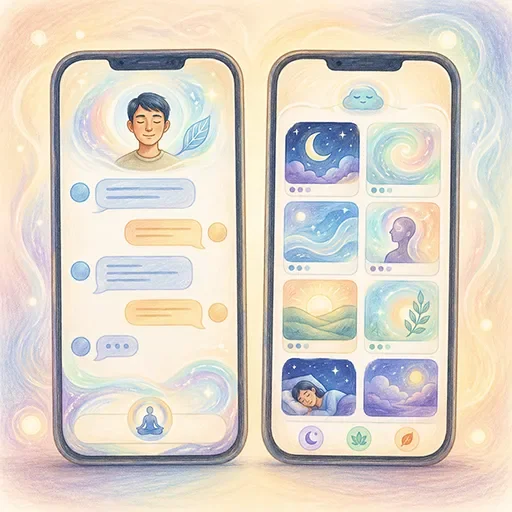
If you're looking for a Headspace alternative or trying to decide between Headspace and Wellness AI, here's what you should know. Headspace is one of the largest consumer meditation brands, with a polished pre-recorded library and an AI companion called Ebb that launched in October 2024 and added voice mode and enhanced memory in December 2025. Wellness AI is a newer AI mental-health app that combines AI-powered therapy chat with a meditation engine that generates meditations from your actual conversations.
These are genuinely different products. Headspace itself describes Ebb as an "empathetic AI companion" — explicitly not a therapist — paired with a library of pre-recorded meditations from named teachers. Wellness AI's chat is oriented around therapeutic conversation grounded in CBT, DBT, and ACT frameworks, and the meditations are generated to your specific concerns rather than retrieved from a library. Both are worth considering, but they're built around different priorities.
TL;DR: Who Each App Is Best For
Choose Headspace if you want a recognizable, polished meditation library with named lead teachers (Andy Puddicombe and others), popular sleep content (Sleepcasts, Wind Downs, sleep music), structured anxiety and sleep programs, an AI companion for in-the-moment reflection and support, or the option to add separately-priced human therapy through Therapy by Headspace.
Choose Wellness AI if you want an AI therapy chat grounded in CBT, DBT, and ACT that engages directly with your specific concerns, meditations generated from your actual conversations rather than picked from a library, on-device conversation storage, or flexible plan options without a separate clinical-services tier.
Quick Comparison
| Headspace | Wellness AI | |
|---|---|---|
| AI chat | Ebb — generative AI "empathetic companion" (Headspace's words). Voice + text. Trained in motivational interviewing; clinical therapeutic techniques are reserved for Therapy by Headspace, the company's separate human-therapy service | Generative AI therapy chat grounded in CBT, DBT, and ACT. Voice + text (voice on iOS) |
| Memory across sessions | Yes (added December 2025) | Yes |
| Meditation format | Library of 1,000+ pre-recorded meditations from named teachers (Andy Puddicombe, Eve Lewis Prieto, Dora Kamau, Kessonga Giscombe, Rosie Acosta, Samantha Snowden) | Generated on demand based on user's unique conversational content or any topic the user describes |
| Meditation customization | Browse by category, teacher, duration; pre-recorded sessions are the same for every user | Choose topic, voice, duration, and background music; each meditation is generated fresh |
| Anxiety programs | Structured: 21-day CBT for Anxiety & Depression program (with peer-reviewed RCT, October 2025), Managing Anxiety, Calming an Anxious Mind, plus SOS sessions for panic, overwhelm, and burnout | Generative: anxiety-specific meditations and CBT/DBT/ACT exercises composed from your conversation |
| Sleep content | Sleepcasts (45–55-min narrated stories), Wind Downs, sleep music, Soundscapes, Sleep Radio mixes, white/green noise) | Sleep meditations generated on demand, with user choices for topic, voice, duration, and background music |
| Clinical research | Peer-reviewed studies including a 2025 RCT of the 21-day CBT for Anxiety & Depression program | Newer (launched January 2025); like most smaller players in this space, no peer-reviewed RCTs yet |
| Human therapy option | Yes — Therapy by Headspace (launched June 2025). Separate subscription; in-network through 45+ insurers, $149 cash per session | Not available |
| Pricing | $12.99/month, $69.99/year, $99.99/year for Family (up to 6); discounted student plan; free for K-12 educators and US teens. Free trial only — no meaningful free tier | $12.99/month, $59.99/year (weekly plan also available; free trial available). Pricing may vary by region. |
| Platforms | iOS, iPad, macOS, Apple Watch, Android, web, Apple Vision Pro, Meta Quest (Headspace XR) | iOS, Android (no web app yet) |
| Data used to train AI | Headspace says messages are encrypted; employee access "on a need-to-know basis... including when conducting quality assurance or improving Ebb's interactions." | Conversations stored on-device |
| User base and ratings | Excellent ratings, large user base | Excellent ratings, small but growing user base |
Features and pricing change over time. Check each app's current listing before committing.
How They Compare
Conversation Style and Memory
This is where the products are most clearly different — and where Headspace itself draws the line most explicitly.
Headspace describes Ebb as an "empathetic AI companion." Headspace also says clearly what Ebb isn't — from the December 2025 voice-launch FAQ: "Can Ebb be used for therapy? No. Ebb is not an AI therapist and does not diagnose, treat, or replace licensed clinical care." Headspace's AI principles page describes guardrails that "restrain" Ebb from giving medical advice and from "using clinical therapeutic techniques." Ebb is grounded in motivational interviewing. CBT, DBT, and ACT are referenced by Headspace only in connection with Therapy by Headspace, the company's separately-priced human therapist service — not with Ebb.
Headspace has made an explicit product choice not to position a chatbot as a substitute for clinical care, and a meaningful portion of the responsible-AI mental-health community would say that's the right call. For users who want a style conversation grounded in cognitive-behavioral frameworks, the trade-off is a narrower conversational scope than therapy-positioned chatbots offer.
Wellness AI is positioned differently. Its AI chat is grounded in evidence-based therapeutic frameworks like CBT, DBT, and ACT, and the conversation is open-ended — designed to engage directly with the specific concerns a user brings, rather than reflecting them back and recommending content. Wellness AI also supports voice chat on iOS.
On memory, the apps now look similar. Headspace launched enhanced longitudinal memory for Ebb in December 2025, alongside voice mode. Headspace's marketing copy: "Ebb gets to know you over time, and remembers what you've talked about before — so you can always pick up right where you left off." Wellness AI's chat is also designed with memory between sessions — referencing prior conversations, noticing patterns, and building on earlier context.
One thing Headspace is explicit about, that's worth knowing: Ebb is paywalled (no meaningful free tier), available only in the US, UK, Canada, and Australia, English only, and limited to ages 18 and older.
In short: Ebb is positioned by Headspace as a companion for in-the-moment reflection and support — not a therapist. Wellness AI's chat is positioned as therapy-grade and uses CBT, DBT, and ACT frameworks that Headspace reserves for Therapy by Headspace, not Ebb. Both apps have memory between sessions.
Clinical Research and Trust
Headspace has been around since 2010 and has invested in research over that time, including a 2025 peer-reviewed RCT of its 21-day CBT for Anxiety & Depression program (Staiano et al., JMIR mHealth) showing symptom reduction. As is typical of industry-funded digital-health RCTs, that trial used a waitlist control and was authored mostly by Headspace employees.
Wellness AI, like many smaller and newer players in this fast-moving space, doesn't yet have peer-reviewed RCTs. Building that kind of evidence base takes years.
In short: Headspace has more published research. Wellness AI is newer and doesn't yet have peer-reviewed RCTs of its own.
Meditation and Coping Tools
Headspace and Wellness AI take genuinely different approaches to meditation.
Headspace offers a library of 1,000+ pre-recorded meditations across mindfulness, anxiety, sleep, focus, and more, led by named teachers including Andy Puddicombe (co-founder) and Eve Lewis Prieto. Anxiety-specific content includes the 21-day CBT for Anxiety & Depression program, Managing Anxiety, Calming an Anxious Mind, and SOS sessions for panic, overwhelm, and burnout. Sleep content includes Sleepcasts (45–55-minute narrated sleep stories), Wind Downs, Sleep Radio, and a CBT-I program. The library is broad and built up over years.
Wellness AI takes a different approach. Rather than a pre-recorded library, it generates meditations by integrating evidence-based meditation techniques with concerns surfaced during the user's actual therapy conversations. You can end a session with a meditation that addresses what you just talked about, or build one from scratch by choosing the topic, voice, duration, and background music. Each meditation is generated fresh — informed by the conversation rather than retrieved by keyword.
Whether this matters depends on what you want. For pre-recorded daily-practice content from named teachers, Headspace is the more direct fit. For meditations that engage with your specific situation rather than the typical topics a library covers, Wellness AI's generative approach is what the product is built around. For a wider look at AI meditation tools, see our comparison of the best AI meditation apps.
In short: Headspace offers a large pre-recorded library with named teachers and structured programs. Wellness AI generates meditations on demand from your actual conversations.
Pricing and Access
Pricing is comparable on a monthly basis and slightly cheaper for Wellness AI on the annual plan. Both apps may adjust pricing over time and may vary by region.
Headspace is $12.99/month or $69.99/year (US), with a Family plan at $99.99/year covering up to six accounts. There's a discounted student plan (around $9.99/year via SheerID), and Headspace is free for K-12 educators and US teens. There's a free trial but no meaningful free tier — both monthly and annual trials require a credit card up front. Therapy by Headspace (human therapy, launched June 2025) is priced separately: typical co-pay $0–$35 in-network through 45+ insurers, or $149 cash per session. App access is included with therapy purchase for three months.
Wellness AI offers weekly, monthly, and annual plans ($12.99/month, $59.99/year in the US) with a free trial. All plans include the full feature set — AI therapy chat, memory between sessions, voice chat on iOS, and unlimited AI-generated meditations. There's no separate tier to unlock features and no separate clinical-services tier.
Practically: if you want meditation-only on the lowest possible annual plan, Headspace's Family plan at $99.99/year split across up to six accounts is the cheapest option per person. For an individual user, Wellness AI's $59.99/year is less than Headspace's $69.99/year. If you want optional human therapy under one umbrella brand, Headspace is the only one of the two that offers it.
In short: Headspace is slightly more expensive on the individual annual plan, but offers a Family plan and free access for educators and US teens. For full access, Wellness AI is cheaper. Headspace also offers separately-priced human therapy.
Privacy and Data Practices
Both apps have privacy features worth knowing about, with meaningful differences in approach.
Headspace describes a multi-layered safety architecture for Ebb. From the AI principles page: "100% of messages sent to Ebb are monitored by a proprietary Safety Risk Identification system," with risks classified into seven categories (suicidal ideation, homicidal ideation, self-harm, domestic violence, substance use, eating disorders, abuse of vulnerable populations) and routing to crisis resources including 988 in the US/Canada. High-risk messages are reviewed by licensed clinicians. Headspace also says all messages to Ebb are encrypted, and that employee access to data is limited "on a need-to-know basis – for example, when conducting quality assurance or improving Ebb's interactions." Headspace does not publicly state that Ebb conversation data is excluded from model training.
Independently, the Mozilla Foundation's *Privacy Not Included assessment of Headspace (last updated April 2023, not refreshed since) carries an active warning label, with Mozilla's specific concern being data sharing with third parties for advertising — Mozilla quotes Headspace's own privacy policy on disclosing personal data "with third parties, such as Facebook, in order to serve Headspace advertisements on such third party platforms." Mozilla otherwise rated Headspace's security as "average" with no known privacy incidents in the prior three years.
Wellness AI takes a different design approach: conversation data is stored on-device rather than on external servers, and conversations aren't used to train the AI. The data-minimization posture is stronger by design.
In short: Both apps take privacy seriously, with different approaches. Headspace has detailed safety monitoring for Ebb, with a still-active Mozilla flag on third-party advertising data sharing. Wellness AI stores conversation data on-device and doesn't train on it.
Who Should Choose Which?
Who Should Choose Headspace?
Headspace is the better fit if you want a polished pre-recorded meditation library with named lead teachers; structured anxiety and sleep programs; popular sleep content like Sleepcasts and Wind Downs; an AI companion for in-the-moment reflection and support; or the option to add separately-priced human therapy through Therapy by Headspace. It's also the better choice if you want web app access, multi-platform support (Apple Watch, Vision Pro, Meta Quest), or a Family plan covering multiple users.
Who Should Choose Wellness AI?
Wellness AI is the better fit if you want an AI therapy chat grounded in CBT, DBT, and ACT — frameworks Headspace reserves for Therapy by Headspace, its separate human therapy service. It's also a stronger fit if you want meditations that adapt to your specific situation rather than picked from a library, on-device conversation storage as a privacy default, voice chat on iOS, or flexible billing options (weekly, monthly, or annual) with the full feature set included at every tier.
The Bottom Line
Headspace and Wellness AI are genuinely different products despite both occupying the broad "AI mental-health app" space. Headspace brings a polished pre-recorded library with named teachers, structured anxiety and sleep programs, and a separately-priced human therapy option. Wellness AI brings therapy-grade AI chat using CBT, DBT, and ACT frameworks that Headspace reserves for its separate clinical service, generative meditation tied to the conversation, and on-device privacy by default.
Neither replaces a licensed clinician for serious mental health conditions. If you're in crisis, contact the 988 Suicide and Crisis Lifeline or a licensed mental-health professional.
About this comparison: I'm the founder of Wellness AI, one of the two apps compared here. I tested both apps and cross-checked claims against each company's official materials including AI principles pages, FAQs, press releases, peer-reviewed publications, privacy policies, and App Store listings. Direct quotes are preserved verbatim from Headspace's own materials. Different institutional versions of Headspace (workplace, healthcare, K-12) may vary from the consumer experience described here. Features and policies change over time — this review reflects what I found as of April 2026. Weight my framing accordingly.
Try Wellness AI
AI therapy chat + meditations composed on your actual concerns. On iOS and Android.


FAQ
What are the best alternatives to Headspace?
It depends on what you want from a meditation app. Wellness AI is a strong alternative if you want AI therapy chat grounded in CBT, DBT, and ACT, plus meditations generated from your conversations. Calm is a comparable polished meditation library if you want a similar product to Headspace minus the AI companion. Insight Timer is the largest free meditation library. For a broader comparison, see our best AI meditation apps guide; for AI therapy specifically, see our AI therapy app comparison; for meditation focused on anxiety, see our meditation apps for anxiety guide.
Is Headspace's Ebb a therapist?
No. Headspace itself describes Ebb as an "empathetic AI companion," not a therapist. Headspace's own FAQ states: "Can Ebb be used for therapy? No. Ebb is not an AI therapist and does not diagnose, treat, or replace licensed clinical care." Ebb is trained in motivational interviewing, and Headspace's published guardrails restrain Ebb from using clinical therapeutic techniques like CBT or DBT. Those clinical frameworks are reserved for Therapy by Headspace, the company's separate human-therapist service.
Does Ebb remember past conversations?
Yes, as of December 2025. Headspace launched enhanced memory for Ebb so it can recall details from past conversations and pick up where you left off. Wellness AI's AI therapy chat also has memory between sessions and is designed to reference what you've discussed before, notice patterns, and build on earlier conversations.
Which app is more established?
Headspace has been around since 2010 and is one of the largest meditation brands in the world, with a polished library, named teachers, and a substantial track record. Wellness AI launched in January 2025 and is a much newer, smaller app built around a different approach (generative AI therapy chat plus meditations composed from your conversations).
Which is better for anxiety?
Different fits. Headspace has a structured 21-day CBT for Anxiety & Depression program plus pre-recorded anxiety programs and SOS sessions for panic, overwhelm, and burnout. Wellness AI's therapy chat engages directly with your specific anxiety using CBT, DBT, and ACT frameworks, and meditations are generated from the conversation. If you want a structured pre-recorded program, Headspace. If you want an open-ended therapy conversation that addresses your specific anxiety, Wellness AI. See our meditation apps for anxiety guide for more options.
Which app has better meditation features?
Different approaches. Headspace has a large library of pre-recorded meditations, sleep stories, and structured programs from named teachers like Andy Puddicombe and Eve Lewis Prieto. Wellness AI generates meditations on demand based on your therapy conversations, with customization of topic, voice, duration, and background music. Headspace is the better fit for a pre-recorded library with named teachers; Wellness AI is the better fit for meditations integrated with the therapy chat and generated to your specific situation.
How much does Headspace cost vs Wellness AI?
Headspace is $12.99/month or $69.99/year in the US, with a Family plan at $99.99/year and a discounted student plan (free for K-12 educators and US teens). Wellness AI is $12.99/month or $59.99/year. Monthly pricing is identical; Wellness AI is cheaper on the annual plan. Headspace has a free trial but no meaningful free tier — both trials require a credit card up front. Pricing may vary by region — check each app's current listing for the latest. Therapy by Headspace (human therapy) is priced separately at typical co-pay $0–$35 in-network or $149 cash per session.
Does either app use my conversations to train their AI?
Wellness AI stores conversation data on the user's device rather than on external servers — by design, on-device conversation data isn't passing through a server-side training pipeline. Headspace's AI principles page describes how Ebb data is used: messages are encrypted and employee access is limited "on a need-to-know basis... including when conducting quality assurance or improving Ebb's interactions." Headspace does not publicly state that Ebb conversation data is excluded from model training. The Mozilla Foundation's "Privacy Not Included" assessment of Headspace, last updated in 2023, also flagged data sharing with third parties including Facebook for advertising. Review each app's current privacy policy for the most up-to-date details.
Does Headspace offer human therapy?
Yes, separately. Therapy by Headspace launched in June 2025 and is a direct-to-consumer human therapy service available in-network through 45+ insurers, with typical co-pay $0–$35 or $149 cash per session. It's not part of the Headspace meditation subscription — it's a separate clinical product. Wellness AI is AI-only and does not offer human therapy.
Related Reading
Broader comparison of AI meditation apps — AI-generated meditations vs AI-recommended content Best Meditation Apps for Anxiety in 2026
Comparison of the top meditation apps focused specifically on anxiety, with Wellness AI as Editor's Pick for situational anxiety 6 Best AI Therapy Apps in 2026
Broader comparison of the top consumer AI therapy apps — conversation quality, memory, meditation, and privacy Meditation for Better Sleep
Techniques and approaches for restful nights, including how guided meditation, breathwork, and body scans can help Wellness AI vs Wysa: Which AI Therapy App Is Right for You?
A founder-written head-to-head on conversation style, clinical research, meditation, pricing, and privacy